
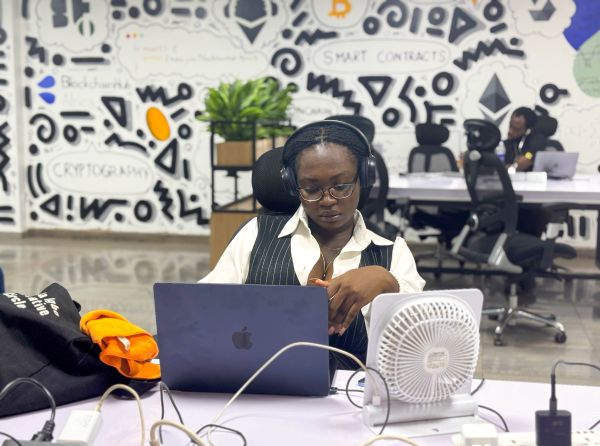
Sophia Ahuoyiza, founder of Tabi Academy, working on her laptop at Blockchain Hub in Enugu, Nigeria on March, 21, 2026. Photo: Toochi Gabriel, bird Story Agency
Programmer, educator, and creative, Sophia Ahuoyiza is part of a major shift taking place across Africa: tech is moving out of the big centres and into smaller spaces across the continent. Based in Enugu, Nigeria, Ahuoyiza works across software development, storytelling, and training, widening access to technical skills, particularly for women, while exploring how technology can connect the creative economy.
By Toochi Gabriel, bird story agency
Enugu, known locally as Coal City after its early source of wealth, today presents a serene contrast to the frantic pace of Nigeria’s larger coastal metropolises. Nestled beneath the rolling greenery of the Udi Hills, the city is defined by its wide, tree-lined avenues and a slower, more intentional rhythm of life.
This is where Sophia Ahuoyiza has chosen to build. The software and content developer began her career in Lagos, where she learned to code and started working in software development. Today her work includes a far more diverse portfolio; she moves across software development, mentoring students, and participatings in creative projects, including acting. These roles are not separate in practice. They inform how she approaches problem-solving and how she teaches others.
Enugu offers access to networks and opportunities that are still limited in other parts of the country. However, there was one issue that she felt needed to be changed.
“I started being curious. Like why are there not a lot of women here?” Ahuoyiza said. “If I’m being interviewed, nine times out of ten it’s a man. I’m not saying it’s wrong for men to be there, but I was like, why are women not in this room?”
Her decision to leave Lagos and move to Enugu became a response to what she saw as a limiting factor for women in the country’s southeast. Ahuoyiza arrived in Enugu with a clear decision to do something for women in the city. She did not have a defined plan at the time, but she knew she wanted to start somewhere. She went to the Enugu Tech Hub and spoke about her intention, which marked her starting point.
“I needed to create an environment where they knew what opportunities are like for them. The conversation went on, and that was how the Ford Foundation sponsored a training for us. We were able to train a total of 400 women in the state, and that went well,” Ahuoyiza said. Finding a receptive environment, she co-founded Goondu Interactive, a company working in gaming and interactive media.
While a large percentage of investment and attention in African tech has focused on sectors like finance and logistics, Goondu takes a different approach by working within the creative economy. The company develops projects that draw on local storytelling while using digital tools to reach wider audiences. This work raises a broader question about the prioritization of technology and its intended audience.
Leslie Oko, co-founder of Goondu Interactive, described Ahuoyiza’s approach to her work.
“She is driven by ambition and a deep motivation to help women gain independence and grow as individuals. She brings a storyteller’s perspective to her work, whether she is coding or building products,” Oko said.
For Ahuoyiza, this is part of the same work she does as a developer. It extends her interest in how people interact with technology, not just how it functions.
Alongside her work in gaming, Ahuoyiza also founded Tabî Academy, a learning platform focused on supporting women entering the tech industry.
Women remain underrepresented in many technical fields across sub-Saharan Africa. Various factors contribute to this, such as limited access to training, fewer mentorship opportunities, and social expectations.
With multiple reports pointing to a growing shortage of digital talent across Africa, initiatives like Tabî Academy are emerging as local responses to a wider skills gap.
Tabî addresses these issues through structured learning and direct mentorship. Sophia is involved in teaching and curriculum design, working closely with students.
Her students’ experiences reflect the impact of this work. Deborah David described her journey:
“I would say Sophia is very intentional, right? She’s intentional about the growth of her mentees, and also I would say she pours; she gives her all when she’s mentoring you; she gives everything, and you could tell she loves what she does,” David said.
Stories like this reflect a broader pattern. More women are entering the field with both technical training and a clearer sense of direction. Sophia’s work does not follow a single path. She combines development, teaching, and creative work, moving between them as needed.
“ I saw other women be there for me and I am like okay there is still a whole lot of work to be done here. Let me do this and focus and it is easier for you to really get solutions when you focus, like instead of saying I want to help everybody, because you can’t solve everybody’s problems. Like okay, let me focus on the people that I understand and I understand their problem scope, help them solve it and take it up from there. So that’s why it’s women for me,” Ahuoyiza said.
Enugu is now ranked as the 4th strongest startup ecosystem in Nigeria. The city recently hosted the Enugu Tech Festival, attracting nearly 50,000 participants, signaling its move from “Coal City” to a “Digital Hub”.
Eliezer Ajah, who leads job creation efforts for Nigeria’s Three Million Technical Talent (3MTT) programme, highlighted a growing opportunity.
“While the attention has been on Lagos, the folks in the southeast in Enugu, particularly, have been quietly building, and we’ve moved from just a loose collection of enthusiasts to an actual innovation corridor that is backed by policy, backed by builders, and fundamentally backed by proof of concept,” Ajah said.
This approach challenges the idea that careers in technology must be linear or limited to one role. It also reflects the conditions of the environments she works in, where flexibility is often necessary.
“We have, I think, three anchor points. The first is things like the Enugu startup bill, you know, the startup act that domesticates things into Enugu. um, the Enugu tech fest, things that bring people together to build as well. The second area is that we have actual policy backing by the government. So we have the Enugu State government and the Anambra State government coming in to do things and support the ecosystem as well. And then we have actual proof of concept like Zend and Airon Technologies with Greenage that have facilities and faculties here that are building things. So we’re at an inflection point where we’re slowly but steadily coming into the fore of the tech ecosystem,” Ajah added.
The growth of Africa’s tech ecosystem depends not only on investment but also on where and how people choose to build. Ahuoyiza’s work contributes to a more distributed model, expanding opportunities beyond a few cities.
From Enugu, she continues to develop software, support new entrants into the industry, and explore new areas within the creative economy, taking her place in a wide cohort of brave African digital nomads gradually expanding access to technology across different parts of the continent.
bird story agency