
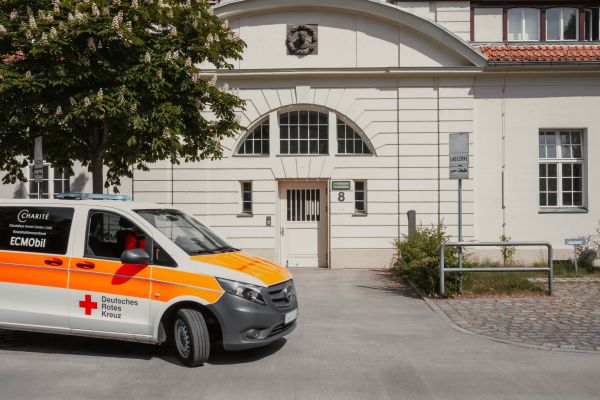
IMAGE: The ECMObil at the Campus Virchow-Klinikum. © Charité | Janine Oswald
Berlin, 27 May 2026
When the lungs fail or the heart stops pumping, every minute counts. For eight years, Charité – Universitätsmedizin Berlin has been operating a specialized vehicle that saves lives in just such cases: the ECMObil. It brings an intensive care team, equipped with a portable heart-lung machine (ECMO), directly to patients at other hospitals that lack the capability to provide ECMO treatment themselves. The ECMObil also saved the life of Antonia, a university student.
Antonia, a student from Potsdam, had caught the flu—annoying, but nothing serious, or so she thought. But then, everything took a turn for the worse: she collapsed and had to be resuscitated—first at home by her boyfriend, and subsequently multiple times by doctors during the ambulance ride to the hospital. Yet even there, her condition continued to deteriorate; she suffered another cardiac arrest. When it became clear that further support was required, the physician in the Potsdam emergency room reacted swiftly and summoned Charité’s ECMObil.
The concept behind the ECMObil is simple: instead of transferring a critically ill patient, the ECMO team travels to them. The vehicle is stationed at the Campus Virchow-Klinikum and is part of Charité’s Department of Internal Medicine and Intensive Care. To reach the scene of an emergency as quickly as possible, the vehicle—like other emergency response units—is granted special traffic privileges.
In this instance, everything unfolded with exceptional speed. Less than 30 minutes later, Dr. Jan Kruse and his colleague arrived on-site in the vehicle and were able to connect Antonia to the mobile ECMO unit. The ECMO machine temporarily takes over the functions of the heart and lungs. Through specialized cannulas, blood is drawn from the body, enriched with oxygen, and then returned to the circulation.
Greater Safety, Better Care
“In cases of severe shock, cardiac arrest, or respiratory failure, ECMO therapy can be life-saving,” explains Prof. Kai-Uwe Eckardt, Director of the Department of Nephrology and Intensive Care Medicine at Charité. “The procedure is highly invasive and complex, but for many patients, it is often their last chance.” Success depends on experience and the collaboration of numerous specialists. Patients must be transferred to a specialized centre—such as Charité—yet the transport itself carries significant risk. This is where the *ECMObil* comes into play: it enables the initiation of ECMO therapy on-site, allowing patients to be stabilized and transported safely.
This was precisely the case for Antonia: after being connected to the heart-lung machine, the university student was successfully transferred to Charité’s Virchow Hospital—without any interruption to her life-sustaining treatment. “Our colleagues in the Potsdam emergency department responded magnificently by alerting us so quickly,” emphasizes Dr. Jan Kruse, Executive Senior Physician in the Department of Nephrology and Intensive Care Medicine. “That significantly boosts the chances of survival.”
**Rapid Response Prevented Long-Term Damage**
And indeed, the 24-year-old made a rapid recovery. To prevent future complications arising from cardiac arrhythmias, a defibrillator was implanted as a precautionary measure. In an emergency, this tiny device can restore the heart’s normal rhythm using an electric shock.
Just ten days after her collapse, Antonia was back on her feet. Two months after the incident, although she was not yet able to resume sports, she was otherwise fit and healthy. Today, she can go about her daily life with almost no restrictions. “When I later learned how quickly the vehicle arrived and how well everything had been organized, I was truly impressed,” the student recounts. “Now, I’m simply grateful that I can do everything I used to do before.” Collaboration That Saves Lives
Since going into service on February 15, 2018, the ECMObil has been called out, on average, once a week. The vehicle and its team have been deployed 478 times to date; most of the patients treated were subsequently transferred to Charité. The ECMObil is a collaborative project between Charité and the Berlin Red Cross. Charité provides the equipment and specialized medical staff, while the German Red Cross (DRK) provides the vehicle. “Our collaboration with the Red Cross runs smoothly; we work together very well,” says Jan Kruse, an intensive care physician who has accompanied numerous missions aboard the ECMObil.
The record after eight years of operation: The ECMObil has decisively improved emergency care in and around Berlin. It facilitates not only faster life-saving interventions but also scientific research into which patient groups benefit most from mobile ECMO support. Initial results from this research are expected next year.
The ECMObil at the Long Night of the Sciences
Anyone wishing to take a look inside the ECMObil themselves will have the opportunity to do so on June 6 as part of the Long Night of the Sciences. Starting at 5:15 p.m., the team will be on-site with the vehicle at the Charité Mitte Campus (site address: Virchowweg 6) to explain the heart-lung machine and demonstrate life-saving techniques in a CPR crash course.
The accompanying imagery may be used free of charge exclusively within the editorial context of current reporting related to the content of this press release. Use is permitted only with attribution to the copyright holder.