
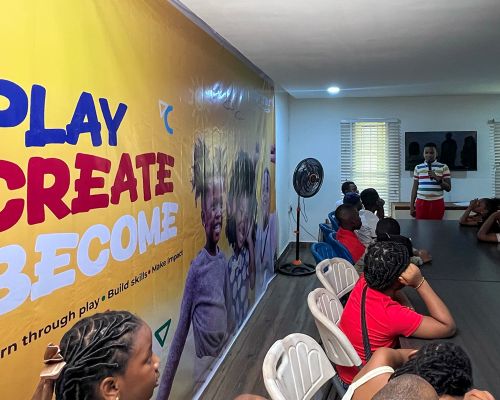
Kids listening keenly to a teacher at Kidpreneur place , 25 Nawfia Street, Independence Layout, Enugu on June, 4, 2026. Photo: Chidera Sam-Eze, bird story agency
Across Africa, crucial questions are being asked about whether children are being adequately prepared for life beyond exams and textbooks. In southeastern Nigeria, an educational entrepreneur is not waiting to find out; she has reimagined what learning can look like by using play.
By Chidera Sam-Eze, bird story agency
The sound of children’s laughter drifts through the compound long before the work day starts. Children move among puzzles, books, music sessions, and role-play activities. Some practice speaking in front of others. Others explore leadership exercises. A few sit quietly, building ideas through drawing and conversation. At the center of it all sits Philomena Nwajagu.
For seven years, the Nigerian educator and social entrepreneur, known fondly as Phil, has been helping children develop essential life skills often overlooked in traditional classrooms. These include confidence, creativity, leadership, financial responsibility, and problem-solving.
“Informal education teaches children how to live, how to be human, and how to interact with society,” explained Jennifer Ekwueme, an intentional parenting enthusiast. Ekwueme is Executive Director of Salma Private School, The SafeHands, also in Enugu.
“When children are book smart and also learn life skills, they become more balanced. Through play, they learn communication, conflict resolution, and teamwork,” she said.
In Nigeria, discussions about education often focus on access and classroom participation. According to UNICEF, about 10.5 million Nigerian children between the ages of five and fourteen are out of school, while only 61 percent of children aged six to eleven attend primary school regularly. Yet even beyond the access issue, another challenge looms large: many school-going children are not gaining the practical and social skills needed to navigate life.
It was this gap that Nwajagu set out to address. By building Kidpreneur Place, Nwajagu created a space where play serves as a tool for experiential learning, where children are encouraged to discover a purpose beyond academic grades.
Her journey began with motherhood. Nwajagu moved to Enugu in 2011 to study Management at Enugu State University of Science and Technology, where she later completed her master’s degree. She settled in the city, started a family, and soon found herself thinking deeply about how children learn beyond the classroom.
Her first experiment began at home.
“My daughter wanted to play a piano, so we decided to buy her one,” she said. “It became an opportunity to teach her about setting goals and saving towards something she wanted. Today she plays the piano, and she sings too.”
That simple experience changed how she viewed learning. She began to see gaps in how children were being taught and how little attention was given to life skills.
At the time, she had no formal structure and no clear model. What she had was curiosity and a growing belief that children learn best through lived experience.
In 2018, that belief became Kidpreneur Place. Over time, it evolved into a structured learning space offering programs focused on leadership, civic awareness, personal development, and emotional intelligence.
When she first introduced the idea, it was not widely accepted. Many parents questioned what children were actually learning outside of formal schooling. Some expected reading and writing outcomes. Others did not understand play as an educational method.
“At first, there was no support,” Phil said. “People would ask what the children were coming to do. I would say we play because children learn through play, but they did not understand it yet.”
However, Nwajagu’s experience putting her own children through the curriculum quickly led to growth at the school.
“I started with one child, and we built from there,” she said. “Over time, that child became a testimony. People began to see confidence, creativity, and leadership develop in ways they did not expect.”
As more children joined, changes became visible. Once-shy children began speaking in public. Others showed early signs of independence and problem-solving. Slowly, parents began to take notice.
Among the earliest participants was Oma Nwajagu.
“When I first started coming here, I was shy,” she said. “Through public speaking activities, I became more confident. Now I can speak in front of a crowd without being afraid.”
As the program expanded, Kidpreneur Place developed several initiatives designed to support children at different stages of growth.
One of them is Flower Bloom, a mentorship program that guides young girls through puberty and adolescence. It covers menstrual hygiene, cycle awareness, emotional regulation, journaling, and self-confidence. It now includes boys in conversations about puberty and personal development.
Another initiative, The Nigerian Seed, is designed around Independence Day celebrations, introducing children to leadership and civic participation through a simulated electoral process. Children form political parties, campaign, vote, and elect leaders in a structured environment that mirrors democratic systems.
“Do you know how your president is being elected? Do you know what he does behind the scenes? Do you know how to vote? Even though we know, yes, you’re not yet 18, but what if we could prepare you before you turn 18? And so they go through that phase, of course, in a comical way, so we get to have a child who is now the aspiring president.”
Another program is Shoe My Feet, which began as a small initiative to provide shoes for children in need. Over time, it expanded into an award-winning program supported by partners and organizations. Children are now also taught how to make footwear using materials sourced from their environment, combining creativity, entrepreneurship, and environmental awareness.
While the initiative has reached more than 6,000 children, for Nwajagu the impact goes beyond the numbers.
“It teaches you those skills you cannot learn only in school,” she said. “It teaches you the small things people think do not matter, but they actually do.”
While she has had to navigate concerns about children’s safety and the legitimacy of informal education to grow her school, another issue has impacted on trust: her gender.
“As a woman, people often ask who you are and what gives you the authority to do this work,” she said. “But support from family and community helped me continue.”
Looking ahead, she hopes to expand Kidpreneur Place into multiple centers across Nigeria, each equipped to prepare children for the future of work and aligned with global development goals.
As the day ends in Enugu, the learning space slowly quiets. Children pack away materials, share meals, and wait for their parents. The energy of the day fades, but the lessons remain.
For Nwajagu, that lesson is clear: education is not confined to classrooms. It is shaped in moments of play, curiosity, and discovery, where children learn not only what to know but how to live.
bird story agency