
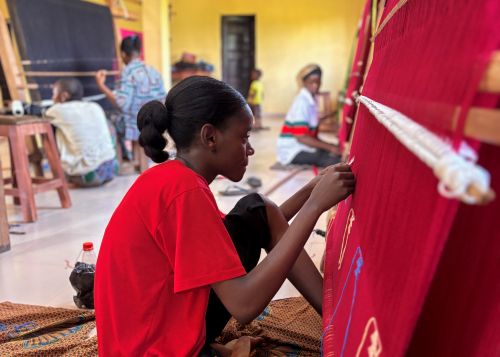
Student at FUNIA university working on a loom in Awkete, Abia, Nigeria on July 29, 2026. Photo: Toochi Gabriel, bird story agency
Once primarily worn as wrappers and ceremonial dress, Akwete cloth is finding new life in contemporary clothing and university training. Weavers, educators and heritage specialists say expanding its market could preserve generations of knowledge while creating new livelihoods.
By Toochi Gabriel, bird story agency
14 August 2026
For three to four weeks, Uchechi Ahunanya sits close to the wooden loom in Obohia-Ndoki in Abia State, Nigeria, her hands moving steadily across a dense curtain of purple thread. Against the workshop’s warm ochre walls, fine strands stretch above and around her as she carefully builds the cloth line by line, guiding each thread into place.
For Ahunanya, weaving Akwete cloth is more than a business. It is an inheritance passed down through generations of women in her family.
Her grandmother, who lived to the age of 103, was weaving before Ahunanya’s mother was born. Her mother continued the tradition, allowing Ahunanya to grow up watching cloth emerge from carefully arranged threads.
“When we were growing up, we saw my mother producing these things and wondered when we could start our own,” the textile entrepreneur recalled. “The first time I did it, I was overjoyed.”
Akwete is a handwoven textile associated with Akwete town and the surrounding Ndoki communities in Ukwa East Local Government Area of Abia State in southeastern Nigeria. Produced historically by women, the cloth is recognised for its intricate motifs, vivid colours and the cultural meanings woven into its designs.
Although the history of its production is contested, documented evidence traces the growth of Akwete weaving to at least the 19th century, when trade between communities in the Niger Delta encouraged Akwete women to adopt, reinterpret and expand existing weaving traditions. The cloth became both a cultural object and an important source of income for women.
Today, artisans and educators are trying to carry that legacy into a markedly different fashion economy.
“Akwete cloth has grown into a modern style,” Ahunanya said. “Before, it was just used as a wrapper. Now we sew tops, trousers, skirts, blouses and gowns.”
She works with different threads and textures according to what a client wants.
Beside her, her 16-year-old daughter Divine Ahunanya demonstrates the same careful hand movements, already fluent in a language of pattern and tension that many in her generation have never learned to speak. One lighter cloth, woven with particularly fine thread, demonstrates how makers are adapting the textile for garments that can be worn more comfortably in Nigeria’s warm climate.
“You can see that the thread is very, very tiny,” she said, handling a piece made for a client. “If you touch it, you can feel that it is cool and lighter. It is not heavy.”
That experimentation matters because Akwete must compete with factory-made and imported textiles that are generally cheaper and faster to produce.
Handweaving is labour-intensive, contributing to prices that can place the finished cloth beyond the reach of many consumers.
A pair of handwoven silk Akwete can command between ₦150,000 (US$110) and ₦200,000 (US$147), while the 100% cotton variant sells for ₦80,000 (US$59) to ₦100,000 (US$73), depending on the complexity of the motifs. Machine-woven imitations exist and sell for less, yet they occupy a different universe in the consumer’s mind. The handwoven version is a status symbol, the kind of textile a bride might wear to meet her traditional wedding, or a politician might drape for a swearing-in. It is aspirational. And that, precisely, is the problem.
Dr Ijeoma Onyejekwe, a chief heritage, monument and site officer with Nigeria’s National Commission for Museums and Monuments, said imported textiles had steadily weakened the market for indigenous weaving.
“Akwete was more expensive and it took more time, but the fabrics being imported were much cheaper,” she said. “It killed the market because people went for what was cheaper.”
Changing economic aspirations also interrupted the transmission of weaving skills. In earlier generations, she explained, girls commonly learnt to weave from older women in their families. As formal employment and migration reshaped communities, fewer young people remained to learn from experienced artisans.
“In those days, every lady and every girl could weave,” Onyejekwe said. “You made Akwete for your family as a mother, a sister or a daughter. But now, how many women can make Akwete? Even at the Akwete centre in Abia State, how many young women come to learn indigenous weaving?”
The decline threatens more than a production technique. Individual Akwete motifs communicate information about identity, status and social function.
Fabrics made for masquerades differ from those worn by ordinary community members, while particular prestige designs have historically been associated with chiefs and traditional rulers.
“Akwete is not just a random design. The fabric tells a story,” Onyejekwe said. “Looking at those fabrics in the past, you could know who the person was and understand the person’s status.”
One prominent design is Ikaki, a name associated with the tortoise. Research on the cloth traces the motif to an Ijebu prestige textile that travelled east through regional trading networks and was subsequently reproduced and developed by Akwete weavers.
The cloth’s ability to absorb influences while remaining culturally distinctive is one reason educators believe preservation should involve continued innovation rather than treating Akwete as an artefact frozen in time.
At the Centre of Indigenous Textile at Alex Ekwueme Federal University Ndufu-Alike in Ebonyi State, students learn about traditional textiles by participating in their production. The university says the centre was created to promote indigenous fabrics and transfer weaving knowledge to a new generation.
Chiaka Nnodi, acting director of the centre, said universities have a responsibility to help safeguard knowledge that could disappear as master weavers grow older and younger people leave their communities in search of employment.
“Akwete is not just a craft,” she said. “It embodies centuries of history, aesthetics, traditional technology, community and memory.”
The students do not only study finished fabrics. They set up looms, prepare threads, examine motifs and experience the complexity of producing cloth themselves.
“They participate in the creation of the work,” Nnodi said. “They see the complexities behind the weave—the colours, the motifs and everything involved. It is not just a story.”
The centre also connects the craft with contemporary design, technology and entrepreneurship. Students are encouraged to consider how indigenous knowledge can generate products and businesses suited to present-day consumers.
“Art education creates a bridge,” Nnodi said. “You bring traditional knowledge together with contemporary skills, technology and entrepreneurial thinking so that it becomes relevant now.”
That approach reflects a wider revival of interest in Nigeria’s indigenous textiles. Designers have increasingly incorporated handwoven fabrics such as Akwete and Yoruba aso oke, as well as adire resist-dyed textiles, into contemporary collections. These materials have appeared in dresses, jackets, bags and other products aimed at both Nigerian and international buyers.
Nigerian creative and photographer Uzochukwu Ebube, who is associated with streetwear brand Cigar Wears, believes Akwete’s future depends on designers presenting it as a contemporary expression of African identity—not simply applying traditional fabric to Western styles.
“Before Akwete can tell our story, young people have to know its story,” he said. “They have to understand it as a form of identity and recognise why it is important as one of the few fabrics indigenous to us.”
Ebube argues that the cloth’s lightweight qualities give designers an opportunity to develop clothing that responds to African climates. Rather than reproducing heavy jackets and layered looks popularised by Western celebrities, designers could create breathable, free-flowing garments rooted in local conditions.
“If we are going to make African fashion, let’s consider the climate and create an African silhouette in which the weather is a very important factor,” he said. “We should define our own cool.”
Celebrity endorsements and music videos could introduce Akwete to new audiences, he added, but visibility alone would not build lasting demand.
“The easy answer is to put it on celebrities, put it in music videos and put it everywhere celebrities appear,” Ebube said. “That can make it a trend. But for cultural fashion to last, it has to represent something. It has to signify something—or become a status symbol.”
However, Ahunanya believes Akwete still needs a much larger and more consistent market. Wider adoption would give producers the confidence to invest more time and resources in weaving while encouraging younger people to see the craft as a viable livelihood.
“I dream that Akwete will grow and take its place among other fabrics,” she said. “When the cloth grows, we producers will produce more and also grow.”
Onyejekwe estimates that an artisan able to complete several pieces a month could earn meaningful income, although actual earnings depend on the textile’s size, complexity, input costs and access to buyers. She believes structured vocational training could give young women an alternative to unemployment while increasing the number of skilled weavers.
The opportunity is not simply to reproduce the wrappers of earlier generations. It is to develop breathable clothing, accessories, interior products and other contemporary applications without stripping the cloth of its identity.
Nnodi describes this as “living knowledge”: a tradition preserved through continued use, experimentation and reinvention.
“Sometimes when we say preservation, we want history frozen in time,” she said. “But no—we should see a living history, or living knowledge, made relevant for now and for the future. That is one of the best ways to preserve it.”
For Ahunanya, that future remains rooted in what she learnt from her mother and grandmother. Each new garment carries their knowledge forward—but it must also appeal to customers whose lives, tastes and clothing needs are changing.
Her ambition is therefore both cultural and commercial: for Akwete to move beyond occasional wear, reach new consumers and support more of the people who produce it.
bird story agency