
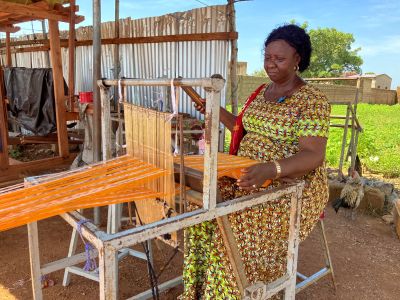
Sidonie Sawadogo weaving at her work station. Photo: Oumarou Konate, bird story agency
Faso Dan Fani, Burkina Faso’s distinctive woven cloth, is evolving with the growth of organic cotton, efforts to combat counterfeiting and improvements in weaving techniques. The women who have sustained this industry for generations are adapting to new quality requirements and seeking better returns for their work.
By Oumarou Konate, bird story agency
2 October 2026
Early one Saturday morning in Koubri, near Ouagadougou, Sidonie Sawadogo prepares her loom for another day’s work. She learned to weave in the 2000s, shortly after getting married, and made it her main occupation. Today, she is an influential member of the National Federation of Women Weavers of Burkina Faso (FENATI-BF).
At 50, weaving is her main source of income. It has enabled her to send her children to school and become financially independent.
“Weaving has enabled me to send my children to school and accomplish many other things. Over time, I have become independent, and I no longer need to wait for my husband’s help to do anything.”
To sell her products directly, Sawadogo opened a shop in Ouaga 2000, a commercial and diplomatic district of the capital, where she displays items made in her workshop.
“My cloths range from CFA 6,000 (about US10)toCFA20,000(aboutUS35). It depends on the quality and the design. Some designs require much more work than others.”
After 22 years of weaving, Sawadogo has seen Burkina Faso’s woven cloth gain value and improve in quality. She attributes this change to market pressures, better techniques and the quality of the yarn, much of which is produced by FILSAH, a Burkinabè company specialising in processing cotton fibre into yarn.
“The quality of the yarn directly influences the quality of the fabric we produce. The weave is more even and more durable.”
She also highlights the importance of training and sharing skills. In the past, she says, techniques were more basic, and weavers did not always fully understand every stage of the process.
About 20 kilometres away, in Ouagadougou’s 1200 Logements neighbourhood, Denise Kafando has been weaving since 1986. The work has helped her contribute to household expenses and support her husband. She, too, believes that weaving techniques and the quality of the cloth have improved.
She attributes some of this progress to the “buy local” policy, which has stimulated demand in Burkina Faso and beyond.
“Today, there are more orders, both nationally and internationally. Last week, I delivered an order worth CFA 4 million (about US6,900) to a local bank. In April, Idelivered another worth nearly CFA 2 million (aboutUS3,500) to an NGO.”
Counterfeiting threatens the industry
But counterfeiting is undermining this momentum. Despite measures taken by the ministry responsible for trade, including a nationwide ban on imports of weaving yarn and woven cloth in force since 24 September 2024, counterfeit yarn and cloth continue to reach the local market, weakening the position of Burkinabè weavers.
The problem persists. Repeated inspections by the Mobile Brigade for Economic Control and Fraud Prevention (BMCRF), following the import ban, have not yet stopped it. At a press conference held in Ouagadougou on 24 March 2026, the brigade, which operates under the trade ministry, presented the results of inspections carried out since October 2025.
During that period, it seized 319 pieces of counterfeit Faso Dan Fani cloth, 174 lots of cloth, more than 10,160 spools of imported weaving yarn and 2,108 pieces of imported woven cloth, with a total value of CFA 20,504,725. A fine of CFA 3,100,000 was also imposed, payable to the public treasury.
A month later, on 15 April 2026, customs officials announced that they had intercepted 31,200 counterfeit cloths imitating Koko Donda and Faso Dan Fani at Dakola, on the border with Ghana. Their estimated market value was CFA 156 million.
These products sell for much less than quality local cloth, attracting price-conscious consumers but also exposing them to lower-quality goods.
“When people go to the market, they want cheaper cloth. But they do not know that, generally, these cloths are counterfeit. When you put these counterfeit Faso Dan Fani cloths in water, they fall apart. Most people only realise they have been deceived after paying.”
For Kafando, this unfair competition severely disadvantages local producers. She also questions the products’ quality and composition.
“These cloths are made of rubber, and they make the skin itch. They cause illness in those who wear them.”
Some of these products reportedly come from neighbouring Ghana, although that account requires qualification. Pauline Bafiogo, the current president of FENATI-BF, says the imported yarn is not manufactured in Ghana but passes through the country before entering the Burkinabè market.
With access to a seaport, which Burkina Faso lacks, Ghana has become a transit country for this counterfeit yarn. According to Bafiogo, the yarn originates in China.
“It is not Ghana that produces this counterfeit yarn. The yarn comes from China before reaching us here. But because Ghana has a port, the cloth passes through there before entering Burkina Faso,” she explained.
The price of locally produced Faso Dan Fani presents another challenge.
Kafando believes it must be considered alongside the work required to produce a handwoven cloth, from preparing and dyeing the yarn to weaving, as well as the cost of raw materials.
“We set a price that reflects the value of our work. We also pay a lot for yarn. We have asked for prices to be reduced, but we are told that cotton is expensive. If the price of yarn falls, the price of cloth will also fall, and we will reduce ours accordingly.”
The promotion of “buy local”, championed by Burkina Faso’s president, Captain Ibrahim Traoré, has nevertheless helped expand the market. Faso Dan Fani has been incorporated into dress codes for courts, schools, universities and the military, increasing orders and opening new opportunities for producers.
According to Kafando, demand now extends beyond Burkina Faso’s borders. Her cloth is ordered in Senegal and Ghana, which she sees as evidence of growing interest in the skills of Burkinabè women weavers.
“Internationally, people appreciate our cloth more than they do here at home. When the yarn is of better quality, the cloth can only be of better quality.”
Organic cotton opens new opportunities for rural women
While weavers increasingly use locally produced yarn, particularly from FILSAH, organic cotton remains largely absent from their workshops. Yet in Koudougou, the Organic Cotton Ginning Company (SECOBIO-SA) processes certified fibre, most of which is exported.
According to Milogo Caro, SECOBIO-SA’s managing director, 99% of the fibre produced by the factory is destined for international markets. Only 1% goes to Burkinabè craftswomen.
“We work with international partners to whom we supply our fibre. Nationally, we do not yet have a partner we work with.”
Established in 2018 and brought into operation in January 2020, SECOBIO-SA emerged from a partnership between SOFITEX and the National Union of Cotton Producers of Burkina Faso (UNPCB). It supports growers in the west, centre and part of the east of the country.
Nearly 60% of the growers are women, according to Caro, partly because organic cotton can be cultivated on small plots.
“Organic cotton is grown on small areas, generally no more than five hectares. These are areas that women in villages can access.”
SECOBIO supplies seeds and organic fertilisers. Its technical teams also train growers and support them throughout the growing season.
Certification sets standards for organic production
Certification requirements include the exclusion of chemical pesticides and herbicides. Ecocert carries out independent inspections during the growing season to check compliance with production standards, Caro explains. Certification is granted only after this process is completed.
“Independent inspections are carried out during the growing season by Ecocert to verify compliance with production standards.”
In Koumbogoro, in Sissili province, 125 kilometres from Ouagadougou, Mamata Konaté has grown organic cotton since 2010. A member of the Assandani cooperative, she planted two hectares this year, which she tends using oxen and without chemical products. She uses inputs supplied through SECOBIO’s support programme.
“For crop treatment, SECOBIO supplied us with the product for organic cotton, and I applied it using a sprayer.”
Konaté continues growing the crop for the income it provides. She considers organic cotton easier to grow and says it offers an attractive yield compared with conventional cotton. Last year, she made a net profit of CFA 100,000 (about US$175), which enabled her to buy a few goats.
“With the profits from harvesting and selling the cotton, we can help our families meet household expenses.”
Like Konaté, Safoura Nébié is a member of the Assandani cooperative. She has grown organic cotton for nearly 20 years. The income helps her pay for school supplies and fees, meet household needs and sometimes invest in other income-generating activities during the dry season.
“When the children start school, we can pay for their supplies and also help our husbands cover school fees.”
The industry nevertheless faces difficulties. Nébié points to delays in collecting cotton after it has been placed in storage, leaving the harvest exposed to animals, as well as delays in payment.
“The main difficulty is the time the company takes to collect the cotton after it has been stored. Animals come and eat the stored cotton, which causes us losses.”
Despite these constraints, Nébié, Konaté and around 100 women growers in the Assandani cooperative continue to place their hopes in organic cotton, which provides them with modest but regular income.
On paper, their production and the work of Faso Dan Fani weavers belong to the same value chain. In practice, the links remain weak: 99% of Burkina Faso’s organic cotton fibre is exported, while weavers such as Sawadogo depend on locally produced yarn to meet demand.
Back in her Koubri workshop, Sawadogo continues preparing her loom, thread by thread. She has spent more than two decades refining her skills and turning them into a livelihood. The future of Faso Dan Fani may depend on the ability to build stronger connections between organic cotton growers and the women who turn yarn into cloth.
“Today’s Faso Dan Fani cloth is of much better quality.”
The challenge now is to ensure that a greater share of the value created by Burkinabè cotton, from the field to the finished fabric, remains in the hands of the women who produce it.
bird story agency
Leave a Reply