
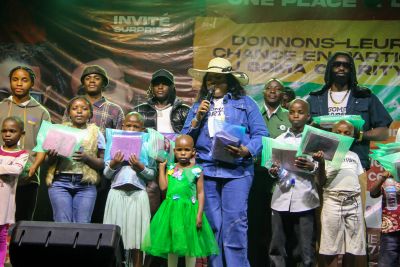
Children on stage during the Goma Charity Show on August 30, 2026. Photo: Andrino Akuda, bird story agency
Artists in Goma are using their music, public profiles and community networks to turn thousands of small donations into school supplies for vulnerable children starting a new school year.
By Andrino Akuda, bird story agency
At the Goma Charity Show, Richard Muhima reached into his pocket and pulled out 5,000 Congolese francs – about US$2. It was not enough to equip a child for school, but that was not the point. He was adding his banknote to a much larger act of solidarity.
“I have contributed in my own way,” Muhima said. “But what is certain is that it is not enough.”
The show brought artists, residents and supporters together as schools reopened in September. Its goal was practical: to turn small donations into notebooks, pens, geometry sets and other supplies for orphaned and vulnerable children.
The effort unfolded in Goma, the capital of North Kivu province in the eastern Democratic Republic of Congo, on the shore of Lake Kivu and beside the border with Rwanda. Years of conflict and displacement have repeatedly disrupted daily life and schooling across the region.
Francine Kaboya Tshatsha, who organised the Goma Charity Show through PRN Solution Initiative, the value of Muhima’s contribution lay in what could happen when many people followed him.
“We chose to start with the school year because education is one of the most important investments we can make for a child’s future,” she said.
The organisers estimated that a complete school-supply kit would cost about US$55. Their first campaign was intended to reach children identified through four orphanages and a cultural centre that supports young people in vulnerable situations. It did not cover school fees, transport or meals.
The organisers have set a target of providing school-supply kits to 320 children through these five partner institutions. They have not yet explained how that number was calculated or how many children will be supported at each institution, but say the beneficiaries will be identified by the organisations that already care for them.
“Five thousand francs can seem small,” Kaboya Tshatsha said. “But when it is multiplied by several people, it becomes a real force.”
A school kit amid a national education crisis
The campaign’s ambitions are modest beside the scale of the need. UNICEF estimates that 3.9 million people in the DRC require humanitarian support for education, particularly in North Kivu, South Kivu and Ituri. By 31 August 2025, threats and attacks by armed groups had forced more than 5,200 schools to close, cutting nearly 1.9 million children off from learning.
Poverty deepens those pressures. The World Bank says 69% of people in the DRC live below the country’s national poverty line, while access to good-quality education remains especially difficult for children from poor and marginalised households.
Against that background, a notebook or school bag cannot solve the larger education crisis. But for a family already balancing food, transport and other essentials, the price of supplies can be one more obstacle between a child and the classroom.
A journey from Kalemie for a child’s dream
The mobilisation reached beyond Goma. Singer and composer Vladimir Shakis Boy travelled from Kalemie, in Tanganyika province, to support the event. For him, making the long journey was itself a declaration of intent: he wanted to help a child with dreams gain the chance to attend school, and to encourage Kaboya Tshatsha in her work.
His journey gave the campaign another measure of contribution. Some people offered money; others offered their presence, time or public profile.
That was also true for artist Sisco Raggar. On 29 August, a day before the show, he joined artists, volunteers, partners and residents for a salongo, or community clean-up, in Goma.
Raggar said public recognition brought responsibilities to the community. Helping a child return to school was a blessing, he said, and he urged people who could afford it to support a child for an entire school year, beyond the supplies raised through the show.
A school kit may help a child enter the classroom. Sustained support can help the child remain there.
From the street to the stage
The following day, the campaign moved from the street to the stage. Congolese artists Sisco Raggar, Vladimir Shakis and JKM Rambo appeared alongside Burundian artist Wiz Designer and Kenyan artist Limbali, using entertainment to draw attention to children’s education.
For Bush Sebar, an artist and dancer from the Invisible Kids Academy, the idea was already familiar. He said he had spent about nine years supporting children in Congo through dance, music and hip-hop culture. He encouraged people outside Goma to support organisations and artists working with young people, and to amplify their efforts.
“We want to use the visibility and notoriety of artists in the service of humanism and the most vulnerable,” Kaboya Tshatsha said. “We want to use music and entertainment to create a real mobilisation around a social cause.”
The organisers said contributions would be converted into school supplies and that the distribution would be documented so donors and partners could see what their support had provided.
That accountability will matter. So will what happens after the performance: whether the promised supplies reach the selected children and whether the campaign can build lasting support around their education.
The initiative speaks directly to Sustainable Development Goal 4, the global commitment to inclusive and equitable quality education. In Goma, however, that international promise is being pursued through intensely local gestures: an artist cleaning a street, a supporter travelling from another province and a resident deciding that a small banknote is worth giving away.
“Never underestimate a small contribution,” Kaboya Tshatsha said. “Everyone gives according to their means, and together we can change a child’s school year.”
One contribution cannot meet the cost of returning to school. The hope behind the Goma Charity Show is that enough people acting together can bring the classroom within reach.
bird story agency
Leave a Reply