
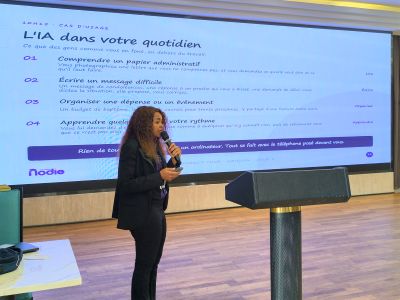
Paulette Fotsing, founder of Nodie IA Academy and the IA Impact Tour Africa, presenting everyday use cases of artificial intelligence during her training session in Abidjan, on September 10, 2026. Photo: Mel AKOI, bird story agency.
Artificial intelligence is transforming how people work and learn across Africa, opening up new possibilities while raising questions about how it is used and who has the skills to use it. In Côte d’Ivoire, Paulette Fotsing is taking these questions directly to young people.
By Akoi Mel Herve, bird story agency
2 October 2026
Hundreds of people sat facing a screen in a conference room at the Hôtel Famille Mondiale in Abidjan’s Cocody area, laptops open and notebooks spread out in front of them. Business owners, entrepreneurs, employees, and students listened as Paulette Fotsing led the session, describing how artificial intelligence may be applied in their everyday careers.
For Fotsing, the training session is part of a wider project. She is conducting the AI Impact Tour Africa in 21 African countries, with the goal of training 10,000 young people in artificial intelligence each year.
“I want young people to develop sources of income through AI,” Fotsing says. “That is really my main goal.”
Fotsing did not start her career with artificial intelligence. After studying industrial risks, quality, safety, and environmental management and working at Eiffage, she transitioned to multimedia production, which progressively drove her into a more public role.
In 2016, she co-founded Wouri Entertainment and Wouri TV, where she worked on African audiovisual projects. The training, she said, helped her overcome her shy nature, which had previously held her back professionally.
‘I was afraid of putting myself out there. So, I hid myself. I was afraid of speaking in public, of being seen, of everything. You can imagine, the whole package.’
It was through this experience of creating content and working with digital tools that she first learnt about ChatGPT. She started experimenting with it in her own work then shared what she learned on social media. Followers’ requests eventually led her to build a training program.
“When I started giving training sessions more than three years ago, they were free,” she says. “They were five-day challenges, and I would have more than 5,000 people, sometimes 6,000 people, connected.”
Many of the participants were from Africa, reinforcing her desire to make AI training more accessible on the continent.
Today. Fotsing is the founder of Nodie IA Academy, which was born out of her work assisting people in transitioning from studying about artificial intelligence to applying it in their businesses and jobs. The academy emphasizes on practical applications, with students learning skills that they can apply right away, such as constructing websites, producing content, and developing AI-powered solutions.
“AI technology is already becoming a part of daily life. According to Microsoft’s 2025 AI Diffusion Report, approximately one in every six individuals globally used generative AI to learn, work, or solve problems in the second half of 2025.
Since 2023, Fotsing states that more than 12,000 people have been trained in artificial intelligence through her training sessions, projects, and other efforts. Currently, she is expanding her online training experience through the AI Impact Tour Africa.
According to Padonou Mickaël, Innovation Manager at Pamadium Africa, understanding AI is crucial as it expands into other industries.
“Practical training in AI is very important because it is a sector that is rapidly expanding, especially on our continent,” he says. So, I think that this is something that is going to be used by everyone, not because it will be imposed on us, but because it is practical and has been proven through real-world use cases.
Mickaël attended “Impact IA”, a national conference on artificial intelligence organized by the Ivorian government to structure the country’s usage of the technology. He believes that studying how AI works might help individuals better grasp how to use a technology that is already becoming commonplace in the professional life.
“…it is important for everyone to start learning about it and begin to understand how it works, simply so that we can embrace this new technology, which is already here and will continue to evolve in the years to come.”
According to a 2025 International Labor Organization (ILO) report, one in four workers globally has some exposure to generative AI, highlighting the importance of workers understanding how the technology can affect the tasks they perform.
For Fotsing, however, knowing about AI is merely the beginning. She wants individuals to learn practical skills that will help them make money or solve problems in their own enterprises and communities.She encourages participants to identify a problem first and then consider which technology can help address it.
“Very quickly, I saw people seriously learning what I was teaching them and actually developing concrete skills around it,” she says. These included creating websites, producing video content for businesses and creating AI agents.
During the Abidjan training on September 10, 2026, ChatGPT served as an entry point before participants explored other applications. They learned how to prompt, create AI assistants, and apply the technology in sectors such as marketing, sales, company growth, and customer acquisition.
Johann Ibrahim Anodjo, Communications Officer at Phoenix Immobilier, was among the attendees. He notes that the training gave him ideas for incorporating AI into his regular work, particularly for tasks that previously took more time and research.
“Before, I used to struggle with certain tasks. I had to go around in circles and carry out various searches. But with ChatGPT, things go even faster,” he says.
For Anodjo, the value is in being able to apply what he has learned immediately rather than simply understanding the technology in theory.
Fotsing says some participants from her previous programs have gone on to offer AI-related services and generate income. She gives examples of people earning between 500,000 and three million CFA francs from such activities, these are accounts she provides from her training experience.
She also recalls the case of a chemical engineer who, after struggling to find work in his field, reportedly started a delivery business after receiving AI training.
Such examples inform Fotsing’s broader view of the technology. She argues that African countries should focus on learning how to use and adapt existing AI tools while also working toward developing systems that respond more closely to local needs.
“If we wait for help to come from elsewhere, we may be waiting for a long time,” she says. “It has to come from us, because no one is going to understand our problems the way we do.”
The AI Impact Tour Africa aims to expand that methodology across the continent. Fotsing encourages those who obtain training to become trainers and assist local businesses.
The first training session in Abidjan, attended by over 1,000 people, provided a glimpse of the size she hopes to achieve. Fotsing’s sense of urgency comes from the rapid development of AI.
“AI is advancing rapidly. It is not waiting for us to be ready,” she says. “So, we have to start now.”
She believes Africa can engage with existing technologies while continuing to develop its own.
“Even if we do not yet have our own models, we need to start engaging with this technology. We need to customise what already exists,” she says. “At the same time, we also need to develop our own models so that they can be much more precise and address our needs much more accurately.”
For her, the starting point is not waiting for perfect conditions, but learning to use what is already available.
Leave a Reply