
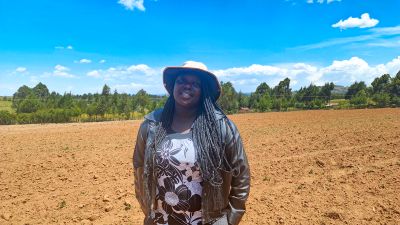
Ruth Njeri Kabiru posing for a picture in her farm in Nakuru County, Kenya on September 3, 2026. Photo: Stacey Kakea, bird story agency
After the corporate job she had dreamed of did not materialise, Ruth Njeri Kabiru built a business producing certified potato seeds. Her next challenge: to get more farmers to use them.
By Stacey Kakea, bird story agency
2 October 2026
The first time Ruth Njeri Kabiru noticed freshly dug potatoes being placed in sacks by farmers and set aside, she wondered why the tubers were not being used for food. She had begun working for a potato cooperative Nakuru County, one of Kenya’s biggest potato-growing regions, after a career in the corporate world failed to materialise.
It turned out that the farmers were using the chosen tubers to seed their fields for the next harvest. With a fast-growing population relying on the crop for both food and income, Kabiru considered the farming practice a huge waste of potential nutrition.
The 28-year-old Kabiru decided there had to be a better way to plant potatoes.
Today, Kabiru produces and uses certified potato seeds, with the aim of helping farmers access better-quality planting material.
Kabiru is the founder and director of Crop Care AgriHub. She focuses climate-smart agriculture, producing and selling certified potato seeds, training aspiring farmers on their use, and assisting growers who want to start seed potato production.
“When we encourage farmers to use certified seeds, it’s because these seeds have a very good impact when it comes to harvesting,” she explained.
Potato is the second most important staple crop in Kenya after maize, supporting food security and providing livelihoods for millions in the country’s value chain. According to the Kenya Institute for Public Policy Research and Analysis, production of potato grown significantly between the period 2018 and 2023.
Despite growing up in Dundori, an agricultural region and one of Kenya’s key food baskets, Ruth never pictured herself growing potatoes. She enrolled at Maseno University in 2016 and pursued a Bachelor of Business Administration, Finance option, as well as the Certified Public Accountants qualification.
Like many in the same position, the young graduate envisioned herself working for a corporation in Nairobi, Kenya’s capital city. As such, when she started looking for an internship position in 2020, she focused on getting a position in Nairobi’s corporate sectors. However, because of the COVID-19 pandemic, many organizations stopped taking on interns.
“Everybody was saying, ‘we’re working from home. We’re not taking on interns right now’.”
Frustrated, she went back to school and told a friend, “I’m not sure I’ll graduate because I can’t find anywhere to do my attachment,” Kabiru said.
A close friend suggested she look for an opportunity at a potato producers’ cooperative in Kuresoi, another agriculturally rich region in Nakuru County. Kabiru approached the cooperative and was offered the internship position. Although she intended to spend the most of her time doing financial work at the office, Kabiru soon found herself in the field.
She was one of the cooperative’s younger members and would often be assigned to accompany visitors to farms, participate in field activities, and attend farmer training classes. The work progressively introduced her to agricultural practice and the issues facing potato growers.
A training program offered another route to Ruth was recruited as a trainer through the cooperative. During her time as a trainer, she taught farmers about potato production before convincing them to become cooperative members.
“Going to the field and interacting with farmers really was good for me” she explained.
Her interactions with farmers introduced her to the problem that would eventually become her business: access to high-quality and certified potato seed.
After spending time with farmers, Ruth decided to try farming as well. Instead of purchasing land, she leased one acre and obtained seed for her first crop through connections she had established with the farmers she interacted with as an intern.
“That one acre would perform really, really well. I think I made over 350K in revenue, so that was good footing.”
The experience convinced her that farming could be a business and provided her a better understanding of how seed influences what farmers get out of their land.
Many farmers continue to recycle seeds by storing potatoes from one harvest for the next season. Certified seed, on the other hand, is produced and examined in accordance with particular requirements, although the increased cost may make adoption difficult.
As per Kenya Plant Health Inspectorate Service (KEPHIS), the use of certified seed is critical in improving yields, by up to 30–50%, and controlling diseases. However, despite such a significant improvement in yield, KEPHIS asserts that certified seed production in Kenya currently meets less than 5% of national demand due to limited seed multipliers and high production costs .
“Potato seed business is quite capital intensive, seriously, because you also have to pay for inspections from the government,” Ruth asserts.
The challenge extends beyond Kenya. According to the International Potato Center,In sub-Saharan Africa, 90% of smallholder farmers access seeds from informal systems mainly from earlier harvests or purchasing from local markets.
Daniel Kamithi is the founder of Nakuru Potato Cooperative Union, which is an umbrella of 13 potato cooperatives in Nakuru County. Daniel, also a potato farmer from Kamara Ward has been farming since 1982. He has seen improvements in potato cultivation, such as the introduction of certified seed in 2012.
“Certified seeds are standard seeds that have been studied, how to preserve them, how they work, and management of these seeds, for example, from insects, is well taught to farmers,” Daniel says. “In today’s world, you cannot just plant for the sake of planting.”
For Daniel, potato farmers not only need to get access to quality potato seeds, but also join fellow farmers in SACCOs where they get easy access to the latest information in the potato production world.
Ruth says less than 10% of Kenyan farmers use certified seed, with many continuing to recycle seeds from previous harvests.
“But now, when it comes to harvest, the difference is like you know, night and day. Too big because one certified seed is free of diseases. They’re very vigilant. They’re very resilient because all the seeds you have seen here have KEPHIS labels,” she says.
Producing certified seed requires inspections, land, machinery, and adherence to production regulations. A crop may be rejected if it fails inspection, leaving a producer with incurred costs.
“So for you to be a seed merchant in Kenya, you have to be registered with KEPHIS. So it tells you the tubers I work with have already been taken to the lab and tested for diseases.”
Ruth considered working as a grower under an established merchant instead of establishing herself as a seed merchant. However, her goal was much bigger, to provide farmers with certified seed while also enabling other small-scale growers to engage in seed production.
Waweru Karaithi, a farmer since 2012, has been purchasing certified potato seeds from Ruth for the past three years. He has observed variations in harvested quantity between recycled and certified seed during his potato-producing experience.
“I have learnt that recycled potato seeds end up losing their quality, and the quantity of production is also low compared to certified seeds,” Waweru says. A 50-kilogram bag of certified potato seed can produce up to five to seven 90-kilogram bags of potatoes on his farm, he says.
Working with farmers has also made Ruth realize the importance of women in agricultural decision-making. Many of the farmers she trains and sells to are women, despite the fact that men continue to have authority over land and capital.
“You will see in training, 80% will be women, not men,” she says. “But if you look at the farm, the title deeds are held by men.”
Apart from face-to-face training, Ruth has expanded her reach to farmers through social media. Some buyers contact her after seeing her work on social media platforms where they inquire about seed, fertilizer, and farming procedures before making their first purchase.
“Occasionally I post testimonials from farmers. You know, if somebody comes and gets seed from me and then they make a million that season. For me, I’m good. They are able to pay their school fees. They’re able to pay for their livelihoods, and they also have enough money to come back here.”
Ruth has also noticed younger people becoming interested in agriculture.
“I’ve seen a rise of Gen Zs and Gen Alphas really wanting to get into farming,” she says.
Ruth is confident that there is a chance for young people who would like to venture in certified seed potato production. If more people were to engage in the activity, Kenya would have enough certified seeds to boost its potato output as well as export to neighbouring countries.
Her sentiments are echoed by a 2026 study by the European Potato Journal which claims that Kenya’s average yield of a potato crop is currently below 10 tons per hectare per year, against a potential of 35-40 tons per hectare.
Beyond Kenya, potato farming is notably important. According to the most recent FAOSTAT data, Africa produced approximately 34.2 million tons of potatoes in 2024, or about 9% of the world’s total. Egypt, Algeria, South Africa, Morocco, and Kenya are among the nations where production is concentrated.
Quality seed potato goes beyond the farm seeing that Ruth is getting opportunities headlined by her efforts. One such opportunity is the sponsorship she received to attend the World Potato Congress which will take place in Kenya in October 2026.
For Ruth, the World Potato Congress is an important event. Not only is the global event being held for the first time in Sub Sahara Africa, but also a chance to meet growers, researchers, policymakers, business leaders, investors, and youth from more than 60 nations. She believes that the congress will allow her to showcase the efforts of Kenyan potato farmers and establish connections with global potato industry stakeholders.
“The significance is that it’s bringing all stakeholders in the potato industry globally and in Kenya. So it’s a good opportunity for the world to see what Kenyan potato farmers are doing, because we’ll be showcasing what we do in our farms.”
Ruth believes that providing farmers with trustworthy information and legitimate sources is essential to increasing potato production. Her work now lies between farming and planting material supply, providing producers with high-quality seed and paving the way for other small-scale farmers to produce their own seeds.
Leave a Reply