
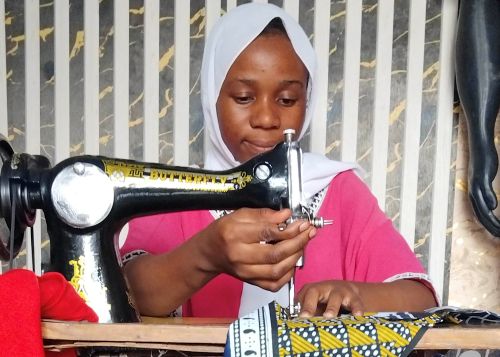
Fatuma Hamis working on a sewing machine at her tailoring workshop in Dodoma, Tanzania, on July 13, 2026. Photo: Felister Richar, bird story agency
Tanzania produces more cotton than its textile industry can process, exporting most of its lint while garment factories and fashion designers import fabric. New investment could help close this industrial gap, creating manufacturing jobs and retaining more value at home.
By Felister Richard, bird story agency
Fashion designer Fatuma Hamis works in one of Africa’s cotton-producing countries, yet much of the fabric she uses comes from China.
Apart from products such as kanga and vitenge, Hamis says locally produced materials are not readily available in the range she needs. Her experience exposes a costly gap in Tanzania’s cotton economy: the country grows and exports cotton but still imports much of the fabric used by its own designers and clothing manufacturers.
“The fabrics I use come from China. Here at home, materials are not easily available, except for some products such as kanga and vitenge,” she said.
Tanzania produced 222,057 tonnes of seed cotton during the 2025/26 marketing season, according to the Tanzania Cotton Board (TCB). But limited spinning, weaving and textile-manufacturing capacity means that most of the cotton leaves the country before it can be transformed into yarn, fabric or finished clothing. On average, only 20% to 30% of the country’s cotton lint is processed domestically, while the remaining 70% to 80% is exported, depending on annual production levels.
The figures highlight Tanzania’s industrial opportunity: connecting its cotton farms to a growing garment and fashion industry. Cotton supports thousands of farmers and generates export earnings, but much of it leaves the country before reaching higher-value stages. Tanzania can gin seed cotton into lint, but lacks sufficient capacity to spin it into yarn, weave or knit fabric, and dye and finish textiles.
Renatus Luneja, the Acting Director General of the Tanzania Cotton Board, says the country’s limited textile processing capacity remains one of the main reasons much of the cotton leaves Tanzania before higher-value manufacturing takes place.
“Tanzania’s industries currently process only about 25,000 to 30,000 tonnes of cotton lint annually, which is far below the volume produced each year,” he said.
Luneja said the government and the private sector are working to strengthen the cotton value chain by encouraging investment in spinning, textile and garment manufacturing. He pointed to the development of the Nyamatara Industrial Zone in Mwanza as part of efforts to create infrastructure that can support industries involved in adding value to cotton and other agricultural products.
According to Luneja, the government has already paid more than TZS 4 billion in compensation related to land acquisition for the Nyamatara Industrial Zone. Infrastructure development, including electricity connections, has begun, while urban planning procedures are still underway. He said there is no official date yet for the declaration of the zone, which will be announced once all legal requirements have been completed.
Luneja said expanding domestic processing will require continued investment, alongside policy and regulatory reforms that encourage the establishment of more spinning and weaving factories.
Venance Mashiba, Manager of the Tanzania Investment and Special Economic Zones Authority’s Central Zone, said Tanzania is promoting investment across the chain, from cotton farming and ginning to yarn, textiles and garments. “We are encouraging investment in the whole cotton value chain—from cotton farming, processing, production of yarn and even garment manufacturing.”
Investors can access government incentives intended to promote industrial development, Mashiba said. However, access to suitable industrial land and regulatory procedures continue to affect the pace of investment.
Some Tanzanian companies are already creating value and employment by manufacturing finished garments.
Established in 2022, Taven Garments produces T-shirts, school uniforms, workwear and other clothing for the domestic market. The factory employs more than 300 people, many of them young workers involved in cutting, stitching, finishing and quality control.
But its operations also illustrate Tanzania’s incomplete supply chain.
According to textile expert Elias Ipyana Sollo, the factory obtains some fabric locally, including material supplied by A to Z Textile Mills. Other materials are imported from China, Turkey and the United Arab Emirates because suitable alternatives are not consistently available domestically.
“Factories like this contribute to the economy through employment creation and tax payments,” he said.
Garment manufacturers nevertheless face high production costs, limited access to materials and competition from imported products. Sollo said better access to industrial inputs, stronger local textile production and more efficient trade logistics would make Tanzanian manufacturers more competitive and reduce their dependence on imported fabric.
The shortage of locally manufactured textiles also affects Tanzania’s designers and small tailoring businesses.
Hamis began designing clothes at a young age and undertook formal training in 2022. She has since built a customer base and believes Tanzania’s fashion industry has significant room to expand.
“There are many opportunities because many people like sewing clothes here in Tanzania. This can help grow the market,” she said.
But designers cannot build a fully local fashion economy without dependable access to competitively priced fabric in different weights, finishes, colours and designs.
Hamis believes that increasing the availability of locally produced material would reduce costs for designers, strengthen small fashion businesses and create opportunities across the industry.
Economist Aloyce Mchunga said Tanzania’s fundamental problem is not a lack of cotton but its limited capacity to transform the crop into higher-value products.
According to Mchunga, changes in economic policy and the collapse of many cooperative unions contributed to the decline of cotton-processing industries that previously supported local value addition.
“The absence of strong cotton processing industries has become one of the main reasons Tanzania continues to export raw cotton instead of producing more yarn, fabrics and finished garments,” he said.
Mchunga said domestic processing could create manufacturing jobs, raise national income and improve Tanzania’s competitiveness in regional and international textile markets. He called for sustained investment and policy reforms across the value chain, alongside modern technology from farming through to textile manufacturing.
He also recommended measures to reduce the country’s dependence on imported clothing, particularly second-hand garments.
Second-hand clothes – or mitumba – provide affordable clothing for consumers and support traders and other workers. Restrictions would therefore have social and economic consequences unless domestic manufacturers could produce garments at sufficient scale and at prices consumers can afford.
For many Tanzanian consumers, second-hand clothing remains attractive because of affordability, variety and uniqueness.
Veronica Dankala, a second-hand clothing user, says she prefers mitumba because it allows her to find unique outfits at prices she can afford.
“It is very rare to buy a second-hand piece of clothing and then meet someone wearing the exact same thing, unlike some new clothes from shops that are mass-produced,” she said.
Beyond style, price is a major factor driving demand. Dankala says she can buy a second-hand item for around TZS 5,000 (US$1.90), while similar new clothes from shops can cost between TZS 25,000 (US$9.45) and TZS 50,000 (US$18.90).
“My financial situation does not allow me to regularly buy expensive clothes, so second-hand clothes help me dress well while staying within my budget,” she said.
For traders, the popularity of mitumba reflects both consumer demand and gaps in local garment production.
Samson Jonathan Kabuko, a second-hand clothes trader, says some customers choose imported second-hand clothing because they perceive it as better quality and more affordable than some locally produced garments.
“Some customers prefer buying second-hand clothes because they perceive them as more affordable and, in some cases, better quality than locally produced garments,” he said.
Kabuko believes Tanzania’s textile industry can compete if local manufacturers improve quality, reduce costs and receive stronger support to create a more competitive environment.
“If locally produced garments were made with better quality and sold at affordable prices, I strongly believe customers would buy them. For Tanzanian cotton products and locally made clothes to compete with second-hand clothing, the government needs to put more effort into supporting the industry,” he said.
Mchunga believes Tanzania could compete with textile producers including Ethiopia, Egypt and Kenya, drawing on its agricultural land, workforce and ability to increase cotton production.
“If Tanzania invests consistently across the entire value chain – from cotton production to textile manufacturing – the country has the potential to build a competitive textile industry that creates jobs, generates export earnings and captures more value within the domestic economy,” Mchunga said.
Realising that potential requires operating spinning and weaving factories, reliable energy and infrastructure, finance, technology, efficient regulation and demand for locally made textiles.
Tanzania has cotton, garment factories and a growing design industry, but lacks the capacity to connect them.
Closing that gap means exporting less lint, producing more yarn, fabric and clothing, and creating industrial jobs. Real progress will come when designers such as Hamis can buy Tanzanian-made fabric at home.
bird story agency