
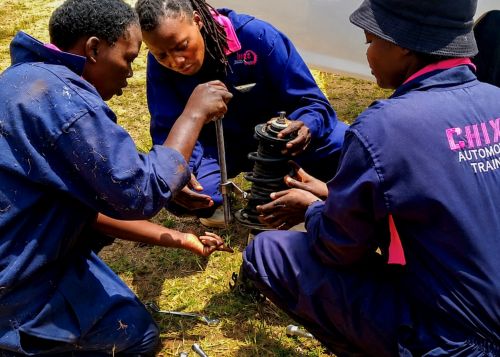
Women in Chixz workwear working together on a suspension strut beside a car during a practical vehicle repair session. Photo courtesy: Chixz Auto Garage and Services.
Kenya’s electric motorcycle boom is pulling women into the repair, battery and fleet jobs needed to keep the new vehicles on the road.
By Seth Onyango, bird story agency
Irene Wali wants more women under the bonnet.
At her Chixz Auto Garage and Services, women are trained to work on vehicles, electric motorcycles and solar systems as Kenya’s transport sector shifts towards renewable power.
Wali’s team also converts petrol motorcycles to electric power, bringing women into a technical side of transport where they have traditionally had little presence.
It follows rising demand for electric vehicle skills across the country. Just last month, Siaya National Polytechnic in western Kenya launched a new electric mobility training curriculum covering repair and maintenance of electric motorcycles, vehicles, tricycles and bicycles. Songa Mobility developed the programme, and the Technical and Vocational Education and Training Authority accredited it.
For Wali, the workshop is a place to test whether those skills can become a livelihood.
Chixz has been training young women in automotive mechanics and more recently in electric mobility and solarisation. The garage has also advertised a three-month hands-on programme in Kilifi covering repair and maintenance of electric motorbikes, fuel motorbikes and tuk-tuks.
Chixz places graduates in jobs through partnerships that include companies such as BasiGo, but also runs its own operations and is preparing a franchise model called Chixz Hub.
Senior technicians will manage local repair shops and battery-swapping points in other towns. Inquiries have already come from Kisumu and other counties where motorcycle numbers are high, and repair services are scarce.
Wali’s small team cannot cover every location itself, so the hub model will let trained women open and run their own branches while receiving mentorship and incubation support.
The garage targets young women and mothers aged below 25 from low-income settlements who cannot afford college fees and may already have children to support.
“Our focus has been to equip young women, young mothers between 16-24 years from low-income settlements who are not able to afford college fees and have parental responsibilities, with technical skills in repair and maintenance of motor vehicles to earn an income in the sector,” Wali told bird.
She said electric motorcycles and three-wheelers have opened another route into that work.
“In rural and peri-urban areas where they are the common mode of transport, electric transport is fast penetrating these areas, but there are no mechanics with the skills to do the work,” Wali said. “Our trained women therefore have an opportunity to get in and earn a living.”
Kenya’s electric vehicle market has grown quickly, registering 39,324 electric vehicles cumulatively by the end of 2025, up from 1,378 in 2022, according to the Ministry of Roads and Transport.
Data from the Electric Mobility Association of Kenya shows electric motorcycles made up 7.07% of new motorcycle registrations in 2024, up from 3.35% a year earlier. There were 68,804 new motorcycle registrations in 2024, including 4,862 electric motorcycles.
Kenya’s e-mobility power consumption also jumped to 4.57 GWh in July–December 2025, marking a 152.49% rise from 1.81 GWh over the same months in 2024, according to the energy authority, EPRA.
Flone Initiative, a women-focused mobility group, sees an opening as each new electric motorcycle drives demand for servicing, fault diagnosis and battery management.
Chixz trains women in vehicle repair and maintenance, electric motorcycle repair and EV battery repair, and offers internships and job placement. The centre is also certified to train people with disabilities.
Wali said the next step for Chixz is to build repair shops that can serve the growing number of electric vehicles outside Kenya’s main cities.
“Our model is to open up repair shops that are ‘one-stop hubs’ along the different trading centres in the remote areas,” she said. The hubs would combine training, spare parts, battery swapping and charging, repairs and vehicle conversions.
Wali said specialist technicians are costly and often choose to work with large electric vehicle firms. Setting up an EV workshop also requires costly equipment, and spare parts can be hard to obtain because some suppliers control access and set prices.
Flo Mwangi, founder and CEO of Ubuntu Rides, runs a fleet management and last mile delivery company that recruits, trains and manages riders who use motorcycles, electric motorcycles and bicycles.
Ubuntu Rides reached 64 riders within six months of launch, with only three women drivers then.
Mwangi insists that women need access to technical training, mentoring and management roles as the industry grows.
“Women really need to move beyond the rooms. Women need to move beyond the admin work,” she said at the recent Flone Initiative webinar.
Ubuntu Rides has also become part of the path for some women trained by Chixz.
“Because Flo (Mwangi) is one of my ecosystem, when I do the training at least I have somewhere to take girls for employability,” Wali said.
Flone Initiative’s Women in E Mobility Network has three pillars: research and advocacy, skills and mentorship, and access to resources including financing. GIZ’s Promotion of Electric Mobility in Kenya project supports the network, created to boost women’s participation and leadership in the sector.
Flone also runs training for women already working in public transport. Its 2026 E Driver and E Conductor programmes, supported by GIZ Kenya through the WE4D programme, offer training in electric vehicle technology and professional recognition.
Government policy is starting to catch up with that grassroots activity, with Kenya introducing its National Electric Mobility Policy in February. It is meant to draw investment into charging infrastructure, local production, skills training and a mix of financial and non financial incentives.
It is part of the government’s plan to build a new transport industry, with work ranging from manufacturing and assembly to vehicle servicing, charging infrastructure, battery systems and fleet operations.
Now women such as Wali, who runs one of the few workshops in the country, are strategising how to absorb more value form the growing chain.
Faith Waraki, who works at AfricaNEV and runs the Green Women Accelerator, said the aim is for women to step in as employers, freight managers, technicians, energy managers and owners.
Waraki argued that skills training needs to connect with actual opportunities in the market. A woman who takes a course in battery technology, for example, needs a clear route towards work that uses those skills.
The Siaya Level 4 programme is designed around service and repair, giving trainees practical exposure to electric tricycles and bicycles through an e-mobility hub supported by Songa Mobility.
Flone has launched the Empower Her Mobility project with GIZ’s Women for the Green Transformation in Africa programme, working with medium sized e mobility companies in Kenya on policies and workplace practices to attract, retain and advance women and people with disabilities.
GIZ’s wider WE4D programme runs from 2023 to 2027 across several African countries, including Kenya, focused on improving women’s employment in the green transformation.
A similar effort is underway in Uganda, led by Liliane Felix, founder and CEO of Women Rising for Africa. She began with the Women on Wheels programme to widen women’s access to motorcycles and has since moved into electric mobility.
She said access to transport had long been tied to women’s safety and economic independence, and her organisation now runs electric vehicle technician training.
There is evidence from western Kenya that this model can lead to jobs and businesses. In Homa Bay, 23 women were trained in electric vehicle technology, battery systems, licensing and technical skills through a programme involving WeTu and partners.
Flone Initiative says many went on to work as technicians and battery swap attendants, while others started electric boda boda and delivery businesses.
The experience also illustrates how personal circumstances determine who remains in the industry.
UNEP, in research tied to an e-mobility project in Homa Bay, found that women accounted for just 5% of electric vehicle drivers in Kenya. Some trainees encountered family pressure over working in the motorcycle taxi business.
For Wali, the garage offers one route. For Mwangi, fleet management provides another; her company already has women working as riders and in fleet coordination.
Waraki sees an even wider pipeline, extending from technical training into business ownership and policy. Felix’s work points towards access to vehicles and transport services as an economic question, especially for women outside major cities.
As electric motorcycles become more common on Kenyan roads, the women trained to repair, service and manage them could become part of the workforce that keeps the new electric fleet on the road.
bird story agency
Leave a Reply