
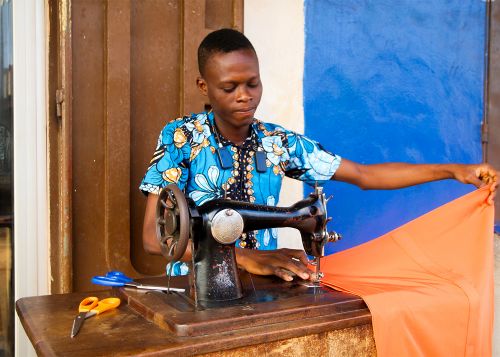
Seasonal factory worker Florent Tchivadji working as a tailor during the off-season in Banikoara, Benin, on September 5, 2026. Photo: Ginette Fleur Adande, bird story agency
As Benin consolidates its position as one of West Africa’s leading cotton producers, towns such as Banikoara thrive during the six-month ginning season. Workers and businesses are now looking for ways to turn this seasonal activity into more stable, year-round livelihoods.
By Ginette Fleur Adande, bird story agency
From November, an almost electric energy takes hold of Banikoara, a town in Benin’s north-western Alibori department and one of the centres of the country’s cotton industry.
The chimneys of the local factory, operated by the Cotton Development Company, SODECO, start up again after months of relative inactivity. Trucks arrive, workers are recruited and an economy serving the factory comes alive.
“The factory relies on a permanent technical core of barely 28 managers and technicians. As soon as the season begins, it recruits between 250 and 350 seasonal and day workers,” says factory manager Saka Sourokou Idrissou.
Handlers, ginnery workers and weighers earn an income for the next six months. Truck drivers buy food from roadside vendors, migrant workers rent rooms and local retailers record higher sales.
More than 45 local small and medium-sized businesses, including welding workshops and hardware stores, benefit directly from the 180 million CFA francs (US$320,000) the factory spends each season on supplies and basic maintenance, according to Idrissou.
Bio Azizou, the district councillor responsible for economic development, says the factory generates about 22% of Banikoara municipality’s own-source tax revenue through business licence fees and transport taxes.
Banikoara’s cotton-ginning complex dates from the 1980s and was previously managed by the state-owned National Agricultural Promotion Company, SONAPRA. Management of the assets was transferred to SODECO in 2008.
According to factory manager Saka Sourokou Idrissou, the Banikoara factory processes between 60,000 and 80,000 tonnes of seed cotton during a typical ginning season.
During the peak season, it operates around the clock in three shifts.
Souleymane Bio, who has worked as a truck driver for more than 15 years, is among those who benefit.
“For six months, I am on the road all the time,” he says. “What I earn enables me to send my children to school, finance my two wives’ businesses and cover the other major expenses needed to support a family.”
Mechanic Abdoul Wahab Tamou experiences a similar surge in business at his workshop, a few hundred metres from the factory.
“When the factory is running, my garage is always full,” he says. “Heavy trucks take a beating on the difficult roads. For six months, I employ three additional apprentices, and money circulates throughout the town.”
But when the ginning season ends around May, the lines of trucks disappear—and many of the incomes they sustain vanish with them. Seasonal workers lose their factory wages, while businesses serving the workers and cotton trucks experience a sharp decline in demand.
During the peak agricultural season, local employment expands significantly, with average monthly household income estimated at 85,000 CFA francs (US$151). In the low season, underemployment becomes widespread and average household income reportedly falls to about 32,000 CFA francs (US$57).
There are, however, opportunities to extend cotton’s economic contribution beyond the ginning season. One lies in making greater use of its by-products.
“While cotton fibre is sent to the port of Cotonou, much of the cottonseed remains in Banikoara and becomes the real fuel of the rural economy during the low season,” says Kora Dokoto, who manages the factory yard.
Cottonseed and the cake produced after its oil has been extracted provide protein-rich livestock feed, supporting pastoralists across Alibori. Livestock farmer Sabi Allassane, 27, says access to this feed helps producers sustain their animals and incomes during difficult periods.
Economic development specialist Franck Kinninvo says the trade in cotton by-products creates an off-season economy of its own.
“These are indirect jobs created at a time when fieldwork has not yet begun to generate income,” he says.
The factory also serves as a storage and distribution centre for fertiliser, certified seeds and crop-protection products ahead of the next farming season.
“The factory provides us with these inputs on credit so that we can start the farming season without paying from our own funds at a time when money is scarce,” says Bio Alassane, a cotton farmer in Gomparou.
These activities soften the seasonal slowdown but do not eliminate it. Roadside food stalls lose customers, demand for rooms declines and Banikoara’s main market becomes quieter.
Mounirou Osseni earns about 200,000 CFA francs (US$355) a month by renting his house to seasonal workers. That income disappears when they leave.
Paulin Bah Yara, who heads Banikoara’s seasonal workers’ union, says hundreds of young workers from Banikoara and surrounding districts lose their regular wages when production stops. Although they receive protective equipment while working, he says they have no long-term medical cover or compensation during the off-season.
“It is the period we dread because we lose our source of income,” says seasonal worker Florent Tchivadji, who earns about 75,000 CFA francs (US$133) a month during the season.
“The town comes alive for six months and then suddenly everything shuts down.”
Tchivadji works as a tailor during the off-season to supplement her income.
Others draw on technical skills acquired at the factory. Dokoto says some seasonal employees have used their experience in industrial electrical work and arc welding to establish small workshops or provide repair services.
This transfer of skills points to one way Banikoara could build a more resilient economy. Other cotton-processing towns, including Parakou and Bohicon, appear less exposed to seasonal downturns because their economies are more diversified.
Parakou is both a regional service centre and an important transport hub on trade routes towards Niger. Bohicon benefits from its position along a major transport corridor and from a broader network of small and medium-sized businesses.
“Banikoara has much to learn from these models,” Kinninvo says. “It needs to shift from being a factory town to becoming a hub for trade in secondary agricultural products by investing cotton surpluses in permanent market infrastructure.”
A shortage of transferable skills remains one of the barriers to this transition. Kinninvo recommends certified technical training during the low season, particularly in solar installation and agro-processing.
“The idea is to transform a vulnerable agricultural worker into a versatile local entrepreneur capable of moving from one sector to another as the seasons change,” he says.
Expanding local processing could create further opportunities. Rather than sending most cotton fibre elsewhere for manufacturing, producing regions could capture more value by developing businesses around cottonseed, animal feed, edible oil, textiles and other products.
For Banikoara, the challenge is to use the economic activity generated by cotton to support enterprises that can operate throughout the year. Investment in technical training, agro-processing, markets and other local industries could turn a six-month boom into a more stable economy.
Cotton would then provide more than seasonal employment. It could become the foundation for diversified businesses and sustainable livelihoods that continue long after the ginning machinery has fallen silent.
bird story agency
Leave a Reply