
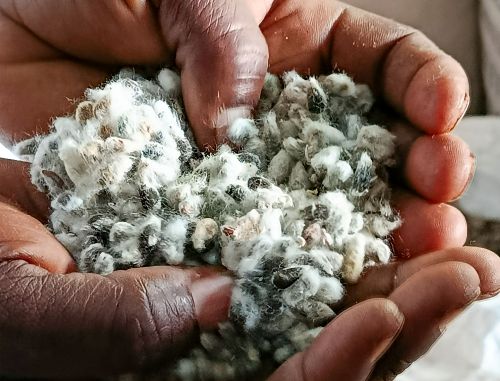
A display of cottonseed after it was separated from the lint using a micro ginnery developed by Kirinyaga University at Kanyuambora Village, Mbeere- North sub–county, Embu County, in July 2026. Photo: Milliam Murigi, bird story agency
In Gokwe, Zimbabwe’s largest growing region, investment in local processing is turning a once-overlooked seed into cooking oil, livestock feed and industrial products. The emerging industry could create jobs and retain more value but farmers want a greater share of its rewards.
By Tatira Zwinoira, bird story agency
Several kilometres from Gokwe’s sprawling cotton fields, located mostly in the south, the familiar story of Zimbabwe’s ‘white gold’ takes an unexpected turn.
The fluffy white fibre that has defined the country’s cotton industry for generations has already been stripped away. What remains are thousands of tiny brown seeds feeding steadily into conveyors, crushers and refining equipment.
Inside this local processing plant owned by Cangrow Cotton Company (CCC), located in a town called Nembudziya some 72km from Gokwe’s business centre, machinery hums as cotton seed disappears into steel presses before emerging as golden cooking oil.
Nearby, the remaining material is transformed into livestock feed and other by-products, leaving almost nothing to waste.
Once treated largely as a by-product of lint production, cottonseed is becoming the foundation of a broader rural industry producing cooking oil, animal feed, soap and other goods. This local processing creates jobs and keeps more of the crop’s value within Zimbabwe’s growing communities.
CCC, a registered seed-cotton contractor and buyer, is among the companies expanding into cottonseed crushing and edible-oil production.
“Cottonseed is no longer a waste product. It has become an important raw material for cooking oil production, proving that every part of the cotton crop has value,” said CCC regional manager Khumbulani Moyo.
“Through beneficiation, we are ensuring that what was once overlooked now contributes to the country’s food industry and the broader economy.”
For decades, Zimbabwe’s industry earned most of its income from lint, while ginned seed was sold largely as a raw commodity. That model is changing as processors look beyond lint to capture more value after ginning.
For Moyo, cooking oil is only the beginning.
“After extracting the oil, the remaining material is processed into stock feed and other by-products,” he said. “Our objective is to maximise the value of every tonne of cottonseed by ensuring that very little goes to waste.”
Every tonne processed locally supports activity beyond the factory: cooking oil reaches households, cotton cake feeds livestock, and other by-products supply agriculture and manufacturing.
The process begins with farmers. At buying points around Gokwe, ox-drawn carts and tractors arrive from surrounding villages carrying freshly picked seed cotton.
Once, selling the crop marked the end of its local journey. The emerging processing industry now offers an opportunity to retain more of its value in the region.
“This value addition means farmers can earn more foreign currency,” says Tina Murabinda, a local small-scale cotton farmer who own a small farm in Gokwe south, near the town’s business centre.
“If cotton seed is processed into cooking oil and other products, it gives us another source of income and encourages more people to continue growing cotton.”
For now, most farmers’ involvement ends once they deliver their harvest and receive payment.
However, several growers argue that while processors continue discovering new commercial uses for cotton seed, those who produce the crop remain largely excluded from the wealth created further along the value chain.
Marry Chisvo, 30s, another small-scale cotton farmer from Gokwe south, has watched that imbalance persist for years.
Like many growers scattered in Gokwe’s south side, she delivers her harvest knowing the cotton seed she produces will eventually become cooking oil, stock feed, soap and other products.
Yet, while she gets paid for her delivery, offering another source of income, she says, the economic benefits are limited and that there is room to grow.
“We are only paid for the crop we deliver. After that, the seed is processed into cooking oil, stock feed, soap and other products, but farmers do not receive anything from those by-products,” Marry said.
“The biggest share of the value comes after the cotton leaves our hands, yet we are only paid a relatively small amount for the crop itself. Right now, this value addition is benefiting the processors more than the farmers. Until processing is brought closer to us, we are not enjoying the full benefits of our crop.”
The major challenge is as the farms are in Gokwe south, they must trek a distance to the CCC plant and ginneries in Sanyati which is also a distance.
Her concerns echo a broader debate unfolding across Zimbabwe’s cotton belt.
While the industry increasingly speaks about beneficiation, many growers argue that genuine value addition should not simply create new products—it should create new opportunities for the communities that produce the raw material.
Currently, farmers like Marry are able to by some of the by-products for resell in their communities but that is most they can do.
Those concerns have strengthened calls for greater investment in local processing.
The Cotton Company of Zimbabwe (Cottco) and the government are investing more than US$1.5 million in a Gokwe oil-expression plant capable of processing 60 metric tonnes a day, or about 450 tonnes of cottonseed a week.
Gokwe was selected because it handles the country’s largest volume of seed cotton and has the workforce to support the operation. Cottco is seeking strategic partners to help complete the wider investment.
Rather than selling ginned seed as a raw commodity, the plant will produce cooking oil commercially, with the residue processed into livestock feed and other industrial products.
Enock Chevedza, a veteran farmer, school head and councillor in Ward 19, believes processing at scale could help growers capture more value.
“Value addition and beneficiation would help farmers realise the true value of their crop through products such as cooking oil, seed, soap, fertilisers, animal feed and even materials used in furniture manufacturing,” he said.
“Cotton has educated generations of young people in this district. Many graduates, businesses and even the rapid growth of townships such as Manoti, Mateta One and Two, Nyarupakwe, Gawa, Manyoni, Hovano, Nyaradza and Gwehava owe their existence to the cotton industry.”
Chevedza said reviving the industry would benefit farmers and the businesses that depend on it.
“The crop was once the biggest employer of our young people, and its revival is key to the strategic growth of both the district and the national economy,” he said.
Cotton Producers and Marketers Association of Zimbabwe national vice-chairperson Alderman Ernest Chigaba believes the greatest opportunity lies not in producing more lint, but in processing more of the crop where it is grown.
After ginning, seed cotton yields lint, seed, cleaner motes and other valuable by-products. The seed can be processed into cooking oil and soap, the remaining cake into livestock feed, and the hulls used in mushroom production.
Keeping those activities in Gokwe would allow communities to benefit from both cultivation and processing.
“When ginning was taking place here, more than 500 seasonal workers could be employed, but now there are fewer than 100. Communities also lose access to by-products that support other businesses,” Chigaba said.
“We need oil-expressing machines here in Gokwe so that we can process the seed locally, create employment and reduce transport costs.”
By mid-June 2026, farmers had marketed more than 5.08 million kilograms of seed cotton, compared with 310,625 kilograms during the same period in 2025. The Agricultural Marketing Authority projects production of 38,500 tonnes this season, up 33% from about 29,000 tonnes last year.
Although still far below the historic peak of 351,000 tonnes in 2010/11, the rebound will make tens of thousands of tonnes of cottonseed available for processing into edible oil, livestock feed and other products.
One uncertainty is Cottco’s placement under corporate rescue in April. However, Ministry of Agriculture, Mechanisation and Water Resources Development permanent secretary Obert Jiri said value addition remained a government priority.
“We have the investment in Gokwe which we did with Cottco for the oil expressors plant because we understand the potential for cottonseed oil,” he said.
For generations, Gokwe’s relationship with the crop largely ended when it left the farm. Now, the small brown seed inside every bale is becoming the starting point for industries producing cooking oil, livestock feed, soap and other goods.
The challenge is ensuring this transformation delivers greater rewards to growers. If it succeeds, Zimbabwe’s “white gold” could be valued not only for its fibre, but also for the seed that allows more wealth to remain where it first took root.
bird story agency
Leave a Reply