
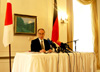
Speaking at a press conference at the Japanese Embassy in Berlin, Ambassador Shinyo described the disaster as one of the worst to affect a country in recent history. “It has never happened in the history of any modern nation to be struck by an earthquake, a tsunami and a nuclear accident at the same time,” he observed.
He said over 150,000 people have been evacuated from their homes to safer places and announced that the authorities in Japan are continuously monitoring the situation. The Japanese government, he said, inspects radiation dosages every day and prohibits the distribution and consumption of food that fails to meet stringent criteria.
The March earthquake and tsunami killed over 20,000 people and the estimated financial cost stands at $300 billion, making it the world’s most expensive disaster.
Officials in Japan have warned that the damage caused by the disaster was likely to be worse than first thought as power shortages would cut factory output and disrupt supply chains.
One month on, the people of Japan are looking ahead into the future focusing on trying to build a new Japan in the aftermath of the disaster, said the ambassador.
As a result of the disaster, the life style of the capital city, Tokyo has had a dramatic change as a result of the irregular supply of electricity, he said.
He stressed that one of the building blocks of Japanese assistance to least developed countries, namely people to people assistance, the so-called human security, may now have to be applied internally to assist its own people cope with the disaster.
Ambassador Sinyo described Germany as a true friend adding that relations between the two countries, which span a cenury and a half had always been cordial. He announced that despite the catastrophe that has hit Japan, plans to commemorate the 150th anniversary of relations between the two countries would go ahead.
Meanwhile, the Japanese authorities have raised the severity of the incident from level 5 to 7 – the same as the Chernobyl disaster in Ukraine in 1986. Hidehiko Nishiyama, a deputy director-general of the Nuclear and Industrial Safety Agency (NISA), said the decision was based on cumulative quantities of radiation released.
The measure became necessary after new data showed that more radiation leaked from its earthquake crippled power plant in the early days of the crisis than first thought.
“The situation at the Fukushima Daiichi plant is slowly stabilising, step by step, and the emission of radioactive substance is on a declining trend,” Prime Minister Naoto Kan told a press briefing Tuesday.
No radiation-linked deaths have been reported since the earthquake struck, and only 21 plant workers have been affected by minor radiation sickness, according to Chief Cabinet Secretary Yukio Edano.
Nuclear experts believe rising the level to 7 does not mean the situation was worse today than it was yesterday, it means the event as a whole was worse than previously thought.
A level 7 incident means a major release of radiation with a widespread health and environmental impact, while a level 5 is a limited release of radioactive material, with several deaths, according to the International Atomic Energy Agency (IAEA).
By Mellisa Sheridan, ANA Diplomatic Correspondent, Berlin