
- Says President Frank-Walter Steinmeier
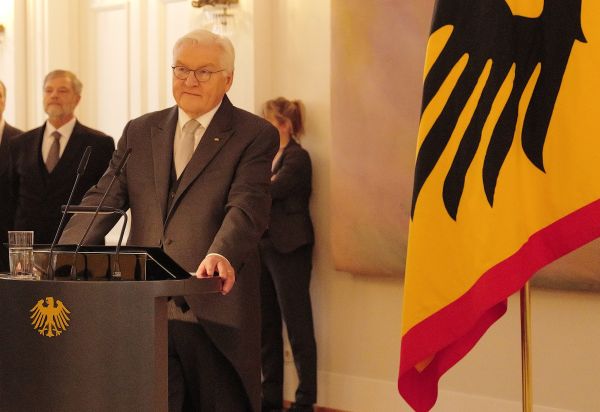
President Frank-Walter Steinmeier addresses the Members of the Diplomatic Corps at Palace Bellevue in Berlin/Photo Credit: AfricaNewsAnalysis/AM
Berlin, 13 January 2026
Germany’ Federal President, Frank-Walter Steinmeier has emphasized Germany’s commitment to fairness, reliability and close cooperation in its dealings with other countries.
Speaking at the New Year reception for members of the diplomatic corps, President Steinmeier said: “We invite everyone who is interested in this kind of cooperation.”
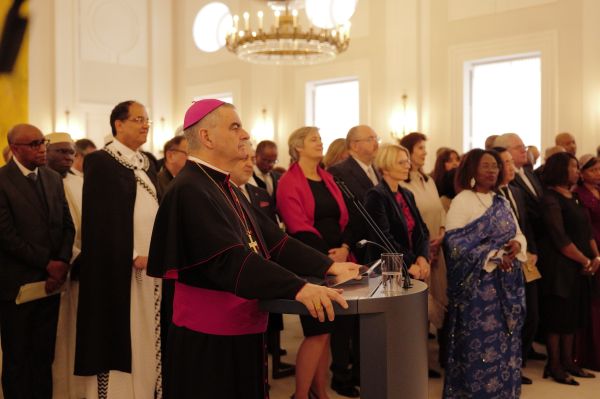
Photo Credit: AfricaNewsAnalysis/AM
He observed that the year 2025 was marked by the commemoration of the end of World War II 80 years ago and Germany also celebrated the 75th anniversary of the Basic Law (Constitution).
Germany, says Steinmeier, acting in concert with its European partners have made it clear that the sovereignty and territorial integrity of all states in the international community were not only principles of the UN Charter, but also, incidentally of NATO.
“They remain our compass in foreign policy,” adding that “Ukraine can continue to rely on our support.
“And therefore, security interests in the Arctic, however justified they may be, are no justification for questioning the borders of the Kingdom of Denmark.”
President Steinmeier urged the assembled diplomats to “stand together against the growing trend of national egoism. Let us not be paralyzed by fear, especially now. Let us seek out like-minded partners! Let us focus on long-term strategies:”
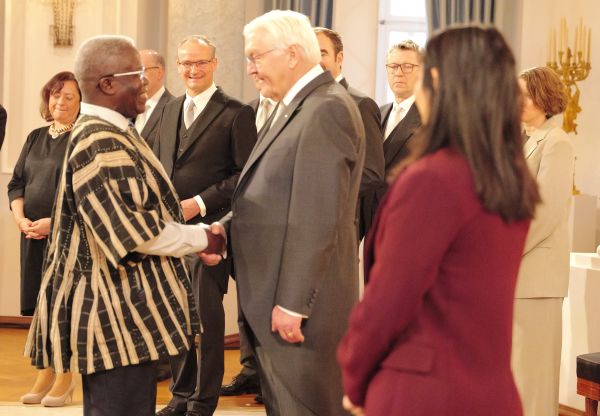
President Frank-Walter Steinmeier welcomes the Ambassador of Ghana, Prof. Ohene Adjei, at Palace Bellevue in Berlin/Photo Credit: AfricaNewsAnalysis/AM
Germany he adds, was committed to “making you, our partner countries around the world a different offer – we are committed to fairness, predictability, reliability, trust, and cooperation. Or, in other words: We are committed to a policy of future partnerships. By not seeking the lowest common denominator, but rather the greatest possible scope for shared development. And we invite everyone interested in this kind of collaboration.”
President Steinmeier stressed that “We are aware of differences, differing interests, and the various paths we take. But we also know that we need each other – not just to react, but to actively shape the future. Many of the global challenges we face cannot be solved by a single country alone. I’m thinking of security policy issues, climate change, and migration.
“Economic issues such as resilient supply chains and technological standards are also part of this. All of this demands cooperation; not perfect agreement, but sustainable solutions that can only emerge through collaboration. It’s not about dividing the world into friend and foe. It’s about remaining capable of action – and doing so together as much as possible.”
He observed that “Germany’s role in the world has also changed; expectations of us have noticeably increased. We are ready to assume responsibility – in Europe and beyond. Together with our European partners, we are working on sustainable long-term solutions: in the international efforts for peace in Ukraine – you recently followed the talks in Berlin – or in other pressing issues concerning the restructuring of the Middle East, and especially the efforts toward the necessary reconstruction in Gaza.”
The German President solicited the support of the assembled diplomats for German candidacy for a non-permanent seat on the UN Security Council for the years 2027 and 2028.
“And because international law is under pressure, we want to advocate for diplomacy and take responsibility,” adding that Germany was prepared to use its candidacy as a voice for cooperation instead of confrontation, for multilateral institutions instead of national power politics.
The Apostolic Nuncio and Doyen of the Diplomatic Corps, Archbishop Dr Nikola Eterovic, noted in his speech that at the start of 2026, “humanity continues to long for peace,” adding that, “Unfortunately, the situation in the world is very grave and in many ways alarming.”
The Doyen stressed that when “we speak about wars, terrorism and violence, then we must also think about their painful and tragic impact,” adding, “in addition to causing hundreds of thousands of fatalities and immense damage to property, wars also lead to mass migration.”
He urged the international community to see the situation in the world today as a challenge for all people of good will.