
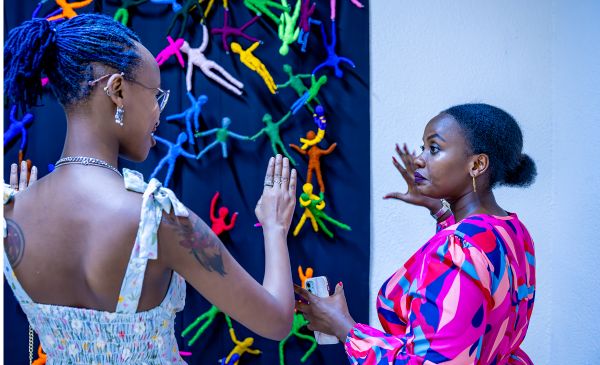
Jemima Kakizi, a Rwandan curator and visual artist, discussing with a guest in front of an installation artwork featuring colorful sculpted figures set against a dark background, during The Testimony of Now exhibition in Kigali, Rwanda, in December 2025. Photo : Alice Kayibanda, bird Story Agency.
Artist and curator Jemima Kakizi is bringing energy and international connections to Rwanda’s burgeoning contemporary arts scene – and her impact is effectively rewriting the country’s arts narrative and opening the way to improved opportunities for artists in the country.
by Alice Kayibanda, bird story agency
The drill-like sounds of a tufting gun cut through the quiet of a hilltop neighbourhood on a sunny morning in Kigali, Rwanda. With focused precision, Ethiopian artist Tsega Zewde Rago guides the handheld machine, punching multicoloured yarn through a taut canvas.
Rago is a graduate of the prestigious Alle School of Fine Arts and Design at Addis Ababa University. When her family moved to Kigali about two years ago, she sought a creative shift and taught herself to tuft using online videos.
She had been an active member of the art community in Addis and was eager to collaborate with artists in her new home. After several futile attempts to connect, she was introduced to Jemima Kakizi. Kakizi is a visual artist and the founder of the Impundu Arts platform.
“I met Jemima when I first moved to Kigali. I didn’t really know any other artists; I wasn’t familiar with the galleries or how exhibitions were put together in this country. And that is how we met. She brought five East African women together to organise a joint exhibition. After that, I essentially became part of the local art scene,” she said.
Jemima Kakizi’s keeps a very close eye on that scene. She can often be found checking out the latest showings in Kigali’s growing number of art centres. One of her favourites is the Niyo Art Gallery, loved by art enthusiasts and digital nomads alike.
Like elsewhere in Africa, Rwanda’s contemporary arts sector is increasingly finding its own rhythm. Artnet Intelligence Report (2024) shows the African contemporary art market has grown by 46% over the last decade, according to ArtTactic, highlighting the fast pace of growth, even in the face of obstacles like the Covid pandemic.
Women are now at the centre of a value shift affecting art. According to the Museum of Modern African Art (MoMAA) 2026 African & Diaspora Art Market Outlook, female artists command more than 52% of total auction turnover, effectively dismantling long-standing barriers.
Kakizi is working to bring that same momentum to Rwanda. The National Institute of Statistics of Rwanda (NISR) Labour Force Survey (2024) found that women still hold only 31% of formal employment in the arts and recreation sector.
“It all started because it was also hard for me to get opportunities as a woman artist and make a living, you know, from my art. I thought that coming together would, give us more visibility and also, when I started doing art, I think I knew, like, three women who were practicing, which is, like, a very small number. I always asked myself, where are the women artists?” she explained.
That isolation caused her to take action. Kakizi went looking for fellow women artists – many who hadn’t imagined their work could live outside their own homes. Through her platform, she bridges that gap, connecting emerging voices with the buyers and collaborators they need to thrive. Her mentorship sessions provide the practical tools – like pricing and portfolio building – that are rarely accessible to those outside traditional circles. For women balancing family life with creative ambition, this support is often what turns a personal passion into a sustainable career.
This vision took center stage in “The Testimony of Now,” an exhibition Kakizi curated at Kigali’s SimpleLiving Art Gallery in December 2025. The concept, born during a residency in Egypt, explores how to pin down the fleeting moments of modern life before they slip away. She reunited with East African artists like Tsega Zewde Rago, who contributed conceptual pieces that grappled with the question: “How do we archive the present before it disappears?”
“…to be able to find a space that is actually centring women and looking into their experiences, I think, is something that is quite precious and needs to not only happen more often but actually needs to be encouraged a lot. Because I don’t think we see that quite often. More often than not, it’s like one artist, one woman artist, and then, like, seven men. And to be able to have a space that has, like, more than, like, five or six women, I’m just—I’m elated to see that,” said Mucyo, a young artist that Kakizi was showing around the exhibition..
Her influence is recognized by peers like Ademola Adeshina, a Nigerian curator who established Kigali’s SimpleLiving Art Gallery in May 2025. He describes her as a “force to be reckoned with,” particularly for her “boots-on-the-ground” advocacy, such as navigating the logistics for an artist living upcountry to ensure her work reached the capital for the December exhibition.
Recent studies by the Rwanda Development Board (RDB) and the Ministry of Youth and Arts suggest the country’s creatives contribute between 2% and 3% to the economy. The government’s target is 5% by 2030.
Kakizi says that achieving that goal requires moving from the typical wildlife drawings toward conceptual work that incorporates contemporary culture and attracts local collectors.
And to further that cause, she writes and contributes to the discourse on Rwandan and African art development through op-eds and interviews in pan-African art publications.
“When I see that artists are able to make a living from their art, that’s the first one. The second would be to see more art spaces in Kigali and Rwandans being part of it. Because now things are changing and I’m very happy to see that Rwandans are buying even artworks, they are collecting. They are not many, but it’s something that has started, which wasn’t there when I started doing art.”
By highlighting the art of established and emerging womem, Kakizi is helping to reframe the conversation about Africa’s art industry and ensure that those who create earn the accolades and revenues they deserve..
bird story agency