
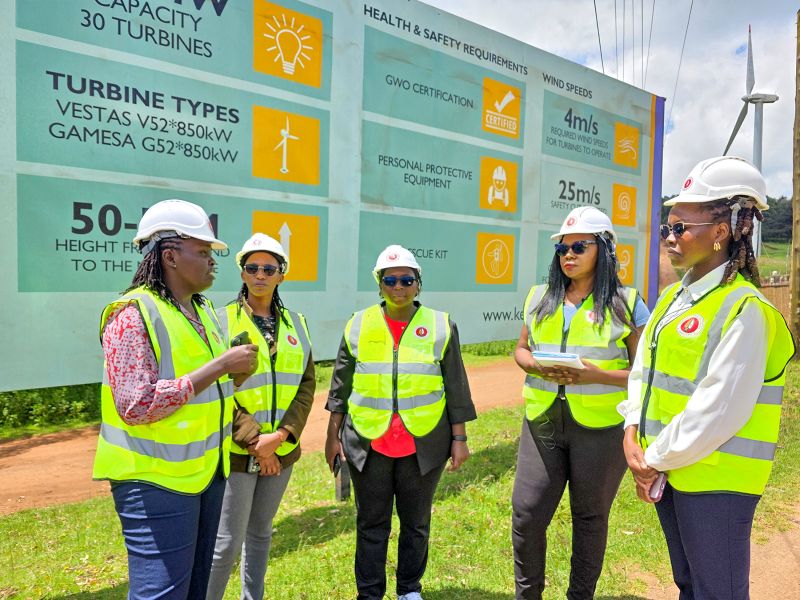
From left: Eng. Maureen Odhiambo, Eng. Charity Tembesi, Dr. Eng. Damaris Oyaro, Eng. Jennifer Gache, and Eng. Linda Lichuma talking to each other at Ngong Wind Farm on April 7, 2026. Photo: Moraa Obiria, bird story agency
Jennifer Gache has built a career at the center of the country’s evolving energy sector, helping pioneer wind energy projects while mentoring a new generation of women engineers.
Moraa Obiria, bird story agency
26 May 2026
By the time the morning sunlight stretches across the grass beneath the wind turbine on the northern edge of the Ngong Hills, Kenya Electricity Generating Company (KenGen) has already been counting hours of generation of clean energy.
“Standing on this point and seeing this wind turbine generating clean energy for the country… I feel that this is an example that all the countries need to emulate,” said Jennifer Gache, an engineer behind the turning blades and the quiet triumph of Kenya’s early wind energy ambitions.
When she graduated from Jomo Kenyatta University of Agriculture and Technology in 1995 with a degree in mechanical engineering, women in engineering spaces were still rare. Entering the profession then felt like lighting a candle against a storm, she explained. Years later, figures from the Engineers Board of Kenya show just how steep that climb was.
2024 data from the Engineers Board of Kenya (EBK) shows that in Kenya’s engineering sector, women remain significantly underrepresented, accounting for only 11 per cent of registered professional engineers, while female enrolment in STEM courses at universities stands at just 22 per cent. This highlights the persistent gender gap within the country’s technical and leadership pipeline.
KenGen’s Ngong Wind Farm began with two wind turbines commissioned in 1993 as a donation from the Belgian government. Before that, KenGen had spent 14 years studying the area’s favourable wind regime through experimental turbines installed on the hills in the early 1990s. The two original turbines have long since been retired and a row of huge turbines now stands like sentinels along the ridgeline of the Ngong Hills. And Gache has carved a place for herself in an arena where few women stood before her.
“You have to come and start everything from scratch,” Gache recalled of a time early on in Kenya’s wind projects when she would have to visit remote greenfield sites, vast stretches of land with little infrastructure and few signs that such ambitious projects could succeed.
At a time when Kenya was still heavily reliant on conventional energy sources, Gache found herself among a few engineers pushing Kenyan institutions to take wind power seriously.
“I was able to tell my story and indicate that wind power was a feasible energy source,” she said.
Gache later went to Malmö, Sweden, to train in wind power technology and wind modeling, an experience that deepened her belief in renewable energy at a time when the sector was still regarded as experimental in Kenya.
“When I came back with that knowledge, I was empowered to convince the organisation that we needed to balance our energy using both renewable and non-renewable sources,” she said.
She worked as chief energy planner, overseeing supply and demand forecasts for Kenya and the wider region, conceptualizing the capital pipeline, and driving strategic planning. It was during this period that she helped lay the foundation for Kenya’s wind energy sector.
“I kicked off the installation of the 5.1MW wind farm at Ngong Hills, helping establish the wind sector in the region,” she said.
Today, when she stands beneath the turbines at Ngong, the achievement still feels personal.
“When you come and see a project that you initiated has taken ground and is working, and people are looking at it as an example, you get so much joy,” she said. “It was very fulfilling work.”
For materials engineer and entrepreneur Nzambi Matee, the experiences of women engineers reflected both progress and persistence.
“The first fundamental step is investing more in development spaces for women engineers,” Nzambi said. “Sometimes you just can’t wait for that space to be given to you,” she said. “Sometimes you have to take it.”
She recalled having to work significantly harder than male colleagues early in her career to be taken seriously.
Gache then worked with the Ministry of Energy to establish a national wind energy map.
Her footprints stretched beyond Ngong. In Bubisa in Marsabit and Loiyangalani in Turkana, she developed technical specifications for 50-metre-high wind masts distributed across 12 sites.
The work often took her into isolated terrain few engineers wanted to navigate. She recalled volunteering for difficult assignments, including traveling to Loiyangalani to scout wind sites in Kenya’s north.
“I’m a trailblazer,” she said with a laugh. “I have a very strong pioneer spirit. I like very tough assignments. I’m resilient, resourceful, and adaptable, and I get along with people very easily. That made it easier to initiate new things and convince people to give new ideas a chance.”
Today, KenGen reports about 26 MW of installed wind energy capacity at Ngong, accounting for roughly two per cent of its total installed capacity.
But for Gache, successful engineering was never just about the number of megawatts. While introducing the wind projects to local communities, she often reminded residents that development did not have to displace livelihoods.
“We told the community they could still graze their cattle here,” she said. “We are generating power, but the community is still able to continue with their activities. That is what good project management is.”
Gache did not stop at wind energy. She moved into another complex and highly technical space: nuclear energy.
In 2009, she coordinated a regional meeting aimed at increasing awareness among decision-makers on the requirements and challenges of developing a nuclear power program. Her work also focused on building technical capacity and helping institutions understand the infrastructure needed for nuclear energy development.
“My efforts led to the establishment of NUPEA (Nuclear Power and Energy Agency), and the conversation on nuclear energy is now well established in the country,” she said.
Away from policy rooms and energy planning meetings, Gache steadily became a mentor to younger women engineers navigating spaces that still often questioned their presence. She encouraged young women engineers to continuously build their skills and seek opportunities in difficult projects rather than shrinking from them.
“It’s a challenging profession,” she said. “But that does not mean women cannot succeed.”
In 2022, she was elected as a council member of the Institution of Engineers of Kenya (IEK), later serving as chairperson of the Women Engineers Committee from 2024 to 2025.
Among the initiatives she championed was the first-ever Women Engineers Committee Summit. She also organised mentorship forums, webinars on job hunting and contract skills and networking walks that created spaces for young women engineers to connect and learn.
One of the young engineers shaped by that mentorship was Linda Lichuma, a graduate civil engineer and intern at the Kenya National Highways Authority (KeNHA).
Fresh from graduating from the University of Nairobi in September 2024, Lichuma found herself adjusting to the realities of engineering practice while working on a 200-kilometre road project.
“Nothing really fully prepares you for how difficult it is going to be,” she said. “But what sustains you is passion and the belief that you belong in STEM.”
Through Gache’s mentorship and the Women Engineers Committee, Lichuma gained access to spaces where engineers and industry professionals made decisions and shaped projects.
“That opportunity showed me that young people need to be brought into rooms where decisions are made,” she said.
Today, Gache works as an East African Community regional consultant for GFA Consulting Group and as a consultant for Physikalisch-Technische Bundesanstalt, the German National Metrology Institute.
Her work now focuses on strengthening regional value chains and improving industrial standards.
Gache now hopes to push even further. She plans to vie for the position of treasurer of the Institution of Engineers of Kenya in the next elections, with her sights eventually set on the presidency, a position no woman has ever held within the institution.
“In all this, my goal is to inspire a generation of engineers, especially women, to see no limits to what they can achieve,” she said, “while leaving behind structures that make it easier for them to succeed.”
bird story agency