
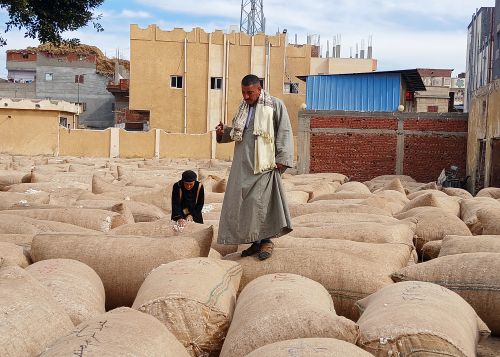
Supervisors and workers at a cotton collection point in Damanhour district. Photo: Mahmoud Doweir, bird story agency
From the first grade assigned at a collection centre to the lot number carried through to a finished textile, Egypt keeps a record of its cotton. Those records help determine what farmers are paid, tell mills what yarn they can make and give overseas buyers a way to check the quality and origin of the cotton they receive.
By Mahmoud Doweir, bird story agency
27 November 2026
When a shipment of cotton arrives at an Egyptian gin, where machines separate the fibres from the seeds, it comes with paperwork that one gin worker calls its “birth certificate”. The documents show where the cotton was graded and what inspectors found. Before ginning begins, staff use them to check that the cotton in the storage yard is the same cotton examined at the collection centre.
The check is part of a system that protects a crop long associated with Egypt’s agricultural and industrial reputation. Egypt planted 201,000 feddans (about 84,400 hectares) of cotton in 2026, up from 195,000 feddans (about 81,900 hectares) in 2025, according to Ministry of Agriculture figures.
Two organisations use the records at different points in the chain. The Cotton Arbitration and Testing General Organization (CATGO), established in 1965 to prevent the mixing of cotton varieties, oversees grading, testing and arbitration. It issues technical certificates that buyers and sellers use to assess the cotton they trade. Further along the chain, the Cotton Egypt Association uses CATGO’s records to verify the origin of cotton in finished products and licenses the use of the Egyptian Cotton mark.
The grade that helps set the farmer’s price
“The authority takes samples of cotton at collection centres, grades them and tests them before the cotton moves on to gins, spinning mills or export markets,” said a CATGO source who asked to remain anonymous.
Cotton farmer and trader Haj Yousry El-Hassouni describes arbitration as “the backbone of the cotton trade”.
“Traders rely on the arbitration certificate, alongside test results for weight, moisture and quality, to buy and sell cotton in Egypt and abroad,” he said.
“Grading and moisture tests help farmers get a fair price and allow traders to check that the cotton they bought meets the agreed specifications,” El-Hassouni said. “Farmers and traders can request tests and certificates throughout the year.”
Moisture matters because it affects the weight on which a sale is calculated. The International Cotton Association uses a benchmark of 8.5% for moisture regain, the weight of water in a sample expressed as a percentage of the cotton’s fully dry weight. A reading above or below that benchmark can affect how much the buyer pays. Laboratories use high-volume instruments, known as HVI, to measure fibre properties such as staple length, strength and how uniform the fibres are in length.
“By the end of June 2026, 3,246 lots comprising 284,377 bales had been subject to arbitration, expert assessment or appeal. The authority also carried out moisture regain tests on 3,408 lots and moisture tests on 30,366 samples,” the CATGO source said.
For a grade to be useful to buyers and sellers, graders at different sites need a common reference. El-Hassouni has hosted delegations at his farm and cotton collection centres that CATGO brought to Egypt to train in grading and testing.
“Grading teams work out of offices and workstations at gins, while laboratories test fibre properties and check for impurities and contamination,” said Atteya Mohamed Saeed, former head of CATGO’s Experts and Standards Sector. “The authority prepares reference samples for different varieties and grades, and its training centre in Smouha, Alexandria, works with the Cotton Research Institute to train graders and standardise assessments.”
How the gin keeps track of each shipment
After cotton is sold at auction, the gin assigns each shipment a separate space in its storage yard, known as a shouna. This is where CATGO and agricultural officials check the shipment against the collection centre records. If they find a discrepancy, representatives from the agricultural authorities, the gin and CATGO investigate. Once the checks are completed, the gin keeps each company’s cotton separate until ginning begins, the gin source said.
After the machines separate the fibres from the seeds, the fibres are packed into bales for spinning mills or export. CATGO issues an identification tag for each bale showing the lot number, grade, gin details and quality test results. An importer can send a sample from the shipment to a specialist laboratory and compare its findings with the certificate.
“Private cotton companies supply domestic spinning mills with the quantities and grades they need, and some of these companies have their own testing equipment and laboratories,” said Ayman Ghazal, who manages cotton marketing in Beheira governorate.
“The arbitration certificate and fibre test results allow the mill or overseas buyer to check that the cotton they receive meets the quality they agreed on,” Ghazal added.
What the grade tells a spinning mill
At Misr Spinning and Weaving Company in Kafr El-Dawar, workers open the compressed bales and divide the cotton into smaller batches. Depending on the yarn they plan to make, they can blend cotton from grades that meet the mill’s specifications or process each grade separately. The fibres are then carded into loose strands called slivers. Workers draw several slivers together to make a more uniform strand for spinning.
“The grade assigned before ginning helps determine the price the farmer receives, while the final grade tells the mill what kind of yarn it can make from each bale,” said Essam El-Deeb, who heads the company’s spinning division.
The link between fibre properties and yarn quality also guides researchers.
“Researchers develop and evaluate cotton varieties, identify the best places to grow them and test the fibres after ginning,” said Nabil Fereig, a professor of crop science at the Agricultural Research Center in Cairo. “Alongside strength and uniformity, they measure micronaire, which indicates fibre fineness and maturity. The Cotton Research Institute works to preserve the genetic purity of Egyptian varieties and develop varieties that mature earlier and use less water.”
“Matching fibre specifications to the needs of spinning mills can help bring processing losses down to between 4% and 6% in benchmark cases,” Fereig said. “Documenting quality and traceability can strengthen exporters’ position when negotiating prices for fine yarns and luxury textiles.”
From the bale to the Egyptian Cotton mark
Once the cotton has been spun into yarn, the lot number on the bale tag gives the Cotton Egypt Association a way to trace its origin. The association assigns codes at successive stages, from spinning, weaving and dyeing to cutting and packing, so an order of finished goods can be traced back to a certified lot.
The association licenses manufacturers, exporters, brands, importers and distributors to use the Egyptian Cotton mark. It uses scheduled and unannounced audits, DNA testing and quarterly checks on volumes to verify that finished products contain certified Egyptian cotton and that it has not been blended with foreign cotton. Buyers and others can verify a licence, check whether it has been suspended and report misuse of the mark.
For a buyer checking the origin of a finished textile, the trail leads back to the same lot number that identified the cotton when it left the gin.
bird story agency
Leave a Reply