
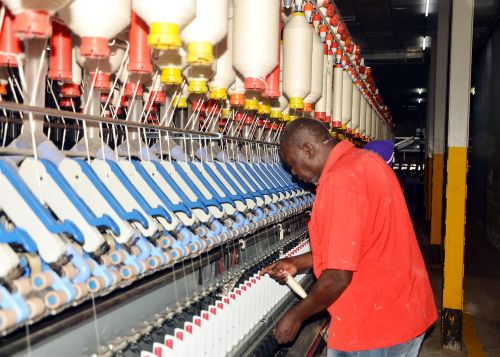
Emanuel Mwanje, a machine operator at Southern Range Nyanza textile factory, operating a cotton yarn machine, in Jinja on August 10, 2026. Photo: John Ricks Kayizzi, bird story agency
African governments are stepping up investment plans, factory projects and partnerships to move the continent’s cotton industry into textile and garment manufacturing. From Ghana and Mali to Egypt, new initiatives are seeking to attract capital, create jobs and retain more value from Africa’s cotton within the continent.
Bonface Orucho, bird story agency
26 November 2026
African governments are putting new capital plans, factory projects and investor partnerships behind efforts to move from raw cotton exports into textile and garment manufacturing.
These efforts could expand manufacturing employment while allowing cotton-producing countries to retain more value from a crop they have traditionally exported largely in raw form.
According to World Trade Organization (WTO) Director-General Ngozi Okonjo-Iweala, the biggest challenge facing the continent’s textile sector is not only a shortage of capital.
“It is that capital and investible projects are not finding each other,” she said.
Okonjo-Iweala was speaking in October on the margins of the Global Aid for Trade Review, where the Cotton Partnership (Partenariat pour le Coton, PPC) launched an Investment Promotion Drive to help African cotton-producing countries move beyond exporting raw fibre and capture more value through textile and garment manufacturing.
That challenge is now being met with a mix of government investment plans, new state-backed manufacturing initiatives and efforts to attract private investors.
Ghana is proposing a US$1 billion investment in textiles and garments between 2027 and 2030 as part of its wider New Economy Programme.
The 2027 budget says the initiative will modernise existing mills, expand garment factories and establish industrial enclaves equipped with power, water, treatment facilities, laboratories and warehouses.
The government has engaged a transaction adviser for three proposed garment factories in the Bono East, Central and Eastern regions, in partnership with the private sector.
The facilities are expected to create about 27,000 direct jobs, with land secured and feasibility studies ongoing, according to the budget.
It is also seeking strategic investors for Akosombo Industrial Company and Volta Star Textiles, among other state-linked enterprises.
The programme received a new employment target on November 24, when Trade Minister Elizabeth Ofosu-Adjare announced plans to establish garment factories in four regions.
“Under the approved sector policy, my ministry is driving the establishment of garment factories projected to create 80,000 direct jobs, most of them for young people and women,” she said.
She cited garment manufacturer North Shore as an example, saying its operations had generated significant employment within two months.
The difference between the budget’s three factories and 27,000 projected jobs and the minister’s four-region, 80,000-job announcement remains unclear. Her latest statement did not identify the additional region, explain whether the figures cover different projects or provide a financing and construction timetable.
Ghana’s plan also includes a potential demand-side intervention. The government intends to amend public procurement laws so that uniforms, hospital textiles, bedding and protective clothing bought with public funds are sourced from Ghanaian manufacturers.
Mali, meanwhile, is pursuing a more direct state-led approach, placing the development of textile manufacturing under a new state-owned company.
On November 20, the country’s National Transitional Council approved legislation creating the Société des Textiles du Mali (STM-SA), a state-owned company intended to process and commercialise cotton and develop textile manufacturing.
The company is to be based in Bamako’s airport zone and will also be tasked with helping revive the existing Compagnie malienne des textiles, or COMATEX-SA.
The government has proposed a cotton-processing plant with an annual capacity of 40,000 tonnes, covering spinning, weaving, knitting, dyeing and garment production.
Mali is one of West Africa’s largest cotton producers, producing approximately 656,000 tonnes a year, yet 98% of its crop is exported as raw fibre, according to government records.
However, the company’s initial share capital of CFA100 million (about US$175,000) should not be confused with the cost of building and equipping the proposed plant. The government has yet to publicly establish the full financing package, construction schedule or expected commissioning date.
Benin offers an example of how such industrialisation efforts can translate into manufacturing output. The country’s Glo-Djigbé Industrial Zone (GDIZ), established through a public-private partnership with infrastructure developer ARISE IIP, processes approximately 40,000 tonnes of cotton annually into between 7 million and 10 million garments.
The facility supplies international brands, including US Polo Assn. and Kiabi, marking a shift from Benin’s previous dependence on exporting raw cotton for processing abroad.
According to Letondji Beheton, managing director of the company operating GDIZ, “Today at GDIZ, we transform 40,000 tonnes of cotton a year and produce between seven and 10 million garments a year.”
Uganda is also expanding its domestic textile-processing capacity through private-sector investment. Fine Spinners Uganda announced a further US$5 million investment in textile machinery in September, bringing its total machinery investment at its Kampala mill to US$35 million.
The new equipment is expected to increase mill capacity by 30 to 40%, adding between 30 and 40 tonnes of yarn and 150,000 to 200,000 garments monthly once fully commissioned.
Fine Spinners chairman Jaswinder Bedi said the investment demonstrated the company’s “confidence in the future of textile manufacturing in Africa” and its commitment to expanding local manufacturing.
Beyond individual national initiatives, the wider Cotton Partnership is seeking to address the financing and investment challenges facing cotton-producing countries across Benin, Burkina Faso, Chad, Mali and Côte d’Ivoire.
A UNIDO-ITC assessment identified US$12 billion in potential investment over ten years, including US$5 billion from private investors. The figures represent an investment pipeline, not capital already committed.
The financing challenge is also drawing interest from international investors, although not all emerging funding initiatives are exclusively focused on Africa.
On November 19, the International Finance Corporation and Social Investment Managers & Advisors launched a fund targeting US$400 million to finance textile, apparel and footwear suppliers in emerging markets.
IFC and fashion group Inditex are contributing US$60 million and US$50 million respectively, while the fund’s first close is expected to reach US$225 million.
The fund will support manufacturers investing in efficient machinery, renewable energy, water reuse and cleaner production. Its target regions include North Africa, the Middle East, Asia and Latin America, potentially opening another financing avenue for African manufacturers seeking to modernise.
Egypt provides a more established example of how foreign investment can support the expansion of African textile and garment manufacturing.
Around 200 Turkish-owned factories operate in the country’s garment, textile and related chemical industries. Their exports reached US$693 million in 2025, up from US$569 million in 2024.
The expansion continued in 2026, with exports rising to US$606 million in January–September, compared with US$498 million during the same period in 2025, according to the Apparel Export Council of Egypt.
Turkish companies consequently increased their share of Egypt’s total apparel exports from 20% to 21%.
Morocco is also attracting large-scale foreign investment into integrated textile manufacturing. In December 2025, construction work began on the EUWEN TEXTILES project, a subsidiary of China’s Sunrise Group, involving an investment of 2.3 billion dirhams (about US$230 million) across industrial facilities in Fez and Skhirat.
The project covers spinning, knitting, weaving and garment manufacturing, with its first phase expected to create more than 2,000 direct jobs, according to Morocco’s investment ministry.
The potential economic benefits extend beyond the textile industry. A 2026 forecast by the Institute for Security Studies’ African Futures and Innovation Programme projects that combining increased external financing with stronger domestic investment capacity could raise Africa’s GDP by US$210 billion above its current trajectory by 2043, compared with US$63.7 billion from increased external inflows alone.
bird story agency
Leave a Reply