
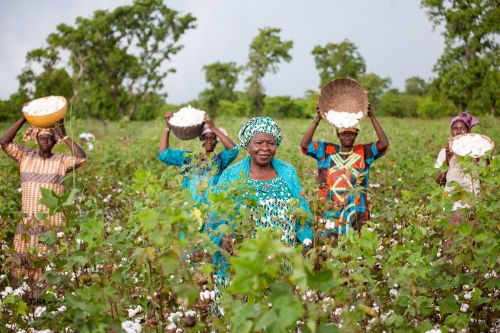
Photo Credit: Better Cotton Seun Adatsi
Africa’s cotton-producing countries are attracting Turkish textile manufacturers seeking cheaper production bases and more reliable access to raw materials as costs and supply constraints squeeze Türkiye’s domestic industry.
By Bonface Orucho, bird story agency
27 November 2026
Türkiye’s textile manufacturers are increasingly looking to Africa, bringing spinning, weaving and garment production closer to some of the world’s major cotton-producing regions.
The movement is creating opportunities for African countries seeking to capture more value from their agricultural exports, while giving Turkish companies access to raw materials, production capacity and growing regional markets.
The shift is being driven partly by pressures inside Türkiye.
The country remains one of the world’s major textile and apparel exporters, with combined exports worth about US$26 billion in 2025. But its domestic cotton production is falling short of the needs of its manufacturing industry.
The supply pressure is reflected in Türkiye’s cotton balance. According to a September 2026 report by the US Department of Agriculture’s Foreign Agricultural Service (USDA FAS), the country’s cotton production is forecast to fall to 495,000 metric tonnes in the 2026/27 marketing year, against projected domestic mill consumption of 1.5 million tonnes.
At the same time, inflation, energy prices and currency volatility are increasing the cost of manufacturing at home.
The pressure on Türkiye’s textile industry is also visible in business closures. Between December 2024 and March 2025, 2,147 textile and apparel companies shut down, including 1,903 garment manufacturers and 244 textile firms.
The contraction continued into 2026, with a further 818 companies closing by August, 707 of them in the ready-made clothing sector.
For manufacturers facing these pressures, relocating production is becoming a way to remain competitive and Africa’s cotton producing countries are increasingly becoming a favorable option.
Africa offers something more than lower production costs. It has an established cotton-growing base, expanding industrial zones and preferential access to international markets through trade arrangements.
The opportunity is particularly visible in West Africa, where countries such as Benin, Burkina Faso, Mali and Chad have traditionally exported much of their cotton as raw fibre.
Benin is now attempting to change that relationship.
Its Glo-Djigbé Industrial Zone has become one of the continent’s most ambitious attempts to build an integrated textile industry, processing cotton into yarn, fabric and finished garments.
The industrial zone’s three textile mills have a combined annual processing capacity of 40,000 tonnes of cotton fibre. The facilities are part of a longer-term ambition to process all of Benin’s cotton domestically rather than exporting most of it in raw form.
The investment model is also attracting Turkish manufacturers.
In Senegal, Turkish-backed AVCI Global Industrie inaugurated a US$10.45 million textile factory in Diamniadio in June 2026, following a partnership with the Ministry of Industry and Commerce.
The facility, which can produce about 1,200 garments a day and is expected to create nearly 200 jobs, is designed to strengthen local manufacturing and supply regional markets.
The investment comes as Senegal seeks to retain more value from its cotton. The USDA projects the country will produce nearly 12,500 tonnes of cotton fibre in 2026/27, but local processors are expected to handle just 3.6% of that output.
The factory offers a practical step towards closing that gap, turning more of the cotton grown in Senegal into finished products on the continent rather than exporting raw fibre and importing clothing.
North Africa is attracting a different scale of investment.
Egypt has become a major destination for Turkish textile companies, with approximately 200 Turkish-owned factories operating in the country.
Companies including Eroglu Garment and Yeşim Group have expanded their manufacturing presence, attracted by Egypt’s established textile industry, access to cotton and proximity to European markets.
Turkish-owned manufacturers are also becoming important contributors to Egypt’s garment exports, accounting for an estimated 21% of the sector’s ready-made garment exports.
The relationship is not limited to garment assembly.
Egypt is investing in the industrial infrastructure needed to process cotton at scale. Its state-led textile modernisation programme includes the redevelopment of Misr El-Mahalla’s Factory 1, equipped with more than 180,000 spindles.
The facility represents an effort to strengthen the spinning stage of production, which converts raw cotton into yarn and supplies the rest of the textile manufacturing chain.
Algeria provides another example of how Turkish investment is reshaping the continent’s textile production capacity.
The Tayal textile complex in Relizane, a US$1.5 billion Algerian-Turkish joint venture, spans approximately 250 hectares and employs around 10,000 workers.
Its integrated operations cover spinning, weaving, knitting, denim and garment production, making it one of Africa’s largest textile manufacturing investments.
Together, these developments point to different routes through which African countries are attempting to expand their textile industries.
West Africa is seeking to capture more value from locally grown cotton, while North Africa is using large industrial facilities and foreign investment to strengthen its position in international manufacturing.
East Africa is also attracting Turkish manufacturers as countries seek to strengthen domestic textile production and capture more value from their agricultural resources.
In Kenya, Turkish manufacturer Raff Military Textile identified the country as a strategic entry point into East Africa in March 2026.
The company, which specialises in military-grade fabrics and uniforms, said it was seeking partnerships with local firms rather than relying on conventional exports.
Its chief executive, Eray Yükseloğlu, said the company wanted to build “long-term cooperation” by working with local experts.
The proposed entry could open opportunities in specialised textile production, although the company has not announced a cotton-processing investment.
Tanzania is attracting interest more directly through its cotton industry.
In February 2026, Turkish textile manufacturers met representatives of the Tanzanian embassy at the headquarters of the Independent Industrialists and Businessmen’s Association (MÜSİAD) in Istanbul to explore investment opportunities in cotton processing and partnerships with local manufacturers.
The investors expressed interest in visiting Tanzania to assess the market and potential projects.
The expansion of Turkish textile manufacturers into Africa is taking place alongside a broader effort by Türkiye to deepen its economic and strategic presence across the continent.
Over the past two decades, Ankara has expanded its engagement beyond trade into construction, infrastructure, energy and defence, positioning Turkish companies and institutions as alternatives to more established external partners, including China, the United States and European powers.
Turkish contractors have undertaken projects worth more than US$97 billion across Africa, while the value of Türkiye’s direct investment on the continent has exceeded US$10 billion.
bird story agency
Leave a Reply