
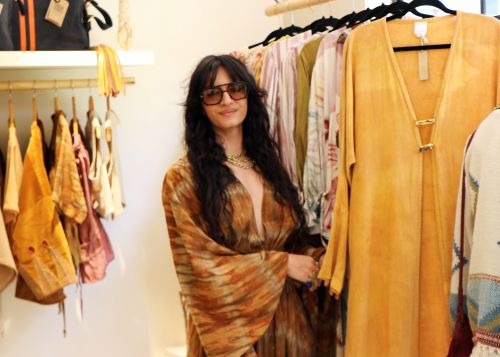
Ria Ana, Founder and Creative Director of Lila Bare, a regenerative, sustainable fashion brand in Kenya, at her shop in Nairobi, Kenya, on October 4, 2026. Photo: Mercy Chelangat, bird story agency
A dyer, a weaver and a tailor show how Kenyan designer Ria Ana Sejpal-Sullivan turns locally grown cotton into clothes for the Lagos runway. In Makueni, a farmers’ cooperative wants to take the next step in the same value chain by ginning its own cotton.
By Mercy Koech, bird story agency
26 November 2026
When LilaBare made its Lagos Fashion Week debut in 2023, its Kolam collection brought together handwoven cloth, plant dyes and prints inspired by the henna designs of Indian brides. The patterns were laser-engraved onto printing blocks in Kenya. The clothes were finished with detailed metalwork and beading.
The label returned in 2024 with beadwork, raffia and details drawn from heritage craft. At the 2025 edition, it showed warm earth tones, organic textures and cowrie shell accents. Behind those collections is a Kenyan network of farmers, spinners, weavers, dyers and tailors.
Ria Ana Sejpal-Sullivan, the label’s founder, says the name pairs the Sanskrit word lila, which she associates with creative play, with bare, meaning “raw, in its natural state”.
“Every single piece we make is a reflection and representation of a living, breathing network of makers,” says Sejpal-Sullivan.
Behind every LilaBare garment is a chain of farmers, weavers, dyers and tailors, and that chain is the country’s cotton-to-cloth story in miniature. Kenya grows cotton and has factories to process it, yet its mills run well below capacity, and its tailors lose customers to cheap imports.
Sejpal-Sullivan says she began working in fashion at 13. Her experience in Kenya’s export processing zone and with tailors and design houses in London left her wondering why a country with so many natural resources imported so much. She founded LilaBare after returning to Kenya.
“LilaBare is the embodiment of a philosophy. I wanted to build the system that I believe is the solution for Kenya, for us, to be able to make the best clothes and the best functional objects and make the most of our artisanal prowess and our cultural heritage,” says Sejpal-Sullivan.
As a child, Sejpal-Sullivan would take the outfits her mother bought her on trips to the family tailor and ask him to remake them.
“A few months after coming back and wearing these clothes on repeat, I would get tired of them, so I would take them to my tailor. And I would say, if we cut up this dress this way and reconfigure it this way, then we can make it into a top, a skirt, or whatever. My tailor would always complain to me: “Ria, why don’t you just bring me fabric?” And I’d say, “That is fabric,” she says.
Developing a textile for the label can take up to three years. Ria says one reason is that she works with locally grown, rain-fed cotton and has to contend with changing rainfall.
“We also do serious research and deep exploration of the source of design ideas until we find the literal root of it. I’m Indian-Kenyan, and so I go back to my Gujarati roots in terms of technique and practice and introduce those ideas to the Kenyan artisans that we work with so that we can create something new together,” says Sejpal-Sullivan.
One of those artisans is Harriet Musimbi, a dyer who works with both undyed cotton yarn and cloth that has already been woven. Depending on the colour Ria wants, Musimbi prepares a dye bath and leaves the yarn or cloth to soak.
“Sometimes we use leftover tea leaves and soak the fabric in them overnight and dry it in the morning to get a soft brown. Sometimes we use kale. We boil them in water for over an hour, then soak the whole garment or the threads in the solution for a night or two, then hang it to dry. We also use other natural products such as hibiscus,” says Musimbi.
“Threads take two to three days to dry, and then they go back to the weavers. What I love most about this production is that none of it is chemical. It’s safe for us, and it’s even better on our skin,” she said.
The weaver who receives the threads from Musimbi is Rose Mwathi, who started weaving as a hobby and never set out to build a business. She had just retired, did not want to be idle, and liked handwork. She spent about six months learning to weave and spin from an established weaver, bought a machine, and built a small workshop behind her house.
“My first product was a shawl. When I made one, I realised that every time I wore it, it kept falling off my shoulders. I decided to add buttons to hold it in place, and many women loved it and started placing orders. Soon, the orders overwhelmed me, and I had to employ one more person to help me meet the demand,” she says.
That was in 2003. Mwathi eventually moved into a larger workshop, where she now oversees 25 employees, including weavers, loom operators, assistants and office staff. Designers like Ria bring her a photograph or a piece of cloth, and her team works out how to weave the fabric they want.
“Hand-woven product is very special. People like it more than a machine-made product because it lasts long and because you are able to design what you want,” she says.
From the loom, the fabric goes to Thomas Ogada, a tailor in Nairobi’s Mathare North. Ogada learned to sew while training at the National Youth Service and has been making clothes for more than 20 years.
A friend introduced him to Sejpal-Sullivan about a decade ago. She wanted garments made to a high standard and delivered on time. Ogada asked her to let him try. They worked in her garage for two years before switching to an arrangement in which he is paid per piece. Sejpal-Sullivan calls him her master tailor.
“Handling cotton has rules. When cotton or linen, for example, is brought, you must first wash it so it becomes soft. You dry it where there is wind and a bit of shade, because if you dry it under the sun, it will stiffen. Once dry, you must iron it before you begin to sketch and cut. If you skip that step, a waist you measured at 32 comes out wrong once the cloth stretches or shrinks,” says Ogada.
At the growing end of Kenya’s cotton supply chain, George Muteti Ndavi farms in Mtito Andei, Makueni County, and chairs a cooperative with more than 500 members. His parents paid for his education with proceeds from cotton. He has used the crop to put his own children through school.
“This area does not get much rainfall, but cotton just needs a little rain to germinate, and it does not wither,” says Ndavi.
Ndavi says he switched from open-pollinated varieties to genetically modified Bt cotton around 2019. He says his harvest rose from at most 350 kilogrammes per acre with ART 89 to as much as 1,200 kilogrammes per acre with Bt cotton. A buyer who collects cotton monthly during the harvest helps make his income more predictable.
“You agree with a buyer who comes every month to buy, and it feels like having a salaried job where you are paid every month. When we start harvesting in the fourth month, we harvest all the way to the eleventh month,” says Ndavi.
The cooperative sells its cotton before it is ginned. Ndavi says it is in talks with a partner to separate the fibre from the seed itself, process the fibre, press the seeds for oil and use what remains as feed for cattle and chickens.
The Kenya Industrial Research and Development Institute builds small-scale ginning machines for cooperatives. Dr Ann Mburu, who heads its textile and leather division, says large ginneries are operating below 40 percent of capacity because they receive too little cotton. Small weaving businesses face a different bottleneck. They struggle to buy yarn in the quantities they need because large suppliers set minimum orders they cannot meet.
“The big ginners are operating at below 40 per cent capacity because Kenya does not have enough cotton for them. And so there is a need for small-scale ginning. Cotton weavers also face a different shortage because of inadequate yarn availability for the cottage industry in Kenya, because they cannot meet the minimum order quantity for the big players. There is a need for a technology that can be used by the cottage industries so that they are able to convert the cotton lint into their own yarn,” says Dr Mburu, citing increased yields from Bt cotton.
Official figures show how much capacity is still going unused. According to Kenya’s State Department for Industry, the country has three operational integrated textile factories, including Rivatex East Africa, Thika Cloth Mills and Supra Textiles. Together, they have the capacity to process 100,000 bales, but in 2025, they handled only 48,000.
The ministry blames this on low yields, especially from open-pollinated varieties, which give between 250 and 300 kilogrammes of cotton per acre, and Bt cotton, which gives 500 kilogrammes per acre, though a farmer with proper inputs can reach up to 1,000.
The state is, however, betting that the whole chain can be rebuilt. Its 2024 National Cotton, Textile and Apparel Policy aims to scale up farming, revive ginneries and mills, and support small and medium enterprises.
It also aims to use tax incentives and access to export markets to create as many as 200,000 jobs, leveraging industrial parks and special economic zones to handle ginning, spinning, weaving, dyeing, and garment making in one place, and reducing reliance on imported fabric.
“What you wear has a profound effect on how you feel psychologically. If you are wearing a really well-cut suit that fits you perfectly, you will walk and move differently through the world. It’s much the same if you are wearing natural fibres, something made with intention and purpose, deeply connected to the place we are from,” says Sejpal-Sullivan.
“Rain-fed cotton feeds into the same cadence and tempo that the rest of our making process follows. It is absolutely slower than the global fashion calendar. As much as we’ve done runway shows all over Africa, that follows a global fashion calendar, and at LilaBare, we have made it a point to decolonise that concept and actually work instead with nature cycles,” she says.
bird story agency
Leave a Reply