
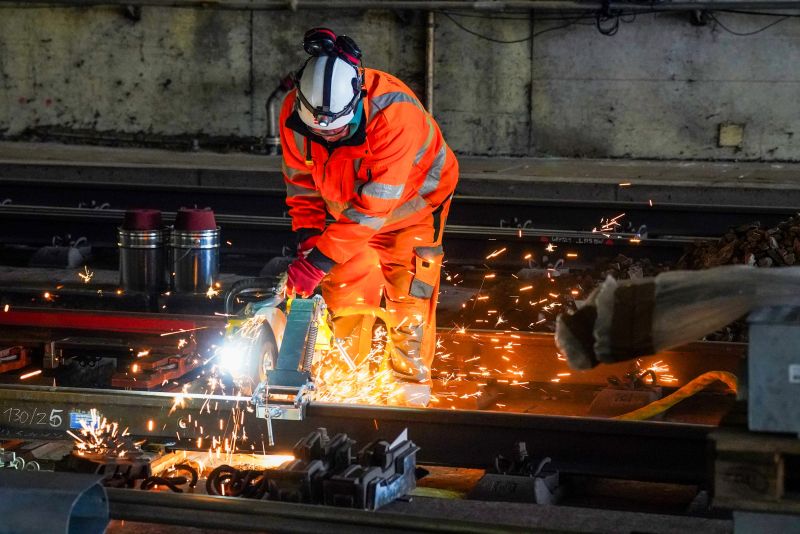
Credit: Deutsche Bahn AG / Volker Emersleben
DB Group closes first half of 2025 with EBIT of minus €239 million • Losses reduced by €986 million • Revenue increased • Fault-prone infrastructure impacts punctuality, especially in long-distance transport • Investments remain at a high level • Administration significantly streamlined
Berlin, 31 July 2025
Deutsche Bahn continued its restructuring programme in the first half of 2025 and significantly reduced its operating loss (EBIT, adjusted) by almost one billion euros compared to the first six months of 2024. Contributing factors included the federal government’s assumption of DB’s upfront costs for infrastructure maintenance, strict cost discipline across all DB rail transport companies, and a significant streamlining of administration.
Consolidated net income after income taxes amounted to minus 760 million euros (first half of 2024: minus 1.6 billion euros). Adding positive one-off effects, mainly from the sale of Schenker, results in net income after taxes of 6.9 billion euros. Adjusted consolidated revenue rose by 3.4 per cent to 13.3 billion euros. Due to the disruption-prone infrastructure, the high number of additional construction sites required and the resulting continued poor punctuality, revenue remained below expectations overall. 63.4 percent of all long-distance trains arrived at their destination on time in the first half of 2025 (first half of 2024: 62.7 percent).
Demand remained high. Around 943 million passengers travelled on DB trains in the first half of 2025 (first half of 2024: around 919 million passengers). Passenger rail transport performance rose to 41.9 billion passenger kilometres – an increase of just under four per cent compared with the same period last year.
Unless otherwise indicated, all figures for the first half of 2025 refer to DB without its logistics subsidiary DB Schenker, which was sold in April.
Railway boss Lutz: Significant progress made in terms of profitability
Following the successful sale of DB Schenker, the DB Group is focusing even more strongly on its core business. DB has been implementing the comprehensive S3 programme since the second half of 2024 to structurally restructure its infrastructure, operations and profitability by 2027. The aim is to restore the performance of the railways and make them more reliable, punctual and profitable.
‘We have made great progress with our S3 restructuring programme, particularly in the area of profitability. The DB Group is now on a much more stable financial footing than it was at the beginning of the year. Our strict cost discipline is paying off. We are making progress step by step,’ said DB CEO Richard Lutz.
By controlling expenditure in the first half of 2025, DB saved around €100 million in material expenses compared with the first six months of 2024 and consistently reduced its workforce, particularly in administration. The proceeds from the sale of Schenker remained entirely within the DB Group and were used primarily to reduce debt, as planned. As a result, DB’s net financial debt fell by €10.5 billion to around €22 billion compared with 31 December 2024.
However, economic restructuring will not succeed without fundamental renewal and modernisation of the network and stabilisation of operations. This is demonstrated by the general renovation of the Riedbahn, which began a year ago and was completed on schedule in December 2024. Infrastructure-related disruptions on the route between Frankfurt/Main and Mannheim were reduced by 60 percent in the first six months after commissioning. The condition of the facilities has improved significantly from a school grade of 3.7 to 2.2, and for punctuality-related trades even from 4.2 to 1.5.
At the same time, the infrastructure subsidiary DB InfraGO replaced 40 old signal boxes in the first half of 2025, 14 more than planned. Speed restrictions were also significantly reduced compared to the previous year, with an average of 70 fewer per day. By the end of June, DB InfraGO had also modernised 157 stations, 16 more than originally planned.
‘We can see that we are achieving the planned construction volumes. But there is still a lot to do. Especially in the heavily used core network, almost every second facility that is relevant for operations and punctuality is in need of renewal and therefore far too prone to failure. That is why we are taking further measures to counteract this and improve punctuality,’ emphasised Lutz.
The package of measures from DB InfraGO includes around 350 million euros more for infrastructure maintenance and further investments in the renewal of facilities. With this, DB InfraGO aims to implement around 1,000 additional improvements to the infrastructure this year – for example, bringing forward the renovation of diversion routes for planned construction sites.
Transport and construction are to be better harmonised overall in order to minimise construction-related disruption for passengers and transport companies. To this end, DB InfraGO also intends to revise and adapt processes – such as construction schedules in major hubs such as Frankfurt/Main and Cologne. DB is sticking to its target of achieving punctuality of at least 65 percent in long-distance transport for the whole of 2025.
DB InfraGO, which is oriented towards the common good, continued to invest heavily in rail infrastructure in the first half of 2025, together with the federal government. Overall, investments were even slightly above the record figures for the first six months of 2024.
Gross investment in the railway system amounted to around €7.3 billion in the first six months of 2025. This is €349 million above the peak value for the first half of 2024. Self-financed net investments – excluding the federal government’s equity increases – declined slightly to around €1.8 billion. The reason for this is that the federal government has taken on a larger share of the overall increase in infrastructure investments.
Developments in the core business
Operating performance on the rail network increased by around one percent in the first half of 2025 compared with the same period last year to around 554 million train-path kilometres. DB InfraGO’s revenue was €4.3 billion, around €232 million higher than in the first half of 2024. DB InfraGO’s operating result (EBIT, adjusted) (in the first half of 2025: minus 204 million euros) improved significantly, but was mainly impacted by deviations from the federal budget financing plan amounting to minus 283 million euros. This is partly due to delayed payments of expense subsidies for maintenance. In the first half of 2025, these were converted from advance payments by DB to regular payments by the federal government.
DB Fernverkehr’s transport performance, at 21.9 billion passenger kilometres, is around five percent higher than in the first half of 2024. Never before have passengers travelled so many kilometres on DB’s long-distance trains in the first six months of a year. At the same time, business travellers in particular were reluctant to switch to rail due to the tense operational situation, mainly caused by the failure-prone infrastructure. As a result, DB Fernverkehr’s revenue remained below expectations despite improvements of 6.1 percent.
However, most passengers are understanding of the current situation with regard to infrastructure. As a result, customer satisfaction rose slightly to a school grade of 2.5 (previous year: 2.7) despite the challenges of everyday rail travel – thanks in particular to the efforts of staff on board the trains.
Thanks to strict cost-cutting measures, DB Fernverkehr’s adjusted EBIT improved significantly by around €173 million compared with the first six months of 2024. DB Fernverkehr continued to post losses in the first half of 2025, at minus 59 million euros (first half of 2024: minus 232 million euros), but significantly exceeded its targets.
DB Regio’s transport performance in the first six months of 2025 was around 23 billion passenger kilometres, two per cent above the first half of 2024 and in line with forecasts. DB Regio’s total revenue increased by around seven percent compared to the first half of 2024, achieving improvements in the triple-digit million range even after deducting the effects of strikes from the previous year – for example, through renegotiation of transport contracts.
DB Regio achieved a turnaround in its operating result in the first half of 2025: with a clear focus on local business activities, the DB local transport subsidiary achieved an operating profit (EBIT, adjusted) in the triple-digit million range of 103 million euros in the first half of 2025, following losses in the first six months of 2024.
The freight transport subsidiary DB Cargo continued its transformation. In the first half of 2025, DB Cargo transported around 83 million tonnes of goods by rail in a climate-friendly manner – 10 per cent less than in the same period last year. This was due, among other things, to the continuing weak economy. In addition, DB Cargo deliberately terminated unprofitable transport contracts on its way to profitability.
DB Cargo’s revenue fell by around nine per cent to 2.5 billion euros in the first half of 2025 (first half of 2024: 2.8 billion euros). DB Cargo significantly improved its operating result in the first six months of 2025 by 165 million euros to minus 96 million euros.
CEO Seiler: Targets exceeded thanks to streamlining
Chief Human Resources Officer Martin Seiler, who is also temporarily responsible for the vacant finance department, said that DB had delivered on its staff reduction targets within the railway network: “As part of the S3 programme, we have set ourselves the goal of reducing the workforce to around 208,000 full-time employees by 2025. As of the end of June, we have already reached 205,000 full-time employees. This means that we have already exceeded our target of 2,000 full-time employees by the end of the first half of the year.” More than half of the staff reductions focused on streamlining administration and sales.
DB is following a fixed plan: with more standardisation, automation and digitalisation, it is reducing its staffing requirements by more than 10,000 full-time employees by 2027 as part of the S3 restructuring programme. In doing so, it is also adapting to the shortage of skilled workers.
Seiler emphasised: “One thing is clear: we are taking a two-pronged approach. We are making savings in one area and continuing to recruit heavily in another, namely operational staff.” DB is therefore continuing to recruit at full speed for operational roles in signal boxes, trains and railway construction, for example, and will take on a total of more than 20,000 employees in this area by 2025, including around 5,700 junior staff in the railway network.
Outlook
In all three areas of the S3 restructuring programme – infrastructure, operations and profitability – DB will continue to push ahead with its specific projects in the second half of the year.
Infrastructure: From the second half of 2025 onwards, DB InfraGO will be working flat out to ensure that the complete renovation of the Berlin–Hamburg line, which is due to start on 1 August, is carried out efficiently and on schedule. At the same time, preparations are being made for the next corridor renovations and, as provided for in the coalition agreement, an extension until 2036 is being examined. In parallel, DB InfraGO will continue to renew facilities, signal boxes and stations throughout the network in the second half of 2025.
Operations: In order to improve operational quality and punctuality, DB InfraGO is improving the interaction between driving and construction, among other things by scheduling fixed time slots for maintenance work in the timetable. This should further reduce the number of trains affected by construction sites by the end of the year. Long-distance transport is continuing to rejuvenate its fleet.
Profitability: The three DB railway companies are continuing to focus on improving their results through cost discipline and structural changes. Following DB Regio, DB Fernverkehr also aims to achieve operating profitability. DB Cargo must become profitable by the end of 2026 at the latest – also in order to meet the requirements of the EU Commission.
For the full year 2025, the DB Group is sticking to its March forecast. DB is aiming for an operating result of slightly more than break-even. Revenue is expected to rise to over 27 billion euros.
DB will continue to invest at a high level, especially in rail infrastructure. Gross investments together with the federal government are expected to exceed 20 billion euros for the full year 2025. Self-financed net investments are expected to rise to more than six billion euros.
All forecasts are dependent, among other things, on the development of the operating situation and the inflow of federal funds, in particular from track access charges and maintenance subsidies.