
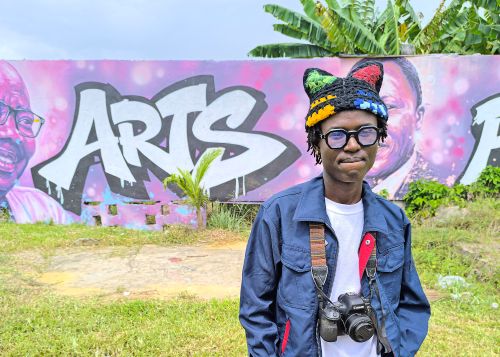
Koné Ibrahim, Ivorian contemporary photographer, posing in front of the “ARTS” mural at the National School of Fine Arts in Abidjan, on October 13, 2026. Photo: Mel AKOI, bird story agency.
At 25, Ivorian artist Koné Ibrahim is developing a practice that combines two disciplines. He uses photography and painting to create images that explore how people communicate, how society evolves, and how common objects acquire meaning.
By Akoi Mel Herve, bird story agency
27 November 2026
In a studio at the National School of Fine Arts in Abidjan, Ibrahim moves among the materials he uses to create his work. Markers and canvases sit among other creative tools, while a camera hangs around his neck. His computer is nearby, which he uses to edit photographs, altering colors and settings until the images match what he wants to express. This process brings painting and photography together, with the final images maintaining parts of the painter’s approach.
“Having acquired all these skills that allow me to truly see beauty, I told myself that the photography I would practise should convey the presence of a painter, that the painter’s soul should still be alive in it. That is why, when people look at my photographs at first glance, they wonder whether they are looking at a painting.”
Ibrahim’s interest in art began as a young child when he learned to draw with his older brother. He later attempted to experiment with photography on his mobile phone. After finishing his baccalaureate in 2021, he joined at Abidjan’s National School of Fine Arts, where he studied painting. A teacher who encouraged him to pursue the discipline became a mentor as he improved his abilities. He earned a bachelor’s degree while developing his photography practice.
The scope of the larger creative sector emphasises what is at stake. According to the African Union press release in 2024, based on UNESCO estimates, Africa’s film and audiovisual industries contribute approximately $5 billion to the continent’s GDP and employ an estimated five million people. Although these data do not directly address the visual arts, they do demonstrate the economic and cultural importance of creative work across the continent.
Ibrahim sees the two disciplines as complementary rather than competitive. Painting taught him to focus on color, composition, and symbolism, which he now incorporates into his photography. He draws inspiration from art history and African art, employing costumes, people, and recognizable things to create works that encourage viewers to explore beyond what initially catches their eye.
“… I don’t really want to choose one and leave the other behind, because it is thanks to one that I am able to make a living from the other, and it is also thanks to one that I can renew myself and create. I would say that photography and painting are my life.”
His decision to work across disciplines influences the topics he tackles. Ibrahim considers his own experiences, prior years’ events, and public-interest concerns. He searches the internet for topics that touch individuals beyond his immediate surroundings and then develops them through his own visual perspective.
“Every story I choose is based on certain things I have experienced or things that happened in previous years. Actually, it is quite simple. When it comes to my subjects, I look online for topics that affect everyone, and then I work on them.”
The market for African art is expanding, but increased worldwide demand does not always imply that more work circulates inside the continent.
According to ArtTactic, global auction sales for modern and contemporary African artists would reach US$62.8 million in 2025, up 42.6% from the previous year. However, African dealers stated that just 30% of their sales value came from within the region. The findings raise a broader concern about how African artists can engage audiences and establish marketplaces closer to home.
These figures reflect a concern raised by French-Cameroonian-Malian visual artist Mélissa Sira Traoré: African art may be gaining international recognition, but artists still need greater opportunities to have their work seen and valued on the continent.
“For a long time, an African artist had to be recognised in Europe in order to exist, and unfortunately, that is sometimes still the case. Events such as the Bamako Encounters, the Dakar Biennale, the Lubumbashi Biennale, and all the spaces being established across the continent are changing that. Our stories should first be shown on the continent, to the people they concern.”
Her point places Ibrahim’s practice within a broader effort to give African artists greater opportunities to represent their own societies and reach audiences at home. The images they create can do more than document people and places; they can also question assumptions about everyday life and open up different ways of seeing it.
One topic that has piqued his interest is evictions and demolitions, which raise concerns about urban transformation and its effects on those who live there. Ibrahim’s photos attempt to capture the realities of his time, utilising art to urge viewers to reflect on events from perspectives they would not otherwise encounter.
His art also explores communication through things that may arise unexpectedly in photographs. In several of his compositions, he places televisions on his models’ heads. The item is not just there to help the image stand out; it also emphasises television’s role as a medium for producing and sharing information.
“When creating a work, it is about symbolism; let’s put it that way. If people stop in front of my work, they may only see the television. They might say, ‘Oh, this person watches too much television; that’s why they put a television on their head.’ No, it goes beyond that. It is not about the person having watched too much television, but rather about the way that person conveys information and communicates. After all, television itself is an audiovisual communication medium.”
Kouassi Allaman, a second-year master’s student at a painting class, has experienced Ibrahim’s method as a model. When the artist first requested him to pose with television screens mounted on his head, he didn’t comprehend the concept.
“At first, I found it strange to see televisions being placed on things because I didn’t know what they were supposed to do,” Allaman said.
Ibrahim had been talking to him about photography when they first met. He then asked him to pose for a photograph, placing a screen on his head.
“After the work was done, when he showed me the finished piece, I was astonished because the setting had changed, the colours had changed, and almost everything had changed. I thought it was beautiful. That was when I started spending time with him.”
Allaman’s reaction highlights an important aspect of Ibrahim’s practice: the photograph is not always the final statement. Editing and composition enable him to rework the original scene by introducing details that alter how viewers understand the image. The approach also encourages interaction between the artist and those who participate in his work.
That conversation relates to a larger challenge confronting African artists: who gets to construct the continent’s narrative, and where do those stories find an audience?
African artists operate in a variety of mediums, including painting, photography, and film, but their work’s exposure is influenced by the locations available for exhibition and the networks through which it circulates.
In Abidjan, Ibrahim continues to combine painting and photography, using both to explore the realities around him. His work does not need viewers to select between photographs and paintings. Instead, it employs the capabilities of each to create stories about the present, forcing viewers to reconsider what they thought they already knew.
bird story agency
Leave a Reply