
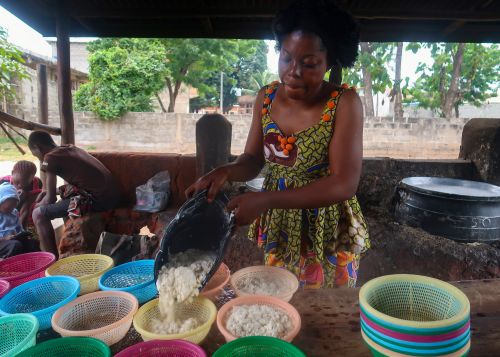
Marie Hounwanou sorting soybeans into plastic baskets in her workshop in Womey Plateau, Benin. Photo: Sylvanus Ayimavo, bird story agency
Training, cleaner equipment and growing demand have helped Marie Hounwanou turn a traditional food-processing skill into a seven-person enterprise. Now new machinery and better safety systems could help hundreds of women processors follow her path.
By Sylvanus Ayimavo, bird story agency
It is barely 7am in Womey Plateau, in the municipality of Abomey-Calavi on the outskirts of Cotonou and Marie Hounwanou’s small workshop is already bustling with activity.
Under a shelter open on the sides, basins of soaked soybeans await processing. A large pot simmers on an improved stove, while the grinder runs in sync with the various stages of production. Hounwanou tends the fire, moves a basin, and gives instructions to her employees.
Within a few hours, most of the soy cheese produced that day will have been sold. Motorcycle taxi drivers will come to pick up orders from women who resell it at the Dantokpa market, while other customers will buy directly from the workshop, sometimes even before the packaging is finished.
This robust trade reflects opportunities created by Benin’s expanding soybean sector. According to the US Department of Agriculture’s Foreign Agricultural Service, Benin’s soybean production increased from 652,000 metric tons in 2024/2025 to 700,000 metric tons in 2025/2026, a rise of 7%. The latest figure is almost double the country’s 2016–2025 annual average of 352,500 metric tons.
But Hounwanou’s workshop also demonstrates the benefits of local processing: soybeans become an affordable source of protein, female vendors have a product to sell, processing creates jobs, and a familiar food becomes the foundation of a local business.
This growth has also driven up the cost of the raw material. Hounwanou recalls that 10 years ago, a bag of soybeans purchased in the northern growing regions cost about 10,000 CFA francs (US$18). Depending on the season, she now pays between 20,000 CFA francs (US$35) and 40,000 CFA francs (US$71).
This increase may benefit producers, but it reduces the profit margins of small processors if their productivity does not rise. For these businesses, equipment capable of minimizing losses or increasing output therefore becomes a key factor in competitiveness.
Hounwanou has been making soy cheese for about ten years. Today, she employs seven men and women and processes about 300 to 325 kilograms of soybeans every day -nearly two and a half bags.
Her business has become more profitable as she has improved her product and methods. Initially, she focused on fried soy cheese, but unpredictable costs sometimes reduced her profit margins. Fresh cheese now accounts for a larger share of her production. “There were times when I worked at a loss,” she says. Today, she adds, “for every bag I process, I earn about twice as much.”
Soy cheese, a tofu-like product, has become popular in Benin, particularly because it is a less expensive alternative to wagashi, a traditional cheese made from cow’s milk.
Dr. Yann Eméric Madodé, a food technology researcher at the University of Abomey-Calavi, explains that its affordability makes it especially important for low-income households. For just 50 CFA francs (US$0.09) or 100 CFA francs (US$0.18), he notes, residents of certain communities can pair soy cheese with akassa and chilli peppers to create a nutritious meal rich in protein and energy.
Soy contains up to 40 grams of protein per 100 grams of dry matter, compared with about 18 to 22 grams for cowpeas, according to the researcher. It also provides fiber, iron, calcium, folate, and other B vitamins. Soy-based foods can thus contribute to a balanced diet and help prevent certain forms of malnutrition.
The increase in soybean production thus provides Benin with a raw material conducive to the development of a local food processing industry. However, this opportunity depends on the ability of small-scale processors to improve their methods, hygiene, and production capacity.
For two years, Hounwanou received training and equipment through the West Africa Competitiveness Program (WACOMP), funded by the European Union. The support focused on processing methods, hygiene, raw material management, work organization, and equipment use.
She now begins by soaking, shelling, and washing the seeds before grinding them. The ground mixture is filtered to separate the soy milk from the solid residue. The milk is then brought to a boil before the coagulant is added. The resulting curd is drained and then packaged. “The cheese I make today is light. Before, it was heavy,” says Hounwanou.
The program also provided her with suitable basins and improved stoves. This equipment has reduced smoke and workers’ exposure to intense heat. “We are no longer as exposed to fire or to illnesses caused by smoke,” she explains.
For Dr. Madodé, the next step is semi-mechanisation. At the university’s Faculty of Agricultural Sciences, researchers working with the French Research Institute for Development have developed a filter press designed to help women process and press larger quantities under safer conditions.
Today, many women processors pour the curds into bags and place stones on top to extract the liquid. A press designed for this purpose could replace this method, reduce the risk of contamination, and ensure more consistent results—without requiring the investment involved in building a large factory. “Following mechanization, the sector’s development will require in-depth training so that processors understand the risks their practices may pose to the public,” explains Madodé.
Soybeans naturally contain antinutritional compounds that can hinder nutrient absorption. Proper soaking, hulling, and cooking can reduce a large portion of these compounds. However, some processors soak the beans for only 30 minutes, even though longer soaking removes more of these compounds.
The choice and handling of the coagulant are also important. Many producers use guisin, the fermented water produced during the manufacture of akassa. If the corn is improperly processed or stored, mold-produced toxins can contaminate the liquid and potentially carry over into the cheese.
Poor hygiene in the workshop can also introduce harmful microorganisms. For Madodé, the solution lies in training and registering processors, improving production facilities, and, ultimately, certifying products that meet health standards. “Most of the work must therefore be carried out with the processors who make the cheese,” he says.
Better systems would also make it possible to derive greater value from byproducts. At Hounwanou’s workshop, the soybean hulls removed during processing are sold to livestock farmers. The solid cake remaining after the milk is filtered can be dried and used as livestock feed, provided it is properly processed. The liquid drained off after coagulation also has potential. Some processors use it in vegetable farming, while others save it as a coagulant for the next production run.
For Hounwanou, the main challenge is no longer finding customers, but producing enough to meet their demand. She works in rented space and hopes to acquire a more powerful mill, additional equipment, and a plot of land to build a suitable production facility.
Her experience highlights the strengths already present in Benin’s soy cheese sector, which include an increasingly available raw material, an affordable product, well-established demand, and entrepreneurs with technical expertise.
The missing link remains the investment needed to enable these businesses to transition from labor-intensive workshops to semi-mechanized and safer production.
According to Dr. Madodé, the authorities can accelerate this transition by working with national organizations of soybean producers and processors to register businesses, expand access to training and equipment, and improve the quality of the harvest delivered to processors. “In processing, it all starts with the quality of the raw material,” he says.
In Womey Plateau, Hounwanou has already demonstrated that artisanal expertise can evolve into a well-structured business that creates jobs. The speed with which her cheese leaves the workshop shows that the market is ready. Her next challenge – and an opportunity for Benin – is to secure the machinery, financing, and sanitation improvements needed to meet that demand.
bird story agency
Leave a Reply