
IMAGE: bird story agency
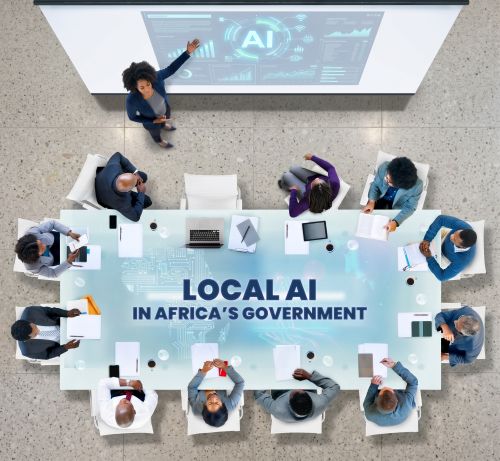
Keen to keep sensitive data under local control, African governments are looking to homegrown AI developers for tools to run essential public services.
By Seth Onyango, bird story agency
Public agencies in Africa are adopting AI to improve welfare, healthcare, procurement and deliver essential services, spurring demand for locally built tools.
Governments, keen to keep sensitive public data under local control, are turning to homegrown AI startups, opening a potentially lucrative market for local developers.
Obtaining state contracts could provide a critical new source of revenue for local AI startups, although tight budgets and limited access to public data remain obstacles.
Already, local developers are competing for a place in a market that ranges from healthcare and farming to welfare payments.
Many African developers are putting a local skin on existing AI models, tailoring them to African languages, public services and markets rather than building the underlying technology from scratch.
The interest follows promising results in countries such as Togo, where the government used AI to help find more than 150,000 vulnerable people who needed emergency cash payments during the Covid-19 pandemic.
The system used mobile phone records and satellite data to reach households that conventional welfare records had missed.
Togo’s AI laboratory has now expanded its collaborations to more than ten public agencies, with over 70 projects covering agriculture, health and public administration.
Kenya is also seeking locally developed applications for government services, while Rwanda has identified dozens of potential uses across its economy.
Now a United Nations-backed initiative is searching for African AI products that could be used more widely.
The selected innovators will present their work in Ghana next month, where they’ll meet officials and regulators weighing the promise of local AI against concerns over privacy, cost and oversight.
Across six African countries, a United Nations programme has identified 21 AI applications as governments invest in the computing power and skills needed to run them.
Other partners on the project are the International Telecommunication Union (ITU) and Research ICT Africa.
The call, which closed on October 2, was open to startups, universities, research institutions, public agencies and individual developers with working prototypes, pilot projects or products already in use. It covers health, agriculture, education, financial inclusion, climate action, trade and public services.
Liz Orembo, who leads international partnerships and engagement at Research ICT Africa data policy, said developers have often been left out of decisions about the rules governing their products.
“Most African AI policy conversations happen without the people actually building and deploying AI in the room,” Orembo said.
The Accra meeting will give innovators an opportunity to demonstrate their work and explain the difficulties they face in securing government data, computing power, internet access and permission to operate across borders.
“These are the conditions that decide whether an African innovation stays a pilot or reaches scale,” she said.
Togo’s experience began with Novissi, an emergency cash transfer programme introduced during the pandemic. Researchers working with the government used machine learning to analyse mobile phone and satellite data, helping identify vulnerable households in areas where reliable income records were scarce.
The system improved the accuracy of targeting assistance by 42% compared with a simpler method based on identifying the poorest districts, according to researchers at the University of California, Berkeley’s Center for Effective Global Action (CEGA).
Between December 2020 and April 2021, the government used the approach to provide monthly payments of about $20 to 154,238 people.
Togo later established a permanent AI and data science programme with CEGA, bringing the technology into government departments beyond social protection.
The laboratory has worked on agricultural forecasts, government records and digital services, while supporting efforts to improve how ministries collect and share information.
In December 2025, Google.org announced $2 million in research support for the programme, including plans to train more than 100 students and 70 government data scientists over two years. The partnership is meant to help more than 20 public institutions use data science in their daily work.
Kenya is pursuing a similar goal through its AI Accelerator Programme, launched by the Ministry of Information, Communications and the Digital Economy, Konza Technopolis and the United Nations Development Programme.
The programme invited developers to submit AI applications that could improve public services and support the country’s green transition, with applications closing in September 2026.
The government is also working with India and Italy on AI systems designed for African languages, including voice tools that can work in areas with poor internet connections.
A September UNDP report examined efforts to establish local AI computing facilities in Kenya, Malawi, Rwanda, South Africa, Togo and Zambia.
The six countries have identified 21 applications, while Rwanda has drawn up a wider list of 42 potential uses across eight sectors.
The projects range from early planning to deployment, with governments seeking greater control over the data and computing systems needed to operate AI tools rather than relying entirely on foreign providers.
Lesotho has taken another route, becoming the first country to apply the United Nations Blueprint for National AI and Data Strategies.
It has begun the first phase of a national computing plan running from 2026 to 2029, following an assessment of its electricity supply, internet networks, data facilities and technical skills.
Prime Minister Samuel Matekane said the government would invest according to the needs of public services rather than build expensive technology facilities without clear uses.
“We will build what fits our resources and our needs. Infrastructure must follow demand,” Matekane said on the sidelines of the United Nations General Assembly last month.
But Lesotho’s work is still largely focused on preparing government systems for AI, unlike Togo, where machine learning has already been used to deliver public assistance.
The growing interest in government AI comes with difficult questions for African developers, who often lack access to the public records, computing facilities and funds needed to test their products.
Government contracts can provide a large customer base, but procurement rules and limited budgets may also prevent smaller companies from competing.
In a July 2026 report, the International Monetary Fund identified weak electricity supply, costly digital infrastructure, shortages of skilled workers and gaps in regulation among the main barriers to wider AI use in Africa.
Orembo said those problems should be addressed with developers involved in the discussions.
“Where does access to data break down? What do compute and connectivity actually cost? Which rules help, and which ones get in the way? What happens when a solution tries to cross a border?” she posed.
The use of AI in welfare programmes also raises concerns about how governments handle personal information and whether automated systems can wrongly exclude people from public benefits.
Togo’s cash transfer programme used mobile phone records to estimate household wealth, a method that allowed the government to reach people quickly but also brought questions about privacy, consent and the accuracy of decisions based on personal data.
But African governments are increasingly drawing up rules to govern such uses. The African Union adopted a continental AI strategy in 2024, while several countries have introduced national plans covering innovation, data protection and public oversight.
The ECA initiative will bring some of those discussions directly to the developers seeking to sell or deploy their products, with the selected innovations on display in Accra next month.
For African startups, universities and research teams, government demand could provide a route beyond small pilot projects.
Still, the size of that market will depend on whether public agencies have the budgets, data systems and technical staff to put locally developed AI to work.
bird story agency
Leave a Reply