
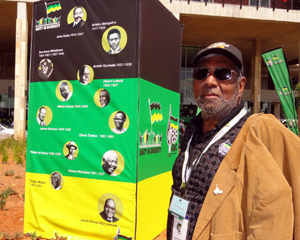
The 53rd National Conference of the African National Congress (ANC), the highest policy-making body of the organisation, will be held in the City of its birth, Mangaung (Bloemfontein) beginning on 16 December 2012. In January this year, Mangaung hosted tens of thousands of people who gathered there to celebrate the 100th Anniversary of the founding of the ANC.
This time, about 5 000 delegates will assemble (not in a church as was the case in 1912) at the University Campus to elect its leaders and plan the path and programme to be followed for the next five years. The branches in the various provinces are busy electing their delegates to attend the Mangaung Indaba (gathering).
This will be no tea party for the delegates. There are mountains of problems to solve. This Conference will have to make sure that its decisions taken are implemented and not business as usual once the delegates disperse after their week-long deliberations. Tremendous responsibility will be thrown on to the shoulders of the individual branches throughout the country to make sure that the Government delivers.
The word delivery has taken on great meaning in South African politics. People are complaining of poor delivery. Some have even gone so far as saying that the situation is worse than that under apartheid. This is a serious state of affairs and it is absolutely vital that the ANC takes such sentiments seriously. The peoples’ patience has been absolutely fantastic, albeit not indefinite. It will be wise not to ignore this fact. There is so much that one can take. But the status quo must change and change fast. I make bold to advise my organisation not to wait until the people make their presence felt. That will be too late.
I am mindful of the fact that it is barely 20 years here that we took over the reins of the country. It is not a long time, especially when one considers that the country was under foreign siege for almost four centuries. They built structures over this period which we are expected to destroy in less than 20 years. That would be a miracle. Even miracles take longer than that.
Ever since the ANC took over the reins of government in the new dispensation that came into being in 1994, it has been harried by constant bashing from the media. Naturally it is the job of the media to keep the government on its toes. I have no problem with that.
My problem with the South African paper-world is its sustained anti-ANC frenzy. Everything negative that happens is the fault of the ANC. Irrespective of how remote that particular incident is from any ANC involvement – to the media this is immaterial. ANC, wrong,- irrespective.
The achievements of the South African Government rarely get a mention. The fact is that within such a short space of time, much progress has been made in uplifting the living conditions especially in the rural areas. This is completely ignored. Admittedly, much more has to be done in the field of health, sanitation, education, and labour. There is a long way to go. Here lies the brunt of the problem. The Conference must direct the incoming leadership to devise PEOPLE FIRST actions to meet the shortfall which a major section of the population is faced with. This is a burning issue and cannot be ignored or swept under the carpet.
This is what the highest policy-making body of the ANC will have to deal with when they gather in Mangaung. They will also have to seriously consider ways and means of removing the stick from the media which, unfortunately, has been handed to them through the follies of some members of our movement. These also include senior office-bearers and Ministers.
Corruption and gravy train mentality has to be smashed, and smashed with the biggest hammer available. There is always the danger of it taking on epidemic heights. Corruption is not a South African monopoly. It seems to be the norm across our borders and also over the seas. But as a South African it hurts most when it happens in my own country. It really and truly gets under the skin. Me, and my generation, did not stick out our necks against such great odds for the fun of it. We were prepared to pay the price for our future generations to live a normal life and not be outcasts in the land of their birth.
The recent killing of mine workers should have never happened. I am waiting with bated breath for the finding of the Commission set up by President Zuma. My own observation of the situation is that all the parties involved cannot emerge unscathed from this horrible incident which includes the state and its organs and the trade unions itself.
In 1954 the white-led trade unionists destroyed the Trades and Labour Council (T&LC), a trade union federation which bore some semblance of unity. As a young trade unionist, I felt betrayed and therefore joined the forces that refused to accept the situation. Even more bitter was the fact that one of those who was involved in the break-up of the T&LC was the general secretary of the union I belonged to.
Even though two federations emerged, Trade Union Council of South Africa (TUCSA) with its racial constitution, and the South African Congress of Trade Unions (SACTU) with its constitution open to all workers, we refused to accept the status quo and continued to work for the unity of the entire working class of South Africa and for the recognition of African trade unions. Under the racist law, Africans were not accepted as workers but as cheap labourers so their unions were not officially recognized nor did they have bargaining rights.
Today, in a democratic South Africa all workers have the right to belong to unions and to fight for better working and living conditions. What is disturbing though, is the fact that the workers in South Africa are more divided today than at any time in the history of the trade union movement. Where on earth do you see a number of unions representing the same industry? This is plain madness. You are playing into the hands of the bosses who have absolutely no scruples about making two dogs fight. The answer is as old as the hills.
This is precisely what is happening in the mines at the moment and other large industries. Workers are being severely exploited and in their frustration they have been taking to the streets in protest which is their democratic right. What is not right is being armed and a threat to innocent people. Under such circumstances it is difficult to control emotions. The penetration of such events by agent provocateurs is child’s play but the damages are enormous. Hopefully our trade union leaders have learnt from this horrible tragedy.
On the factory floor, in the belly of the earth or wherever ideologies, religion, and political party affiliations have no place. Here you are a worker. You have one concern – your unity to engage the employing class to pay you a wage with which to support your family. Everything else is private.
The question must also be asked – why live bullets? Or shoot to kill? Maybe the Commission will throw some light on these issues.
In June 1955, we adopted the Freedom Charter at the Congress of the People in Kliptown near Johannesburg. It is a document to chart the way forward in a democratic South Africa. One of the chapters is headed:
The Doors of Learning and of Culture Shall be Opened!
It reads, inter alia, …”Education shall be free, compulsory, universal and equal for all children”. Our visions of those days have taken on the norm of a bad dream. Education is not free and it is not compulsory. The truth is that education, especially basic education, is in a shamble. Many schools are in a dilapidated state and lack essential facilities.
Critics are complaining that thousands of experienced teachers were retrenched and teacher training colleges were closed down. Shortage of fully trained teachers is a huge problem. Since 1996, 2238 schools have been closed down in South Africa. Well-resourced private schools are now blooming. This in turn keeps out the pupils from poor families. It is an unexplainable situation considering that education is allotted a huge slice of the national budget.
Yet, Ms Angie Motshekga, Minister of Basic Education, complains of budgetary constraints and limitation of available resources. She even argues that children do not have an unqualified constitutional right to basic education. Constitutional law expert Pierre de Vos retorted: “Children need to be provided with basic education now. It is not about waiting for money to do this.”
This will be the 6th time that the ANC National Conference* will be meeting in South Africa after the ban on it was lifted in 1990. Like millions of people in the country, I will be waiting with bated breath to see what guidelines and solutions this Conference will offer.
• The first of these Conferences was held in Durban in 1991.What a fantastic gathering. There was so much of hugging, back-slapping and kissing , singing and dancing as the delegates gathered which would have given any onlooker an impression of a big carnival. Far from it. Here were comrades meeting each other after long years of separation. In my own case I was meeting comrades some of whom I had last seen in prison in 1965. The atmosphere was just simply ecstatic and emotional. The regime had spread us all over the world. But we refused to die and were back home and raring to go to create a democratic South Africa. Such an atmosphere happens once in a life time, and those of who were there will take that memory to our graves with us.