
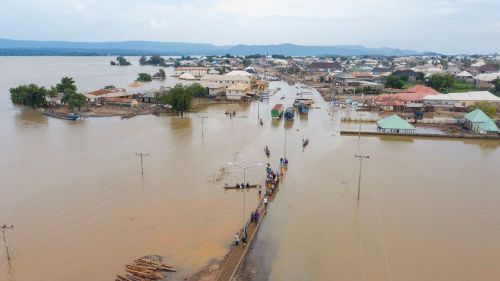
Flooding in Kabawa Lakoja Kogi State, Nigeria. Photo : bird story agency
Local health teams and community organisations are bringing psychological support closer to flood survivors, helping families cope with losses that can persist long after the emergency.
Seth Onyango, bird story agency
25 October 2026
Marta Nguene wants to become a television presenter. At a reception centre for flood survivors in Benguela, Angola, the 14-year-old already has people’s stories to tell.
She gathers families’ concerns and experiences, then brings them into psychosocial support sessions as a reporter, according to an October 2026 account from the World Health Organization.
A survivor of flooding along the River Cavaco, Nguene is helping her neighbours make themselves heard while pursuing an ambition of her own.
Her work is part of a growing response in African communities hit by climate-induced disasters like flooding, where local people, trained community workers and African organisations increasingly deliver psychological support as an integral part of recovery.
For Roger Nokes of StrongMinds, an organisation providing community-based depression care in Africa, those connections matter because the consequences of disaster extend into relationships, livelihoods and people’s sense of purpose.
“Sometimes, experiences like surviving a devastating flood can result in common depression triggers like conflict, isolation, grief, and life change,” he told this publication.
Someone forced to relocate may become separated from the friends and neighbours they once relied on. A lost business can leave a family struggling with fewer resources. Finding a different job or settling in a new community can unsettle a person’s understanding of their role in life.
Those changes can continue to affect people long after the water recedes.
“People may live with fear that a similar event may happen again and that fear could interrupt their lives or influence the decisions they make on a daily basis.”
Similar experiences emerged in a recent Bhekisisa documentary, in which flood survivors in Mozambique and South Africa described fear returning with rain. Delfina Catarina, a survivor of Cyclone Idai in Beira, said rain and wind still kept her from sleeping.
In Benguela, provincial health services and local partners worked with WHO to provide weekly psychosocial support to more than 200 families.
The response also trained 50 health and psychosocial support professionals to recognise distress, provide initial care and refer people needing specialist support. Alongside support for families, the initiative sought to strengthen connections between communities and health services for future emergencies.
African researchers and health teams are now examining those experiences and developing ways to respond closer to where people live.
Across Burkina Faso, Kenya, Mozambique and South Africa, the Weather Events and Mental Health project, known as WEMA, is examining how extreme weather affects depression, anxiety and post-traumatic stress disorder.
Professor Collins Iwuji of the Africa Health Research Institute leads the project, which gives community-based co-researchers a role in telling and interpreting their experiences, alongside surveys and analysis of health and weather data.
But even as evidence of climate-related mental health challenges grows, communities are finding ways to support recovery long before formal services arrive.
Their efforts come as climate-related mental health gains greater recognition on the global agenda.
At the COP31 climate summit in Turkey next month, strengthening health systems against the impacts of climate disasters is expected to become a formal priority for the first time.
In communities, Iwuji said the new efforts are intended to help residents shape locally relevant responses by bringing their knowledge and experiences into discussions about what support should look like.
But for communities repeatedly exposed to floods, the concern is not only what happened during one disaster, but what the next storm may bring.
In Johannesburg’s Setswetla informal settlement, a study of 100 adults highlighted difficulties involving intrusive memories and experiencing positive emotions amid recurring floods.
Published in April 2026 in Natural Hazards, the research offers evidence from one community of how emotional distress can accompany repeated exposure.
The effects can reach into relationships as well as individual wellbeing.
Nokes said the loss of household resources can create disputes within families. Displacement can also leave people isolated, while changes in work and community can unsettle their sense of purpose.
But he emphasised that grief does not inevitably become depression since people respond differently to loss.
For those who need treatment, StrongMinds’ approach uses interpersonal group therapy for depression, delivered by trained lay community members where the group itself becomes a source of support.
“Survivors connect with others who have lived through similar experiences and carried similar feelings, which helps them feel less alone and more understood.”
Participants are encouraged to recognise the strengths, relationships and resources they can still draw on, helping them tackle practical difficulties together rather than facing them alone.
“Together, group members work through the practical challenges they face right now. Solving these problems one at a time helps them feel safer and more in control of their daily lives,” Nokes said.
“Ultimately, survivors leave feeling empowered. They have found their own ways to cope and keep going in the face of adversity, and they carry that confidence with them as they rebuild their lives.”
A 2026 systematic review of Nigerian studies recommends task-sharing, meaning training community health workers and other non-specialists in psychological first aid. It notes that Nigeria has fewer than 300 psychiatrists for more than 220 million people.
It comes even as a recent separate analysis of Angola’s post-flood recovery noted that mental health support is increasingly being treated as part of climate adaptation itself, rather than a service delivered after the emergency has passed.
Community health workers are playing a central role by identifying people in distress and connecting them with appropriate support. Similar lessons have emerged elsewhere.
Following Tropical Storm Ana in Malawi, community workers, health personnel and social welfare officers received training in psychological first aid to support survivors.
Local responders reported that many affected families had received food, shelter and other humanitarian assistance but still carried unaddressed emotional burdens linked to their losses and displacement.
For researchers, one of the clearest lessons is that mental health support needs to reach people quickly and locally.
Dr Boniface Chitayi, a consultant psychiatrist with Kenya’s Ministry of Health, said disasters that result in loss of property, bereavement and forced migration often contribute to higher rates of anxiety and depression.
“Stressful events can trigger most serious mental illnesses,” Chitayi said. “Mental health issues are often forgotten amid other life-threatening disasters.”
Researchers working in Kenya and the other WEMA countries argue that community health workers should be trained to identify trauma and psychological distress following floods.
Iwuji said psychological first aid should begin in the immediate aftermath of a disaster.
“Training community health workers to deliver psychological support in the immediate aftermath of this event is highly important and also to be able to identify people with severe forms of mental disorders for onward referral,” he told Bhekisisa.
In Nairobi’s Mukuru informal settlement, where homes sit alongside the Ngong River, researchers interviewed more than 500 flood-affected residents. Nearly half showed signs consistent with post-traumatic stress, highlighting the scale of need even in places where specialised mental health services remain scarce.
According to the World Health Organisation, only a small proportion of countries in the African region have integrated mental health into primary healthcare systems, while dedicated mental health funding remains limited across much of the continent.
Yet practitioners say solutions do not always require large numbers of psychiatrists.
Nokes believes community-based approaches can bridge crucial gaps in care.
“Disaster response still treats mental health as an afterthought,” he said.
“Survivors need more than psychological first aid in the first few days. They need ongoing, community-based care that is in place before disaster strikes and stays long after the emergency teams leave.”
Researchers have found that mental health is becoming increasingly difficult to separate from wider discussions about climate resilience.
In South Africa, University of Cape Town researchers have been exploring practical adaptation measures that improve living conditions in informal settlements. Cool reflective roof paint, ceilings and solar-powered fans are being tested as ways of reducing heat stress and improving sleep.
Such interventions may appear modest, but experts say they demonstrate how climate adaptation can improve both physical and mental wellbeing.
“Mental health becomes an essential pillar of climate adaptation,” Harvard Medical School psychiatrist Giuseppe Raviola said during discussions on climate-related psychological distress in West Africa.
Across Africa, that idea is gaining traction.
bird story agency
Leave a Reply