
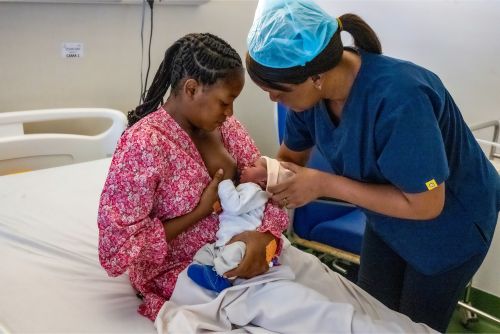
A mother breastfeeds her newborn son at Sampaka Hospital in Malabo, Equatorial Guinea. Exclusive breastfeeding during the first six months provides essential nutrients, antibodies, and protection that support healthy growth and child development. Photo courtesy: Frank Dejongh/UNICEF.
Burundi has become one of the world’s highest-performing countries in exclusive breastfeeding, and its success is reshaping the global conversation on maternal and child health. As WHO and UNICEF push a new investment case for breastfeeding, the country is emerging as evidence that strong health systems, workplace policies, and public investment can transform outcomes.
Bonface Orucho, bird story agency
Burundi has become one of the world’s highest-performing countries in exclusive breastfeeding, with rates above 80% that place it among a small group of global leaders.
Its performance is drawing attention as the World Health Organization (WHO) and UNICEF increasingly argue that breastfeeding outcomes depend less on awareness campaigns than on health systems, workplace protections, and public investment.
The shift has gained momentum during World Breastfeeding Week, which this year focuses on the theme “Breastfeeding for a Sustainable Start in Life: Strengthen What Works.”
WHO and UNICEF are using the week to urge governments to expand breastfeeding counselling, strengthen maternity services, improve workplace protections, and increase financing for maternal and child health systems.
“Too many mothers and families around the world still lack access to services and interventions that enable and support breastfeeding,” WHO Director-General Tedros Adhanom Ghebreyesus said in a joint UNICEF-WHO statement released on July 31.
The statement says rising breastfeeding rates globally show that sustained investments in policies and programmes for mothers and families are working.
Burundi stands out within that global trend.
According to UNICEF Burundi, the country’s exclusive breastfeeding rate reached 83.3% in the 2024 SMART survey, well above the global average. UNICEF said the figure places Burundi among the world’s strongest-performing countries in exclusive breastfeeding, although disparities remain within the country, particularly in urban areas.
The Global Breastfeeding Scorecard 2025, produced by the Global Breastfeeding Collective led by WHO and UNICEF, identifies Burundi as one of only six countries reporting exclusive breastfeeding rates above 60%.
The scorecard also lists Burundi among the countries that achieved the largest recent improvements, with gains of more than 14 percentage points between the 2015–2019 and 2020–2024 periods. The report says Burundi, Bhutan, and Timor-Leste recorded some of the strongest recent increases in exclusive breastfeeding.
Burundi’s performance comes as global breastfeeding rates continue to improve.
According to WHO and UNICEF, exclusive breastfeeding among infants under six months has risen from 37% in 2012 to 47% today, while breastfeeding up to two years has increased from 38% to 50% over the past five years. The World Health Assembly has now set a target of 60% exclusive breastfeeding by 2030.
The new global policy argument is increasingly economic.
The 2026 Global Investment Case for Improved Breastfeeding, developed by Nutrition International with WHO and UNICEF for the Global Breastfeeding Collective, estimates that inadequate breastfeeding costs the global economy US$339 billion annually, equivalent to 0.32% of global gross national income.
The report attributes those losses to 383,000 avoidable child deaths, 138,000 avoidable maternal deaths, millions of lost years of education, and reduced human capital. It argues that breastfeeding support should be treated as a high-return public investment rather than a narrow nutrition intervention.
The report models three levels of intervention, ranging from health-system support to maternity leave and workplace policies.
Scaling the core health-system package, centred on breastfeeding counselling and the Baby-Friendly Hospital Initiative, would generate an estimated US$59.4 in economic returns for every US$1 invested over ten years.
Even the most comprehensive package, which includes paid maternity leave and workplace support, would produce substantial economic returns while preventing hundreds of thousands of child deaths.
“The evidence is clear,” WHO and UNICEF said in their joint statement.
They identified skilled breastfeeding support in health systems, community-based counselling, maternity protection policies, and protection from the marketing of commercial milk formulas as cost-effective interventions that improve breastfeeding outcomes.
The Global Breastfeeding Scorecard points to the same institutional factors.
It identifies seven priority areas that governments need to strengthen: financing, regulation of breast-milk substitute marketing, paid family leave, workplace breastfeeding support, baby-friendly maternity facilities, skilled breastfeeding counselling, and stronger links between health facilities and communities.
The report also highlights the scale of the remaining policy gap.
Only 14% of countries report that most births occur in Baby-Friendly facilities. Only 20% require workplace breastfeeding accommodations such as nursing breaks and breastfeeding facilities. Only 17% have legislation substantially aligned with the International Code of Marketing of Breast-milk Substitutes.
Burundi’s results suggest that a low-income country can achieve unusually high breastfeeding rates when support systems are functioning.
UNICEF’s country programme in Burundi has focused on strengthening health and nutrition services, community-based support, and maternal and child health systems.
The story is increasingly relevant across Africa.
Kenya has recorded one of the continent’s most significant improvements, increasing exclusive breastfeeding from 13% in 2003 to 60% in 2022, according to national survey data cited by WHO and UNICEF. Those gains have been linked to breastfeeding counselling, Baby-Friendly Hospital implementation, community support programmes, and regulation of breast-milk substitutes.
The Global Breastfeeding Collective argues that these interventions work best when they operate as a connected system rather than as isolated campaigns.
The collective’s recommended approach combines health-facility counselling, community follow-up, enforcement of marketing regulations, and maternity protection policies.
The financing implications are significant for the region.
According to the Global Breastfeeding Scorecard, Africa accounts for 36% of global financing needs for breastfeeding support, and 91% of the required investment is for expanding infant and young child nutrition counselling.
The report says the continent will require sustained government and donor investment if countries are to meet the 2030 global breastfeeding targets.
WHO and UNICEF are also placing increasing emphasis on workplace policy.
The scorecard notes that maternity leave and workplace accommodations are closely associated with longer breastfeeding duration and higher rates of exclusive breastfeeding. Yet only a small share of countries currently meet international standards for paid maternity leave or require employers to provide breastfeeding facilities and nursing breaks.
That emphasis reflects a broader change in the global breastfeeding agenda.
For decades, many breastfeeding initiatives focused primarily on encouraging mothers to breastfeed.
The new investment case argues that breastfeeding outcomes are increasingly determined by whether health systems, employers, and governments provide the support that allows women to continue breastfeeding after birth and after returning to work.
Scaling up breastfeeding could prevent almost 400,000 child deaths and around 140,000 maternal deaths each year, according to WHO.
Every US$1 invested in breastfeeding promotion generates an estimated US$59 in economic returns through lower healthcare costs, improved cognitive development, higher educational attainment, and increased lifetime earnings.
World Breastfeeding Week runs from August 1 to August 7.
bird story agency
Leave a Reply