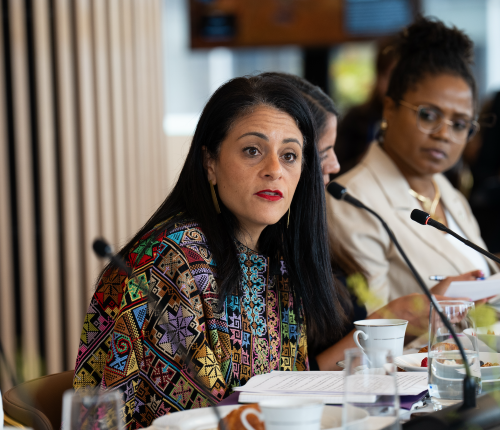
Heba Alby/ Image: bird story agency
The UN turns 81 in turbulent times. Africa can lead efforts to steady the ship – and turn demands for change into reality.
By Heba Aly
25 October 2026
As the United Nations turns 81, it is failing to deliver on its primary mission of saving “succeeding generations from the scourge of war”. Violence abounds – with fresh and protracted conflicts scarring the African continent.
New challenges pose threats too: from the advent of Artificial Intelligence to the ongoing devastation of a changing climate.
But the promise of an organisation that would guarantee peace – even if not realised today – is worth holding on to. This not a call to return to the past, however. This is about renewing that pledge for a new era. And doing so with African leadership.
The UN was established with input from only four African countries, after all. Ethiopia, Egypt, Liberia, and South Africa were the sole African states invited to draft the UN’s founding document, the UN Charter, in 1945. Much of the continent was under colonial rule. The following eight decades of the “rules‑based order” was therefore built on rules Africans did not write, institutions Africans did not design, and norms Africans were expected to obey, but not shape.
So, as the UN turns 81-years old under considerable strain, how can we renew its vows? And how can Africa shape its future?
Supporting independence but still imperfect: the UN’s role in Africa
For Africa, the UN has been far more than just a diplomatic forum. Through the UN General Assembly, the international community accelerated the dismantling of European colonial rule across the continent while the UN’s work on human rights helped establish norms that inspired African constitutions, regional instruments, and national reforms.
The UN has made significant, though often imperfect, contributions to peace on the continent. From the Democratic Republic of Congo, Liberia, Mozambique, Somalia, Sierra Leone to Liberia, peacekeeping operations have played important roles in supporting fragile transitions from war to peace. The organisation’s mediation efforts, electoral assistance missions, and humanitarian interventions have saved countless lives.
But Africa is still systematically under-represented in bodies where the most consequential decisions are made.
This includes in the UN Security Council, which still reflects the geopolitical realities of 1945, and where Africa does not have any permanent representation. This means its voice carries less weight when it comes to appointing the next UN Secretary-General, as well as in deliberations on international peace and security – even if 80% of resolutions passed by the Council in the past decade concerned Africa.
The institutions dedicated to the global economy – such as the International Monetary Fund, the World Bank, and World Trade Organisation – equally disadvantage the African continent; both in decision-making processes, as well as in upholding trade regimes that have privileged the Global North.
And for eight decades, Africa has endured double standards on human rights, norms, and the equality of nations while participated in a system that has failed to acknowledge the legacy of colonialism.
Africa is now home to more than 1.5 billion people; approximately 18% of the world’s population. With 54 member states, it represents almost a third of the UN’s membership. The continent’s economies, innovations, cultures, and diplomatic influence are increasingly shaping international affairs.
International institutions fail to meaningfully include the African continent at their own peril; at risk of becoming nothing more than relics of a bygone era.
Africa’s role in renewal
African countries have long pointed to their exclusion as a matter of historical injustice. In 2005, the African Union adopted a common position on UN reform, the Ezulwini Consensus, which includes advocating for permanent and non-permanent seats on the Security Council for Africa. Over two decades later, this has failed to materialise.
But the continued relevance of the UN for Africa depends upon its willingness to evolve. And as the world goes through a period of systemic transformation, old assumptions are being challenged, and new power centres are emerging, many on the African continent.
The question has therefore become not whether the international system will change, but whether that change will be managed through inclusive dialogue – or left to fragmentation and crisis. Back in 1945, the founders of the UN understood that no institution can remain effective indefinitely without periodic renewal. They included Article 109 in the UN Charter as a mechanism to enable this renewal, and to do so in a manner that is democratic and inclusive.
During the UN’s recent annual gathering in September, the foreign ministers of South Africa, India, and Brazil called for “ambitious, comprehensive and profound reform of the UN, particularly the UN Security Council” which includes the “convening of a review conference, in accordance with Article 109”. This, according to the ministers, would help adapt the UN to contemporary geopolitical realities and address new global challenges.
In the General Assembly Hall, President William Ruto of Kenya called for “ours be the generation to complete the unfinished work of San Francisco” – referencing the conference where the UN Charter was drafted and the ‘promise of San Francisco’, which was that a review conference would be held within the UN’s first ten years. This promise has remained unkept.
In New York, Kenya, alongside Australia, Brazil, Canada, the European Union, and India, also sponsored the Partners for Multilateralism. At the initiative’s launch, it was noted that “Article 109 of the Charter provides the way” to deliver its objectives on renewing the UN. The Gambia has also announced it supports the convening of an Article 109 review conference to make the UN “fit for purpose, fit for the people, and fit for peace.”
Elsewhere, Ghana’s President, John Dramani Mahama, launched the Accra Reset, which calls for the transformation of global governance. How Article 109 can deliver this initiative’s aims was explored by civil society earlier this year. Support is found beyond Africa’s shores too: Kazakhstan, Kyrgyzstan, North Macedonia, Honduras, and Japan have all called for renewing the UN Charter.
For Africa, reviewing the UN Charter can help achieve the outcomes that is has been campaigning for over several decades – including the Ezulwini Consensus. But Security Council reform is “not the full spectrum of what we need in reforming multilateralism” a representative from Trust Africa, a Dakar-based organisation, said during in New York last month.
Reviewing the UN Charter would also be an opportunity to address the international financial system, debt, development, AI, and climate. It is a chance for Africa to bring its unique perspectives – shaped by colonialism, liberation, reconciliation, peacebuilding, and regional cooperation – into building a vision of what the future of international cooperation should look like.
The continent’s leadership would not be about replacing one hierarchy with another. Rather, it would be about ensuring that global governance becomes genuinely representative and responsive to the needs of all humanity. The objective is simple but transformative; notably to move from a world where global decisions are made for many by a few, to a world where all peoples have a meaningful voice in shaping their collective future.
Africa, in tandem with others, can help draft the beginning of a new chapter in the shared journey toward a more just, peaceful, and inclusive world. That would be the most fitting tribute to the spirit of the UN as it turns 81.
Heba Aly is the Director of the Article 109 Coalition and former CEO of The New Humanitarian. She is Egyptian-Canadian and is based in Geneva.
bird story agency
Leave a Reply