
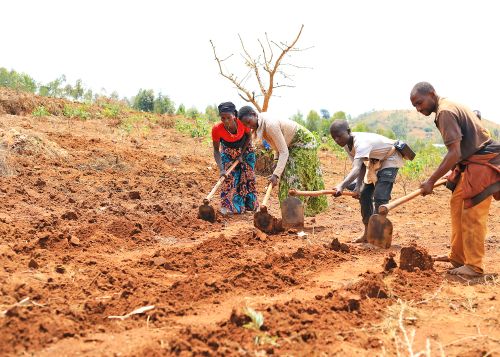
Francine Masamvya and members of her farming group dig planting holes on a hillside in Bugendana, preparing to sow maize using the methods promoted by One Acre Fund’s Tubura programme. Photo: Ferdinand Mbonihankuye, bird story agency
Burundi is drawing on international climate finance to help smallholder farmers protect their soils and cope with increasingly uncertain growing conditions. A project backed by the Green Climate Fund shows how that money reaches farms, what farmers still pay for and how the project’s contribution to their resilience is being assessed.
By Ferdinand Mbonihankuye, bird story agency
25 November 2026
The sun is high above Gitora hill. On the red earth of Bugendana commune in Burundi’s central Gitega province, hoes strike the soil as Francine Masamvya bends over her field. Around her, men and women from her farming group dig planting holes, a task known in Kirundi as guca amabango. A cord stretched across the field keeps the rows straight.
Masamvya, 48, has farmed since childhood and lives in Gitora, in Bugendana’s Mugera zone. For years, she recalls, she sowed much and harvested little.
“In the past, we farmed in the traditional way, blindly, what we call ‘jujuta’ in Kirundi,” she says. “Since we came to know the Tubura approach of One Acre Fund, we know to put three maize seeds in each hole, with proper spacing. We farm better and we harvest better.”
She used to put as many as five seeds in one hole, crowding the plants. Now she measures out the compost and spaces the planting holes evenly.
“At first, I harvested about 100 kilos, even though I had sown a lot,” she says. “Today, with only three kilos of seed, I get almost 800 to 1,500 kilos of maize from these two hectares.”
The larger harvest allows Masamvya to feed her family and sell part of the crop.
“We don’t just produce for the market through agriculture,” she says. “We also grow food for our children, to ensure they stay healthy with a balanced diet.”
The income pays for school uniforms, fees and supplies, and has helped her raise goats and chickens.
Heavy rain can wash soil off the slopes. To protect their fields, Masamvya and other women farmers dig contour lines and plant trees near their crops.
“We fight to secure production by digging contour lines to protect our fields from erosion during heavy rains, and by planting agroforestry trees,” she says.
Below the field, the group’s nurseries hold grevillea and calliandra seedlings. Agronomist Ildephonse Nimbesha says the leaves provide organic matter for the soil. He says the trees help control erosion, use less water than eucalyptus and provide shade. They also supply timber and stakes for climbing beans, reducing pressure on natural forests.
The Food and Agriculture Organization (FAO) says well-designed and maintained agroforestry can improve soil fertility, conserve water and limit erosion, while a poor combination of trees and crops can reduce yields. Publications by the Burundi Institute of Agronomic Sciences (ISABU) stress the importance of vegetation cover and soil structure in limiting erosion from rain. International research on soil bioengineering describes how hedgerows, contour lines and agroforestry trees can help stabilise soil.
On Gitora hill, Samuel Bigirimana of the Village Association for Mutual Aid and Community Development (AVEDEC) describes restoration work in small catchments. The work included planting trees upstream, digging contour lines and planting grasses and reeds to hold the soil in place.
Bigirimana says this helped restore the Maguzanza spring, and a pumping system now supplies areas that previously had no water.
“Today, there is no longer significant run-off: the water easily infiltrates into the soil,” he says.
Women on the hillside sow crops, sell vegetables, dig contour lines and plant trees. Their earnings help feed their children, pay for school and cover other household expenses.
Access to advice, markets and finance can affect what women earn from that work. So can secure land tenure. Farmers who plant trees that take years to mature need to be able to benefit from them over time. Agriculture supports much of Burundi’s population, according to the FAO’s country brief.
One Acre Fund, an American NGO that works across Africa, runs Tubura. The programme takes its name from the Kirundi verb gutuburura.
“When you harvest, you eat your fill, then you increase your harvests,” says Yvan Marre Intungane, a communications officer at One Acre Fund.
The programme began in Mbuye and now works in more than 1,220 communities. The NGO says it supports more than 600,000 households and employs more than 1,900 staff who work in their home communities. Tubura delivers seeds and fertiliser close to where farmers live, helps them plant trees, and supports farmer groups and cooperatives in selling their produce. It also provides lamps, mobile phones, saucepans and menstrual hygiene kits.
Farmers receive agricultural inputs on credit and repay their cost after harvest. One Acre Fund says it reinvests the repayments to extend the programme. The NGO says it does not seize land, livestock or tools when repayments are late. It reports a non-repayment rate of about 2 percent.
Intungane says the agroforestry work forms part of a project funded by the Green Climate Fund (GCF).
On 24 October 2024, the GCF approved a US$25 million grant to One Acre Fund for SAP045, “Scaling up Climate Resilience Solutions for Burundian Smallholders”. With US$10 million in co-financing, the project totals US$35 million. It is due to run until October 2029 and aims to help 2.3 million people cope with climate change through access to agricultural inputs, advice and agroforestry support.
The GCF reports paying US$4,994,186 in October 2024 and US$6,377,056 in May 2026, together about 45 percent of its contribution. For farmers like Masamvya, support comes through training, seedlings, advice and access to inputs. Tubura was already operating before the GCF approved the grant in 2024.
In 2026, One Acre Fund plans to distribute 105,407 avocado saplings and 1.3 million Japanese plum trees from its 1,220 nurseries, alongside calliandra, grevillea and other species.
Under the practice farmers call jujuta, Intungane says, farmers sometimes sowed more than four seeds per hole and walked long distances to find fertiliser. “Nowadays, a farmer plants two kilograms and harvests more than 400 kilograms,” he says.
Masamvya says she harvests between 800 and 1,500 kilograms from three kilograms of seed across her two hectares.
Intungane says fertiliser is in short supply while the NGO waits for import authorisation. Farmers repay input costs after harvest, when their income depends in part on how well the rains have held up.
The GCF’s 2025 Annual Performance Report, published in July 2026, includes early comparisons between participating and non-participating farmers. Those comparisons do not establish how much of the change in farming practices or yields is due to the grant.
On Gitora hill, the cord stretched across Masamvya’s field guides her group as they dig the next row of planting holes. She says the maize she harvests from these two hectares feeds her children, and that what she sells helps pay for their school fees, uniforms and supplies.
bird story agency
Leave a Reply