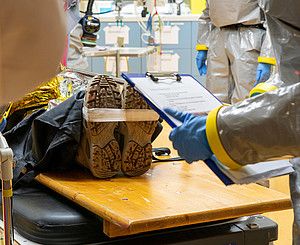
Disaster response exercise © Charité | Artur Krutsch
Berlin, 24 November 2026
Whether it is a natural disaster, a terrorist attack, or a collective defence emergency, the key to effectively caring for many injured people lies in optimally distributing them among suitable hospitals. This requires a reliable overview of local treatment capacities—something that is currently lacking. Led by Charité – Universitätsmedizin Berlin, an interdisciplinary team of medical and IT experts—the REAKT consortium—aims to establish such an overview. Supported by the Federal Ministry for Research, Technology and Space (BMFTR), the consortium is developing a digital platform that provides real-time visibility into medical resources, patient flows, and supply chains.
In an acute crisis, the primary focus is on individuals who require immediate treatment for their injuries. However, especially if a situation persists, the medical care provided to the rest of the population must not be neglected. “To optimally distribute injured patients, we need to know more than just the number of available beds,” says Prof. Vera Jaecker, Deputy Clinic Director and Head of the Trauma Surgery Section at the Centre for Musculoskeletal Surgery at Charité’s Campus Virchow-Klinikum. “An empty bed is of little use if the surgical team, the necessary instruments, or blood supplies are unavailable.”
A real-time platform instead of manual inquiries
What truly matters is the “operational treatment capacity”—that is, what a hospital can deliver at any given moment. “While there are existing systems—such as a registry for intensive care beds or platforms that connect emergency medical services with hospitals—this information is not integrated,” explains Vera Jaecker, who coordinates the REAKT project. “Furthermore, there is no comprehensive overview of the availability of surgical and trauma-related resources; currently, such information can only be obtained through manual inquiries.” To improve the management of patient care during crises, the REAKT team aims to integrate existing data systems and supplement them with additional information—such as current operating room and bed capacities, the availability of qualified specialists for treating specific types of injuries, surgical instruments and sterilization capabilities, blood supplies, medications, and the inventory levels and supply chains for essential medical products. This allows bottlenecks to be identified early, well before they can jeopardize patient care. The platform is designed to be accessible to emergency dispatch centres, emergency medical services, hospitals, and relevant authorities. The overall situational overview is further supported by a communication system that enables all stakeholders to exchange information securely.
System integrates heterogeneous data
Resilience is a core principle of the project, ensuring functionality even if IT systems or communication networks fail. “Until now, there has been no approach within the German healthcare sector that systematically integrates heterogeneous data sources from hospitals, civil protection services, and medical-technical logistics,” explains Vera Jaecker. “We are developing a ‘federated’ system that connects existing data sources rather than replacing them with a single, centralized solution. This makes the system less vulnerable should individual components fail.”
For the development of this software, physicians are collaborating with researchers specializing in communication systems, data infrastructure, and systems engineering. In addition to Charité, partners in this joint project include the Robert Koch Institute and the Fraunhofer Institutes FOKUS and ISST. The concept is initially being developed and tested within the Berlin Trauma Network of the German Society for Trauma Surgery (DGU)—a network of Berlin-based hospitals that already collaborate on the care of severely injured patients. Once the REAKT platform has been successfully tested in simulations, the plan is to roll it out nationwide across Germany.
About REAKT
REAKT stands for “Resilient Real-time Platform for Coordinating Cross-Sectoral Capacities and Communication in Trauma and Crisis Situations.” The consortium is coordinated by Charité – Universitätsmedizin Berlin. Other consortium partners include the Fraunhofer Institute for Open Communication Systems (FOKUS), the Fraunhofer Institute for Software and Systems Engineering (ISST), the Robert Koch Institute (RKI), the Academy for Trauma Surgery (AUC), and Capgemini Germany. The consortium works in collaboration with the Berlin Senate Department for Science, Health and Care, the German Armed Forces Hospital in Berlin, hospitals within the Berlin Trauma Network, the German Society for Trauma Surgery, and the companies Miele Professional and B. Braun. REAKT is receiving 4.9 million euros in funding over three years from the Federal Ministry for Research, Technology and Space (BMFTR) under its grant guidelines for cross-sectoral measures for resilient healthcare.
Leave a Reply