
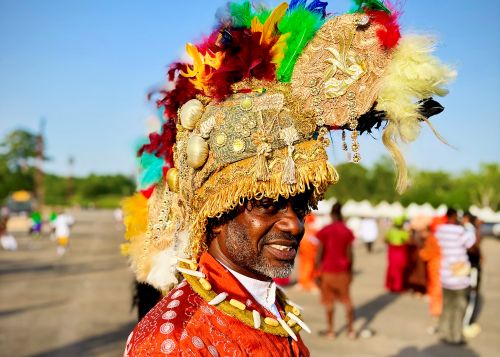
Attendee dressed in colourful garments at Nigeria’s National Festival of Arts and Culture, held at Okpara Square in Enugu State, Nigeria, on November 20, 2026. Photo: Toochi Gabriel, bird story agency.
At Nigeria’s National Festival of Arts and Culture in Enugu, adire makers say young people are taking an interest in the fabric, even as sales remain slow. The festival offers a glimpse of how textile makers and others working in fashion, film, animation and storytelling can build on the connections they make and the skills they gain to earn a steadier income throughout the year.
By Toochi Gabriel, bird story agency
25 November 2026
To make a batch of adire, Oloyede Abosede folds a length of cloth and ties it by hand, placing each knot where she wants the fabric to resist the dye. The cloth goes into boiling water before she applies a mixture of dye, soda and sulphite. She seals the fabric, then leaves it to dry in the sun for several hours. Only when she loosens the threads does the pattern fully emerge.
“If you start from morning, you can ready it in evening,” says Mrs Abosede, a textile maker from Ogun State. The materials for one batch cost her about ₦20,000.
Abosede was among the vendors at the 38th National Festival of Arts and Culture (NAFEST), which opened on 20 November 2026 at Okpara Square in Enugu State. Themed “Connected Culture”, the festival brought together participants from across Nigeria to showcase the country’s arts, crafts and cultural traditions.
For Abosede, who learned the trade from her husband after their marriage, there are reasons to be encouraged about the future of adire. She has noticed more young Nigerians showing interest in the fabric, particularly for contemporary clothing.
“Young people, they are buying adire now,” she says, adding that crepe and “shaking materials” are popular for skirts, gowns and trousers. Some young people are also interested in learning how to make the fabric. “Maybe they’re directing them from school … to go and learn how to do adire. So we see some of them, they come to us, ‘I want to learn this, I want to learn this.'”
It is a welcome development for a trade passed down through generations. But interest in the fabric does not always translate into enough sales to sustain the people making it.
Asked whether NAFEST had brought her business, Abosede’s assessment was less encouraging.
“The reason why we came for this programme, everything has changed the way Nigeria is, the way it is now. … People are not buying. There’s no sales at all. … Some years back, they did this programme at Abuja. People have made sales. But this one, there’s no sales at all.”
For a vendor who has to cover the cost of materials, transport and time spent making the fabric, a festival appearance is only useful if it connects her to paying customers.
Abosede says the business has helped her family meet everyday needs, including paying school fees, even as sales remain uncertain.

Attendees dressed in colourful garments at Nigeria’s National Festival of Arts and Culture, held at Okpara Square in Enugu State, Nigeria, on November 20, 2026. Photo: Toochi Gabriel, bird story agency.
“How everything is at the moment, things have changed. So, with the little bits coming in, we thank God, we manage to send our children to school and take care of ourselves through it,” she says.
Nigeria’s creative economy contributes approximately 2.3 per cent to the country’s GDP and employs more than 4.2 million people, according to figures cited by the Federal Government in 2025.
At the festival’s opening, Minister of Arts, Culture, Tourism and the Creative Economy Hannatu Musawa called for a stronger connection between cultural celebration and economic opportunity.
“We must move from merely celebrating our culture to building sustainable economic value around it,” she said, urging stakeholders to move “from visibility to value creation, and from cultural participation to sustainable economic opportunities”.
Another vendor from Ogun State, Mrs Salako Taiwo, who sells Adire, Batik, Tie and Dye and Egbalawa, shares some of Abosede’s observations about younger consumers. Having learned the craft from her mother, she says interest in Adire is not limited to older generations.
“Na everybody dey buy am, oh. Everybody dey buy Adire. All our small, small girl or boys dey like Adire. … No be only old woman, old man dey like am.”
But business at the festival has been modest. Asked how sales were going, she replied: “Everybody manage am small, small, oh. Na small, small they manage am, oh.”
The experiences of the two vendors point to a gap between the visibility that cultural festivals provide and the income artisans hope to earn from participating in them.
Favour Ogbuji, a cultural entrepreneur, founder of Igbo Hangout and Festivals, and publicist involved in marketing NAFEST, says the problem extends beyond individual events. Nigerian craftspeople, he argues, are not being adequately connected to markets where their work can generate sustainable income.
“With the globalisation of African arts, with the sporadic spread of African media, African consumables, it is now pertinent that in-as-much as we are reaching more people in the world, the local producers should be adequately incentivised in the sense that we must create funnels whereby the actual producers of these arts, the actual source of these arts, are actually being compensated of what is due them,” he says.

Oloyede Abosede, a textile maker, engaging a customer at her stall at Nigeria’s National Festival of Arts and Culture, held at Okpara Square in Enugu State, Nigeria, on November 20, 2026. Photo: Toochi Gabriel, bird story agency.
He identifies a lack of platforms that position artisans to reach wider markets as one of their biggest challenges.
“Platforming is how they get seen. Platforms where they get seen, where they get appreciated, where their art, their goods, their services can get patronized from.”
He also believes that attracting younger consumers requires changing how traditional products are presented and sold, rather than abandoning the cultural practices behind them.
“A whole lot of us see the culture as archaic, see the culture as old. Some even see the culture as dirty. So again, in rejuvenating people’s mind, we must approach it from a different perspective in how it is being presented, in how it is being sold,” he says.
For NAFEST organisers, however, the festival’s primary purpose is not to function as a marketplace.
Obi Asika, Director General of the National Council for Arts and Culture (NCAC), describes NAFEST as Nigeria’s cultural Olympics, arguing that its central responsibility is bringing people together to celebrate and share their cultures.
“NAFEST, which is the National Festival for Arts and Culture, is Nigeria’s cultural Olympics. That’s like asking, ‘What is the Olympics doing to create opportunities for artisans and whatever?’ Let’s be real. That’s not the primary function of NAFEST,” he says.
But he also points to efforts to give participants access to skills and opportunities beyond the festival. This year’s programme included capacity-building sessions involving the Bank of Industry, Southeast Development Commission, Ministry of Finance Incorporated, British Council, GIZ and the European Union.
“We’re bringing skills in storytelling, film, fashion, animation. Some of the biggest names in this country will be in Enugu doing their work,” Asika says.
“The impact can be measured by the amount of people that came into Enugu, which was at least 5,000. They stayed in Enugu accommodation, they spent their money here, they ate the food, and they experienced the city. That’s the economic impact,” he says.
That ambition raises an important question: what happens to the artisans after the festivals ends?
For Abosede and Taiwo, the immediate concern is finding customers willing to buy their products. For the organisers, it is about creating pathways through training, partnerships and wider exposure. For Ogbuji, those efforts must also include platforms that connect producers directly to buyers.
bird story agency
Leave a Reply