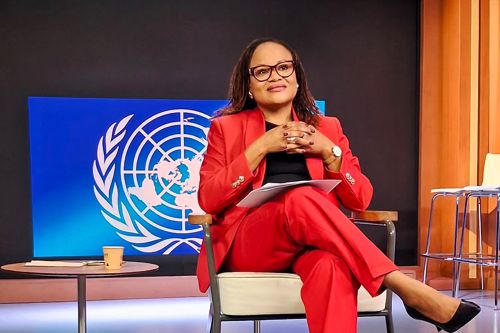
Leah Mushi poses for a photo on set during one of the bullletin sessions. Photo courtesy: UN News
The Tanzanian journalist reflects on her journey from Tandale to the UN, the importance of communicating global issues in Kiswahili, and why young Africans should see international opportunities as within their reach.
By Bonface Orucho, bird story agency
06 November 2026
Leah Mushi describes herself as a girl from Tandale, one of Dar es Salaam’s low-income neighbourhoods.
Today, she works at United Nations headquarters in New York, as a Global Communications Officer bringing global affairs to Kiswahili-speaking audiences.
Her journey from volunteering unpaid at a university radio station in Tanzania to working at the UN reflects a career built on curiosity, persistence and a willingness to pursue opportunities she once thought were beyond her reach.
Journalism was not her original plan. Interested in economics, business and international affairs, Mushi found her way into mass communication after a university lecturer recognised her curiosity about world events. She spent three years volunteering at a university radio station in Mwanza before joining the Tanzania Broadcasting Corporation (TBC), where she rose to become an online editor.
Her path eventually led beyond the newsroom to media training, international communication and the UN. Today, she works to make complex global issues accessible and relevant to Kiswahili-speaking audiences.
In this conversation with bird story agency, Mushi reflects on the journey that brought her to the UN, the power of language to connect global issues with people’s lives, and the lessons she hopes young Africans will draw from her experience.
This interview has been edited for length.
1. You have described yourself as a girl from Tandale who is now living her dream at the United Nations. How did that journey unfold?
I’m living my dream. I am a Tanzanian, a mother of two, a journalist and a proud African journalist working at the United Nations headquarters in New York.
I started as a cub reporter. I volunteered at a university radio station in Mwanza for three years without pay. After completing my degree in mass communication, I got a job at the Tanzania Broadcasting Corporation in Dar es Salaam.
I worked hard, covering everything from small stories on the streets to major stories from the president’s office. Eventually, I became an online editor.
But I had bigger dreams. I did not just want to become a manager or a director in a newsroom. I wanted to explore other opportunities, including media training and programmes that supported journalists. Those experiences exposed me to international work and helped me move towards the United Nations.
2. Journalism was not your original plan. What led you to it?
Initially, I wanted to study economics and business. I was also interested in international affairs.
After Form Six, I was working and trying to save money for university. When I eventually went to Mwanza to enrol, the course I wanted was already full. I had to stay with a friend as I waited for my sister to send me money to return home.
My friend’s father was the head of the Mass Communication department at the university. We started talking about international affairs, politics, wars and what was happening around the world, including Barack Obama’s emergence as a possible US president.
He asked me why I knew so much about these things but did not want to become a journalist. He encouraged me to study mass communication and volunteer at a radio station.
That conversation changed my direction. I started journalism, and today, the international affairs I was so interested in are central to my work.
3. What made you want to move from journalism in Tanzania into international work?
When I started, I was interested in public relations and thought I might eventually become a public relations manager. But as I continued studying and working, I realised that my interest in international affairs was much deeper.
I pursued a degree in international communication in China, and that experience helped me understand how much I wanted to work in an international environment.
I also looked for opportunities that would expose me to issues beyond Tanzania. I became involved in networks and initiatives supporting women journalists, including the Graça Machel Women in Media Network, where I served as the Tanzania chapter leader.
Through those networks, I met other African women journalists and gained a broader perspective. I was interested in international affairs and climate change, so I deliberately sought out spaces where I could learn and contribute.
4. Why was working at the United Nations such an important goal for you?
As a journalist covering international affairs and politics, I kept hearing about the United Nations. Whether the subject was women, elections, wars, hunger, children or development, the UN seemed to be involved in so many issues.
I started wondering about this institution that was connected to so many things happening around the world. I made it my mission to work there.
At one point, after leaving a media house, I went for a job interview and told the interviewer that if the UN offered me a job, I would leave. The person told me that recruitment at the UN takes a long time.
But I was determined. I did not just want to work for the UN somewhere in Dar es Salaam. I wanted to work at the headquarters in New York.
5. You now communicate international affairs in Kiswahili. Why does language matter so much in this work?
People understand and remember information better when it is communicated in a language they know.
Kiswahili is spoken by many people across Africa. If you are explaining something like Ebola, for example, communicating it in Kiswahili can make the information easier for audiences to understand.
Language also allows you to use expressions and sayings that people are familiar with. These can help explain complex ideas in ways that connect with people’s experiences.
For me, Kiswahili is not just about delivering information. It makes me feel that I am speaking directly to my people. It creates a connection.
6. How do you make global issues relevant to audiences whose everyday realities may be very different from those discussed at the UN?
You have to remain connected to what is happening on the ground. I read news from East Africa, follow discussions on social media and keep up with what people are talking about. I also follow UN agencies and the issues they work on.
You have to understand your audience and think about how a particular issue affects them.
Take artificial intelligence, for example. In some countries, people are discussing the electricity and water used by data centres and how these facilities affect surrounding communities. But there are people in East Africa who still do not have reliable access to electricity or the internet.
If you are communicating about AI to those audiences, you have to consider their circumstances. You cannot assume that everyone approaches the issue from the same starting point.
The same applies to pollution. Someone living in an industrialised area may understand the impact of factories differently from someone who has never seen one. The issue may be global, but the way you explain it must make sense to the people you are speaking to.
7. How do you handle technical subjects when there is no familiar Kiswahili term for a concept?
Some subjects, particularly health, can be difficult because the terminology is very technical. You cannot simply translate a word and assume that you have communicated the right meaning.
I consult scientists and technical experts, use dictionaries and other references, and seek help from people who understand the subject. I also consult language experts, including a professor at the University of Nairobi and BAKITA, Tanzania’s National Kiswahili Council.
Artificial intelligence is one example of an area where terminology can be challenging. If I do not know the right term, I have to find out rather than inventing one.
I treat Kiswahili as a professional language. You have to take it seriously and make sure that what you communicate is accurate.
8. You interview heads of state, ministers, refugees and young people at the UN. Do you ever doubt yourself?
All the time. Self-doubt is something I experience regularly.
There are rules, responsibilities and implications attached to the work we do. When I am preparing to interview a president, I ask myself whether I am adequately prepared. When I am telling the story of a refugee, I ask myself whether I will tell that person’s story properly.
We serve Kiswahili-speaking audiences, including people across the Great Lakes region and in the diaspora. That is a responsibility I take seriously.
You have to prepare, understand the subject and think carefully about the people whose stories you are telling. You cannot take that responsibility lightly.
9. How has working at the United Nations changed the way you see yourself and what is possible?
I see possibilities now that I might previously have thought were impossible.
When I was younger, there were spaces I thought were meant for a certain group of people, not for someone like me. But as I joined national, African and international networks, I began to realise that the people in those spaces were ordinary people, too. They had worked to get there.
At the UN, I also meet people from different backgrounds and hear stories from refugees and people from Asia, Europe and other parts of the world. Those conversations change your perspective. You learn how different people deal with challenges.
Now, I see almost everything as possible.
I describe myself as a girl from Tandale because I want people to know where I come from. I want someone from a disadvantaged background to understand that where you begin does not have to determine where you end up.
You can be the one who goes first. You are that person. I came from Tandale, and now I’m here in New York, working at the United Nations.
10. What advice would you give young Africans who want to build careers in journalism or international affairs?
Brand yourself. Education is important, but how you present yourself also matters. Your personal brand matters.
Social media is part of your digital footprint. You should behave online in a way that reflects the person you want to become. That does not mean you must be serious all the time. You can have fun and be friendly, but when it comes to professional matters, you have to be careful.
There is no reward for insulting people or being unnecessarily critical online. Use social media to build a professional brand.
You also have to prepare before an opportunity comes. Think about where you want to be in five years and start working towards it now. If you are not yet ready for the opportunity you want, ask yourself what skills you need and what you can do to develop them.
Do not wait until the opportunity appears to start preparing for it.
bird story agency
Leave a Reply