
IMAGE: bird story agency
African countries are pairing ports, factories, energy and logistics as they compete for manufacturing investment and seek to keep more value from raw materials on the continent.
Bonface Orucho, bird story agency
07 October 2026
African special economic zones are becoming larger industrial bets as governments and investors bring ports, factories, processing and logistics into the same development.
New projects in Kenya and Nigeria are putting major industrial facilities alongside maritime infrastructure, while operating zones in Togo and South Africa are showing how the model can support processing, exports and manufacturing.
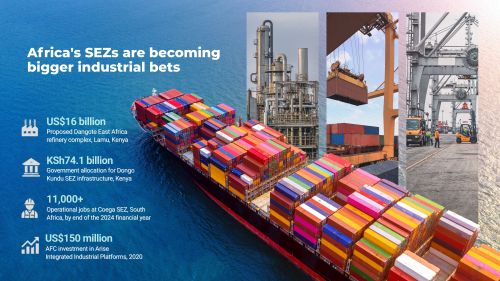
In Kenya, construction has begun on the planned Dangote East Africa Petroleum Refinery in Lamu, part of a proposed US$16 billion complex combining refining, petrochemicals and power generation.
The project is being developed within the LAPSSET corridor, linking the planned industrial complex to a wider transport and logistics network serving regional markets.
In Nigeria, DP World, Ogun State and the Ogun Deep Sea Port Company have signed agreements to explore a 10,000-hectare development combining a proposed deep-sea port with a special economic zone.
The projects reflect a shift in the business case for SEZs, from providing land and incentives to reducing the cost and complexity of producing and moving goods.
“For us, that’s what successful SEZs are about, capturing more value in Africa, creating jobs, increasing exports, and really building globally competitive African industries,” according to Osam Iyahen, senior director and head of infrastructure at Africa Finance Corporation.
Iyahen was speaking during an October 1 Invest Africa webinar on the role of SEZs in building competitive industries in Africa.
AFC invests in power, transport, logistics, natural resources and heavy industry, making integrated zones attractive because they bring several of these requirements together.
“SEZs are quite important to us because they bring together all these sectors together that I just mentioned,” Iyahen said.
AFC invested US$150 million in Arise Integrated Industrial Platforms in 2020 to support its expansion into Benin and Togo.
Iyahen said the platform has helped countries move from exporting raw commodities towards local processing and manufacturing, while attracting additional investment and creating jobs.
Togo provides a concrete example.
On September 1, Togo Soja, a company based at the Adétikopé Industrial Platform, shipped its first export of processed shea butter, opening the country’s 2026 export season for the product.
The shipment followed the ramp-up of a plant that has been operating since 2023 and processes soybeans and other agricultural products, including shea.
The PIA says the operation is developing an integrated chain from raw-material supply and industrial processing to packaging and international markets.
“This shipment reflects the industrial dynamic developed on the platform and its ability to support companies from the transformation of raw materials to opening up to international markets,” according to Idiola Sandah, general administrator of the PIA Coordination Authority.
Togo, earlier in the year, in January introduced export taxes on cashew nuts, soybeans and shea nuts from January 2026 as it seeks to encourage more processing inside the country.
The quantity of shea butter in the first shipment was not disclosed, but the move illustrates the commercial logic behind integrated industrial platforms: export more processed products rather than raw commodities.
Logistics is another part of that equation.
Agility Global is building warehouse parks across African cities, providing ready-to-use facilities for companies entering new markets.
“We’re building large-scale, first-world warehouse parks across the main cities in the continent,” said Geoffrey White, CEO of Agility Africa.
The company has opened facilities in five countries, with some already fully occupied, White said.
Its customers include e-commerce companies, agro-processors, manufacturers, vehicle assemblers and fast-moving consumer goods distributors.
About 65% of its tenants are multinationals and 35% are small and medium-sized businesses.
“Our concept is to remove, for companies moving into Africa, the risk of land tenure and project execution, and to remove the capital burden of going into the African marketplace,” White said.
Ports are becoming another piece of the industrial proposition.
At Lagos Free Zone, Nigeria’s Lekki Deep Sea Port sits within an industrial development designed to combine manufacturing, logistics and maritime access.
Tejaswi Avasarala, director of commercialisation at Lagos Free Zone, said Tolaram’s more than five decades of manufacturing experience in Nigeria had shaped the project.
The company has a “very deep and firsthand understanding” of the challenges facing investors trying to build deeper value chains and local supply chains, he said.
“We are trying to bring all that into the way we have conceptualized and delivered Nigeria’s first deep sea port,” Avasarala said.
The same model is now being explored on a larger scale in Ogun State.
The proposed Ogun development remains at the planning stage, so its projected investment and employment figures have yet to become operating results.
Kenya is pursuing a similar port-industrial model at Mombasa.
DP World and GulfCap Africa signed a shareholders agreement in September for the planned 222-hectare Mombasa Industrial Park.
The first phase is expected to cover 40 hectares, while more than 60 local and international companies have expressed interest.
The completed park is projected to support more than 20,000 direct and indirect jobs.
At Dongo Kundu, the Kenyan government has allocated KSh74.1 billion for infrastructure supporting a 3,000-acre SEZ that includes industrial parks, logistics facilities and a free port.
Further south, Coega SEZ in South Africa shows what the model can look like after years of development.
The zone, next to the Port of Ngqura in the Eastern Cape, had 67 operational investors and more than 11,000 operational jobs by the end of the 2024 financial year.
bird story agency
Leave a Reply