
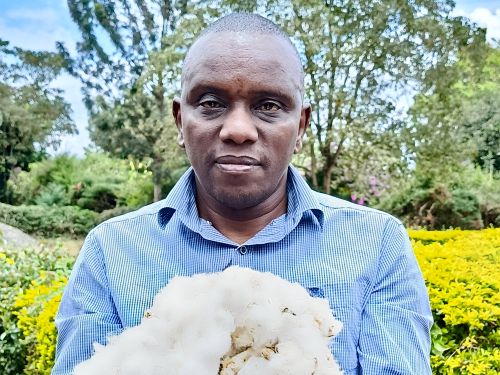
Dr David Kabata , holding cotton in the Bt seed production demo farm at Kirinyaga University, Kirinyaga County. Photo Milliam Murigi, bird story agency
At Kirinyaga University, researchers are testing whether Kenya can produce quality Bt cotton seed locally. The trials could help improve supply and lower costs, but taking the research to farmers will require commercial investment and support across the cotton value chain.
By Milliam Murigi, bird story agency
06 October 2026
Inside a laboratory at Kirinyaga University in central Kenya and on nearby fields, researchers are investigating a question that could shape what farmers plant in future: can Kenya produce its own Bt cotton seed? Bt cotton is genetically modified to produce proteins from the bacterium Bacillus thuringiensis that protect it against certain insect pests.
If you haven’t received either invite, please let me know.
Flo and Lesego, you also have an invite for the Friday social media meeting.
Their work aims to establish whether the seed, currently imported, can be produced locally as Kenya seeks to strengthen its cotton industry.
“The experiment is about more than producing seeds. It is about generating the evidence needed to determine whether a process can work locally before it is taken to farmers and commercial producers,” says Dr. David Kabata, one of the researchers involved.
According to Kabata, the trials started in September 2025 and seed from the trial plants is now ready for laboratory testing. The tests will assess whether the seed is true to type, viable and healthy, and retains the intended Bt trait.
Grace Wambui, the trials’ field assistant, says the process began when the team received approved and certified Bt cotton seed from Mahyco. They received seed for both male and female parent plants, which they planted on separate demonstration farms according to the trial requirements.
“With these trials we are trying to establish two things. First, whether it is possible to produce high-quality BT cotton seeds locally, and the second one is to see if cotton can become a perennial crop. We want to see if cotton plants can be retained for subsequent seasons and still remain productive instead of planting new seeds every season,” says Dr. Kabata.
According to Wambui, workers were trained to select suitable female plants for seed production using a sticky/non-sticky test. They took young cotton bolls from the female plants and rubbed them against the backs of their hands. Plants whose bolls felt sticky were considered unsuitable and uprooted, while those with non-sticky bolls were retained.
At the flowering stage, workers hand-pollinated the female plants to support seed production.
Kabata says the laboratory results will guide the next stage of research, whether the locally produced seed meets the required quality standards or falls short.
“If the seeds don’t perform as expected, the team plans to identify what may have affected their quality and refine the production process before conducting further trials. The objective is not simply to produce seed once, but to establish a reliable process for producing quality cotton seed locally,” adds Dr. Kabata.
The research comes as Kenya seeks to revive its cotton industry, with access to adequate and affordable seed central to efforts to expand production. Kabata says local seed production could reduce costs if the trials succeed.
“If we are able to produce the seeds here, it means that the price can go down by half,” says Dr. Kabata.
Local production could also give Kenya greater capacity to align seed supply with farmers’ planting requirements. However, the Agriculture and Food Authority (AFA) cautions that producing seed locally will not automatically make it affordable. Prices will depend on the efficiency and scale of the production and distribution system.
Dr. Paul Chege, a crop scientist and biosafety expert, says local production could also help the country build seed reserves and maintain sufficient stock as farmers seek to expand production.
According to AFA, demand for Bt cotton seed is increasing as Kenya expands cotton production and promotes improved varieties. The authority expects demand to grow further as more farmers adopt Bt cotton and the area under cultivation increases.
Supply, however, has not always been sufficient to meet potential demand. Kenya depends on imported certified Bt cotton seed, with delays associated with government procurement sometimes disrupting farmers’ access.
“Lack of a local seed production and supply system is one of the major constraints affecting cotton production and expansion in Kenya. Emphasis should be on strengthening local production, multiplication, distribution and availability of Bt cotton seed, while ensuring that farmers have access to seeds in adequate quantities and before the planting season,” reads a statement from AFA.
Chege says local seed production alone will not resolve the challenges facing cotton farmers. Other parts of the value chain also need investment.
In the short term, he says, Kenya needs to strengthen extension services tailored to cotton production, revive existing ginneries and establish new ones to ensure farmers’ harvests can be processed.
He also advocates support for cottage industries to create jobs and enable more people to benefit from cotton production beyond the farm.
“Local production of Bt cotton seed is one of the critical factors that can revive the cotton industry by bringing down the cost of production and improving the quality of the produce, but it should not be viewed in isolation; it is not a silver bullet. Sound extension, proper soil and water management, mechanization and other agronomic practices must also be adhered to,” says Dr. Chege.
According to AFA, local seed production requires a system that connects research to farmers and, ultimately, finished products.
That means developing suitable cotton varieties, producing sufficient quality seed, testing and certifying it, and distributing it in time for planting. Farmers also need support to grow the crop successfully, while processors need the capacity to gin the harvested cotton and supply industries making textiles and clothing.
If effectively implemented, such a system could provide a more sustainable foundation for expanding cotton production and strengthening links between researchers, farmers and processors.
At Kirinyaga University, the researchers are working with an already approved and certified variety rather than developing a new one. This could shorten the route to supplying farmers if the locally produced seed meets the required quality and performance standards.
Kabata says commercial seed companies will need to take the work forward if the trials yield positive results. The university’s role is to establish whether quality seed can be produced locally and generate evidence to guide the next stage. It cannot produce seed on a commercial scale.
“This is a research production centre, so our main goal is, first of all, to do research and know whether it is possible to produce these seeds locally or not. From there, the other part we can play is to train people on how to produce these cotton seeds wherever they are,” he says.
Moving beyond the university’s demonstration farms will therefore require commercial seed companies and other producers to invest in larger-scale production and distribution.
Kabata is also calling on other researchers to pursue similar work and on the government to support institutions investigating ways to strengthen Kenya’s cotton industry.
bird story agency
Leave a Reply