
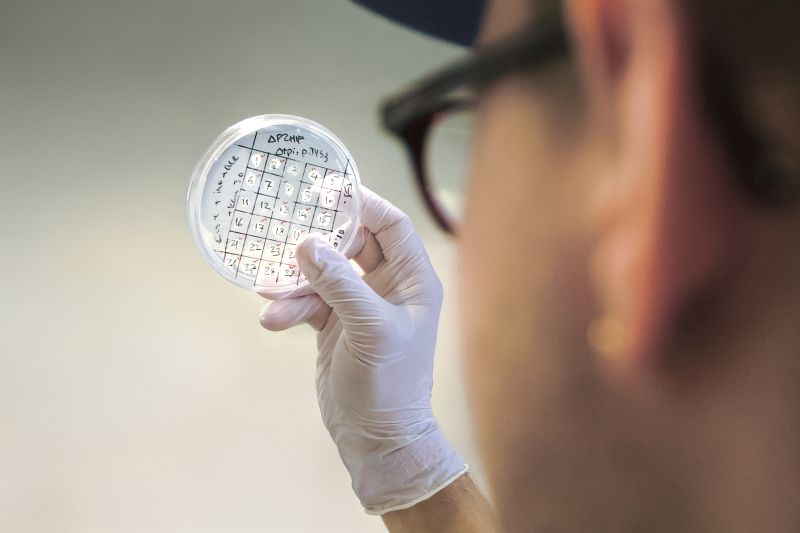
In search of the optimal microbial strain: In the CarboNcare project, researchers are developing bacteria capable of sustainably producing basic chemical feedstocks. © Charité | Stefan Hristov
EU Project Aims for Breakthrough in Sustainable Chemical Production
Berlin, 01 June, 2026
Plastics, pharmaceuticals, cosmetics—almost all products of daily life are based on fossil raw materials. A European research team led by Charité – Universitätsmedizin Berlin now aims to revolutionize this cornerstone of the chemical industry: In the CarboNcare project, researchers are developing bacteria capable of producing key chemical precursors from sustainable methanol—thereby replacing fossil raw materials. The project is funded by the European Innovation Council (EIC) through a Pathfinder Grant of 3.1 million euros, a funding instrument specifically designed to support groundbreaking innovations with high market potential.
The chemical industry remains heavily dependent on finite raw materials such as petroleum, natural gas, and coal. Many alternative approaches rely on sugar and biomass; however, their cultivation requires valuable land and competes with food production. “Our goal is to decouple chemical production from both fossil and plant-based raw materials,” says Dr. Steffen Lindner-Mehlich, a scientist at Charité’s Institute of Biochemistry and leader of the newly launched CarboNcare project. “After all, we want to make the chemical industry more sustainable without compromising food security. To achieve this, we are reaching deep into the biotechnological toolbox.”
The researchers’ objective is to enable a circular CO₂ economy—that is, to utilize the carbon dioxide released into the atmosphere (for instance, through the incineration of a plastic product at the end of its lifecycle) as the very basis for its manufacture. Ideally, this creates a closed carbon loop free of additional emissions. The first step on this path is already feasible today: Methanol—a central feedstock in the chemical industry—can already be produced from CO₂ captured from the atmosphere.
Bacterial Factories Set to Produce Lactate, Succinate, and Butanediol
The scientists involved in the CarboNcare project are now turning their attention to the second step: the conversion of methanol into key intermediates such as lactate, succinate, and 2,3-butanediol. From these substances, industry manufactures pharmaceuticals (e.g., tablet coatings), food products (e.g., preservatives and flavor enhancers), bioplastics, cosmetics (e.g., lipsticks and creams), and rubber for tire production. In the future, bacteria—acting as tiny biological factories—are set to take over this methanol conversion process. “We are genetically reprogramming two bacterial strains already utilized in industry—*Escherichia coli* and *Pseudomonas putida*—so that they ‘consume’ methanol and excrete lactate, succinate, or butanediol,” explains Steffen Lindner-Mehlich.
However, this is easier said than done; typically, bacteria channel the majority of the energy they derive from their “feedstock” into their own growth rather than into the production of chemical products. “That is why we are coupling the bacteria’s growth to the production of the desired chemicals,” the project leader explains. “Consequently, if the bacteria wish to grow, they must simultaneously produce the target molecule. This approach not only increases the yield but also renders the processes more robust and predictable—a crucial factor for industrial application.”
Optimization for Industrial Use
To comprehensively redesign the bacteria’s metabolic pathways, the project team intends to first simulate the biochemical processes on a computer before carrying out the necessary interventions within the bacterial organisms. “Beyond molecular biology, however, we also have industrial scalability firmly in our sights,” emphasizes Steffen Lindner-Mehlich. Therefore, the fermentation process is being designed to ensure it functions reliably on an industrial scale in the future, and it will be thoroughly analyzed in terms of both its environmental footprint and its economic viability. Eight European partners from academia and industry contribute the interdisciplinary expertise required for this to the CarboNcare project.
“We aim to develop a serious, sustainable alternative to established production pathways in the chemical industry,” emphasizes Steffen Lindner-Mehlich. “This will enable plastics, cosmetics, and other everyday products to be manufactured in a climate-neutral manner in the future.” The demand for basic chemicals illustrates just how great the potential of this approach could be: the global market for lactate alone amounted to approximately 2.9 billion euros in 2021 and continues to grow.
About CarboNcare
The CarboNcare project aims to develop a novel platform for the climate-neutral production of basic chemicals. It is funded through an EIC Pathfinder Grant and coordinated by Dr. Steffen Lindner-Mehlich (Charité). Additional consortium partners include the Max Planck Society and the DECHEMA Society for Chemical Engineering and Biotechnology (Germany), Leiden University (Netherlands), the French Alternative Energies and Atomic Energy Commission (CEA), the Technical University of Denmark (DTU), Impresa Sociale (Italy), and the University of Applied Sciences and Arts Western Switzerland (HES-SO).
EIC Pathfinder Grants
Through its Pathfinder Grants, the European Innovation Council (EIC) supports radically new technologies with the potential to create new markets. To this end, it funds visionary, high-risk projects at an early stage of development. EIC Pathfinder Grants are part of Horizon Europe, the European framework program for research and innovation.
Leave a Reply