
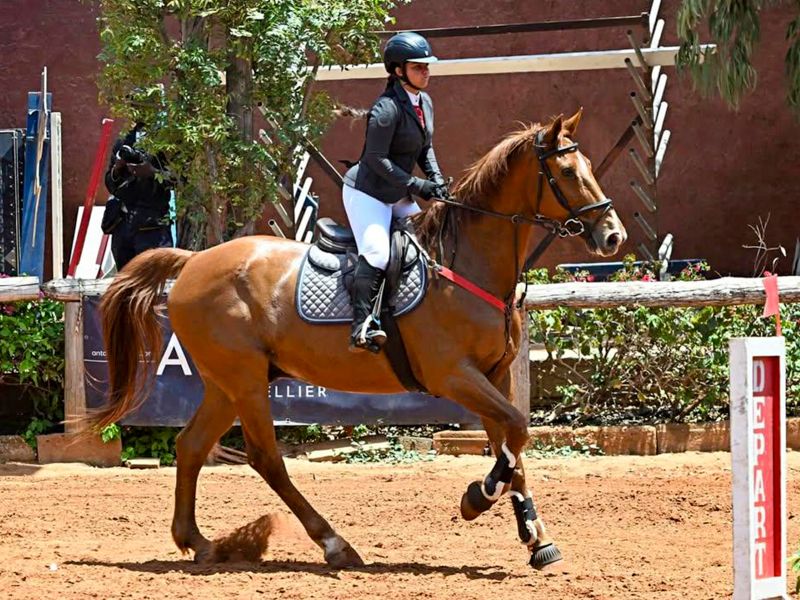
Laure Fakhry and Delirio D’OCQ Z at the 2025 Senegal Championships in Dakar, Senegal. Photo: Saliou Deme, bird story agency
As the only woman to own and run a stable in Senegal, Rayana Fakhry occupies a rare position in the country’s equestrian world. Through Écuries Hachem, the stable founded by her mother, she is training young riders, rehabilitating horses and championing an approach that places animal welfare at the centre of the sport. In doing so, she is helping shape a new generation of equestrians while expanding what leadership in the sector can look like.
By Fama Ndiaye, bird story agency
12 June 2026
Late afternoon at Écuries Hachem is one of the busiest times of day. Inside the stables, horses shift in their stalls as riders prepare for training sessions. The occasional neigh breaks through the steady rhythm of footsteps, conversation and work. At the centre of the activity is Rayana Fakhry, moving from one task to another, checking on riders, horses, and staff.
The 38-year-old oversees every aspect of the stable, from caring for horses to managing staff and supporting young riders. Écuries Hachem was established in 2022 but became fully operational in June 2023. That was when Fakhry took over the running from her mother, who founded the facility in Ndoukhoura Peulh, about 40 kilometres from Dakar. Yasmine Achem was the first woman to own and run a stable in Senegal.
“This is a stable that belongs to my mother. She entrusted it to me so that I could carry on the legacy,” says Fakhry.
When the stable first opened, its earliest riders were Fakhry’s daughters, Laure and Yasmine, along with members of the staff. Few people expected the project to develop as quickly as it has.
Today, the stable regularly competes in events organised by the Senegalese Equestrian Sports Federation. More children are enrolling for riding lessons, while horse owners increasingly entrust their animals to the facility.
“We have small ponies for the children, and we have boarders. That is to say, we have horses that people entrust to us. We take care of them. And at some point, generally, they take them back to Mali, all over the place. So, there you go. The flow comes and goes, actually. So, we generally have about thirty (30) to thirty-four (34) horses in the stable,” says Fakhry.
Her goal is not only to build a successful stable but also to help grow the sport in Senegal by creating opportunities for young riders.
That commitment is visible in the way children are introduced to horses at Écuries Hachem. Before they learn how to compete, they learn how to care.
For 13-year-old Yasmine Fakhry, every riding session begins with tending to the horse she will ride.
“First, I bring out the mare I’m going to ride. So, I take care of her because the connection with her horse comes first. I saddle her. I take care of her so I can ride her. Then I go work in the arena. When I finish working, I take care of her again. Just like I did at the beginning. And then I bring out my other horses and take care of them because you have to have a connection with your horse.”
The routine reflects one of the principles that guides life at the stable: the relationship between horse and rider matters as much as technical skill.
That belief also shapes how Fakhry approaches horses that arrive at the stable with difficult histories.
Some are injured. Others have been labelled too complicated to train. Many have been passed from owner to owner. At Écuries Hachem, they are given another chance.
One of the best-known examples is Delirio D’OCQ Z, a horse considered challenging by many riders. Through patience and consistent work, both horse and rider found their footing. Today, he stands among the stable’s success stories.
For Fakhry, these cases reinforce her belief that horses should not be viewed solely through the lens of performance.
“We have a maternal side that naturally draws us toward the horse’s well-being,” she says.
It is a perspective shared by Blanche Mattern, a French rider from The Basque Country who has spent years around horses and closely follows the evolution of equestrian sports.
“Having women in the field brings a breath of fresh air, and it also brings a firm hand in a velvet glove—more discipline, clubs that are very structured, because the environment is highly competitive. It’s very difficult for women, so they have even less room for error. It also gives young female riders greater access to equestrian sports. And for me, that also leads to greater well-being for the animals and in terms of training.”
According to Blanche, greater female participation is helping introduce approaches that place more emphasis on understanding animal behaviour and building trust between horse and rider.
The responsibility extends beyond maintaining a family business. In Senegal’s equestrian sector, leadership roles are still largely occupied by men. Running a stable requires managing people, animals, finances and training programmes, often simultaneously.
“You have to be very strong to manage a team of men,” she says.
Over time, however, Fakhry has built a team united around a shared vision. Rather than focusing solely on competition, she has tried to create an environment where riders, staff and horses are all valued.
“If we succeed, we’ll succeed together.”
That philosophy has helped transform Écuries Hachem from a small family project into a growing presence within Senegal’s equestrian community. The approach is already producing results.
In 2025, Laure Fakhry won the Senegal Cadets Championship title with Delirio D’OCQ Z. The victory marked an important milestone for the young rider and for the stable that had invested years in both horse and athlete.
Yet Fakhry’s journey in equestrian sports is about more than medals. Long before she became a champion, she formed a bond with a mare named Riverside. The relationship began when Laure was still developing as a rider. Riverside was known for being difficult, and many people would have chosen another horse. Laure did not.
“She was a very complicated mare. And yet, she was still the mare I chose because I don’t think it can really be explained. When two beings are meant to meet, that’s just how it is. So at first, it was very complicated because, as I said, I wasn’t at all at her level. And she was a mare who hadn’t really received much love. She wasn’t close to humans, etc. But I worked very hard. In the end, we became very, very close. We knew each other inside and out. We had a very, very strong bond.”
Over time, the connection between horse and rider deepened. During periods when Laure struggled with depression, Riverside became a source of stability.
“It was very special because, in the end, it was this mare who saved me, since I’d suffered from depression several times. And it’s thanks to her that I’m doing well today. So when I lost her, it was very, very painful. I went through a major depression afterward because I really couldn’t imagine my life without her anymore. There was no Laure without River and no River without Laure.”
After Riverside’s death, the birth of a foal from another mare, Utile Mouche, helped Fakhry slowly move forward. The experience strengthened her belief that horses are companions first and competitors second. That philosophy is reflected throughout Écuries Hachem.
While Senegal’s equestrian scene is currently dominated by show jumping and racing, Fakhry believes there is room for the sport to expand.
“Right now in Senegal, we’re focused solely on show jumping and racing. But it doesn’t stop there. There are plenty of areas we can develop. For example, in equestrian competitions, we have cross-country and dressage.”
She also believes that greater investment in training is necessary if the sector is to continue growing.
“It’s already starting to happen with the Equestrian Sports Federation. But honestly, it would be great if we could get a lot more training for our grooms and coaches, to bring them up to speed and keep them current. It’s true that it costs money, so it’s not always easy. But that’s a start. Then there are the farriers: the ones who take care of our horses’ hooves. Because as they say, no hooves, no feet, no horse.”
The challenges extend beyond skills development. Most specialised feed, equipment and supplies still need to be imported, increasing costs for riders and stable owners alike. Even so, Fakhry sees significant potential for the sector. A stronger local equestrian industry could create employment, develop specialised skills and make the sport more accessible to future generations.
Back at Écuries Hachem, the day’s training is drawing to a close. Riders return their horses to the stables, while staff prepare for the next day’s routines. The sounds of activity gradually fade, leaving only the occasional neigh from the stalls.
For Fakhry, the work continues.
By training young riders, rehabilitating horses and creating space for women to lead within the sport, she is doing more than preserving the stable her mother built. She is helping shape a different future for Senegal’s equestrian community.
bird story agency
Leave a Reply