
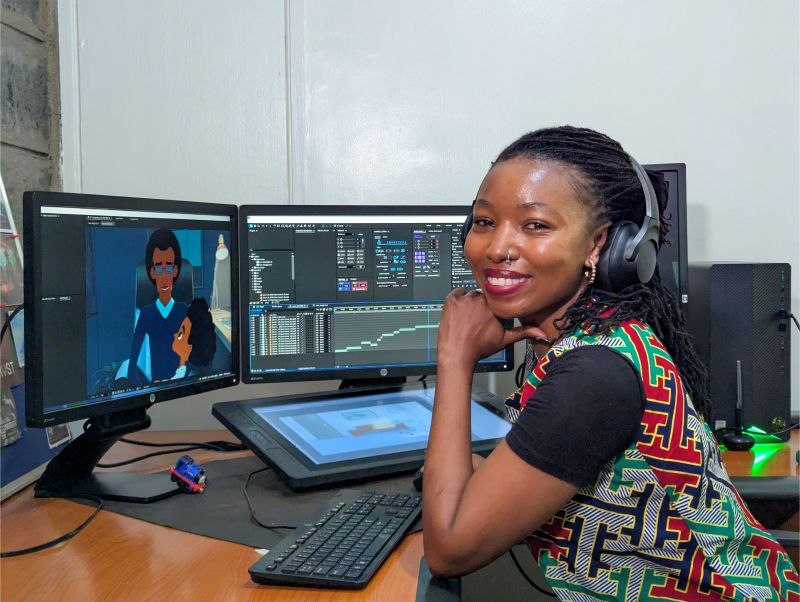
Mary Wanjiku in her work station at Chomoka Studios offices in Safari Park Avenue, Nairobi, Kenya on June, 6, 2025. Photo: Finley Maranga, bird story agency
In 2021, Mary Wanjiku walked away from a stable television career to become an animation intern. The move marked the beginning of a journey that would lead to national recognition and highlights the opportunities and challenges facing a new generation of African animators.
By Finley Maranga, bird story agency
On Saturday mornings growing up in Kenya, Mary Wanjiku would settle in front of the television to watch cartoons such as Johnny Bravo and Edd n Eddy. Like many children, she was captivated by the stories unfolding on screen. Unusually, perhaps, she also spent years wondering how they were made.
The universe that made up her cartoon world seemed distant and unattainable.
“It seemed like magic,” she says. “I didn’t know how people made cartoons. It felt like a dream that was very far away.”
Today, Wanjiku is one of the people creating that magic.
The 30-year-old producer is co-founder of Studio M&A, a Nairobi-based production company developing animated and live-action projects for audiences in Kenya and beyond. Earlier this year, her animated short film Lore won the Kalasha Award for Best Animation Production, one of the highest honours in Kenya’s film industry.
The recognition marked an important milestone for a producer who only a few years ago left a stable television career to start again as an animation intern.
Wanjiku’s journey mirrors a broader shift taking place across Africa’s creative industries. As global demand for African stories grows, a new generation of creators is building studios, developing original intellectual property and creating opportunities for young talent in sectors that barely existed a decade ago.
For Wanjiku, however, the path was far from straightforward.
When she enrolled at Kenyatta University to study film, animation occupied only a small corner of the curriculum.
“There was only one animation unit and it was very basic,” she recalls. “It wasn’t enough to teach me everything I needed to know.”
After graduating in 2017, she joined Kenya’s television industry, working first as an editor before moving into production roles on projects for broadcasters and streaming platforms. The work provided valuable experience and a steady income, but animation remained at the back of her mind.
For years, she talked about pursuing it. Eventually, she realised that talking was no longer enough.
In 2021, she made a decision that surprised many around her. She left her full-time job and entered the industry as an intern at Chomoka studios.
“The only way I could learn was to become an intern,” she says. “I wanted to understand the whole animation pipeline.”
That pipeline is far more extensive than many people realise. Long before a single frame appears on screen, creators move through concept development, scriptwriting, character design, world-building, storyboarding, rigging, animation, sound design, editing and distribution. Every stage requires specialised skills, equipment and funding.
For many African creators, funding is where the real challenge begins.
Wanjiku remembers starting work on her first animated short film with what seemed, at the time, like a workable budget.
“I had about ten thousand shillings and I thought I would get it done,” she says with a laugh. “Two years later I was still trying to make something.”
Animation is one of the most resource-intensive forms of filmmaking. Powerful computers, specialised software and highly skilled teams often make projects expensive to produce. Across much of Africa, creators must navigate those costs while operating in industries that are still developing the financing structures available in more established animation markets.
Yet despite these challenges, the sector is gaining momentum.
The International Finance Corporation estimates that Africa’s creative economy could generate more than US$20 billion annually and create over 20 million jobs by 2030 if investment, infrastructure and policy support continue to improve. For many young Africans, creative industries are increasingly being viewed not as hobbies but as viable career paths.
Support organisations have played a significant role in helping bridge some of the gaps.
Wanjiku’s work has benefited from support provided through Alliance Française Nairobi, which funds selected creative projects and facilitates access to international markets.
According to Harsita Waters, Director of Cultural Affairs and Communications at Alliance Française Nairobi, the demand for creative funding far exceeds available resources.
“There was about 400 million shillings worth of requests and we only had 30 million shillings to support projects,” she says.
For creators fortunate enough to receive support, the benefits often extend beyond funding. Mobility grants enable filmmakers and animators to attend international festivals, pitch projects, meet distributors and explore co-production opportunities.
“That’s where you’re able to sell your product,” Waters explains. “That’s where you’re able to network, find co-producers and distributors.”
Distribution remains one of the industry’s biggest hurdles.
“The hardest part is distribution,” Wanjiku says. “You can create something beautiful, but then where do you sell it?”
The question is one facing animation industries across Africa as creators seek pathways to global audiences.
Fortunately, international interest in African storytelling has grown steadily over the past decade. Streaming platforms, international broadcasters and film festivals are increasingly seeking stories from the continent. At the same time, African creators are becoming more confident in telling stories rooted in their own cultures and experiences.
For Wanjiku, authenticity is central to that success.
“I think we’ve proven ourselves internationally,” she says. “We’re telling our own stories.”
Studio M&A was founded in 2021 with that vision in mind. The company develops animated and live-action projects that place African narratives at the centre while appealing to global audiences. Among its recent projects is Lore, a short animated film about a young boy struggling to process the death of his father while confronting cultural expectations surrounding grief and remembrance. The film earned national recognition with its 2026 Kalasha Award win and has helped elevate the studio’s profile in the industry.
The momentum is creating new opportunities. Wanjiku has participated in the Annecy International Animation Film Festival in France, widely regarded as the world’s leading animation festival and market. The event attracts thousands of industry professionals each year and serves as an important meeting point for producers, distributors and investors.
Exposure to such spaces is important not only for individual careers but also for the wider ecosystem that African creators are working to build.
That commitment to building others is perhaps one of the defining features of Wanjiku’s work.
Among the young people she has mentored is , a computer security and forensics student who says he never considered animation a career until he met her.
“Before, it was just something you watch for fun,” he says.
Through Wanjiku’s mentorship, he gained exposure to the industry, attended film events and learned about the different career paths available within animation production.
“She opened a lot of opportunities for me,” he says.
His advice to aspiring animators reflects the same lesson Wanjiku learned when she left her television career.
“Just start,” he says. “Starting is the main problem. Be curious and keep learning.”
Industry leaders believe more young people are already doing exactly that.
Ernest Livasia, General Manager of Chomoka Studios and Chairperson of the Association of Animation Artistes Kenya, says the industry is becoming increasingly diverse, with women entering animation in greater numbers and assuming leadership roles as producers, writers and production managers.
“The numbers of women learning animation compared to men are almost the same,” he says. “It’s no longer a male-dominated field.”
For Wanjiku, that progress matters because the future she imagines extends beyond her own projects.
She wants more young Africans to see animation as a career they can pursue without leaving the continent. She wants stronger local studios, more original intellectual property and a wider network of creators supporting one another. Most importantly, she wants African stories to continue travelling further.
“I want to inspire people,” she says. “I want to mentor people because I don’t think I had so much of that.”
The cartoons she watched as a child once felt impossibly distant. Today, she is helping ensure that the next generation grows up seeing something different: stories created by Africans, for audiences everywhere, and an industry that no longer feels out of reach.
Leave a Reply