
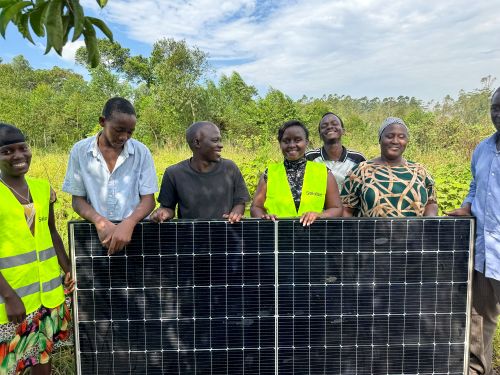
Shifra Ainomugisha and farmers posing with solar panels at the farm in Ibanda. Photo Courtesy: Commonwealth Secretariat
Four years ago, Ugandan engineer Shifra Ainomugisha, now 28, turned the rotten tomatoes of her childhood into a climate-smart business. This year she received the Commonwealth’s top youth honour.
By Lerato Pooe, bird story agency
Every morning, before the day’s fresh tomatoes could be prepared for sale, Shifra Ainomugisha had another job: removing the rotten ones from her family’s store.
She was the only girl in a tomato-growing family in Ibanda District, western Uganda, and the routine was so familiar that, at first, the waste appeared normal. Her family worked hard, yet a large part of each harvest spoiled before it could be sold.
“I used to wake up every single morning to collect rotten tomatoes from our store and leave the fresh ones for sale,” Ainomugisha recalled. “But it was so heartbreaking that the biggest percentage of the tomatoes were going to waste.”
As she grew older, the connection between those losses and her family’s circumstances became harder to ignore. At school, differences between what children could afford made visible what spoiled produce meant at home.
“We were kept in poverty, yet we were labouring a lot,” she said. “Maybe I needed a certain kind of school shoes, but I couldn’t get the shoes. It kept sinking in that something was not right.”
That recognition, which began when she was about 15, eventually became the foundation for Solafam Uganda Limited, the climate-technology company she founded with university colleagues. In June, Ainomugisha was named the 2026 Commonwealth Young Person of the Year, as well as the regional winner for Africa, for work that combines solar-powered cold storage, shared solar irrigation and an artificial-intelligence advisory service for farmers.
For International Youth Day, her story celebrates young Africans building solutions from problems they know intimately.
Ainomugisha studied renewable-energy engineering at Makerere University in Kampala. There she met other sons and daughters of farmers, including Solafam’s chief operating officer, Moreen Nabahiirwa, a mechanical-engineering student, and now a colleague with business expertise.
They had knowledge and an idea, but no capital. A lecturer who had watched them work on a related university project became the first person outside their families to take the idea seriously.
“After school, you don’t have anything to start a business if you have not worked for an organisation and earned a salary,” Ainomugisha said. “We only had knowledge. We needed that one person to believe in us.”
That one person was their lecturer who connected them to the Sahara Impact Fund. Its support helped them build a solar-powered cold room from a repurposed shipping container, locally sourced batteries and solar panels. With nowhere else to install it, Ainomugisha placed it at her father’s home.
Her parents became the first people to test her prototype. Soon, other farmers in her village would come to look at the solution they had built in their home. Other farmers watched, but winning their confidence proved difficult.
“They saw a very young girl, 23 or 24 years old,” she said. “They would ask, ‘What do you mean you’re doing this? You’re a woman entrepreneur, an engineer, and you’re solving this?’ It was hard for people to take us in and believe in our solution.”
Without proper storage, Ainomugisha says freshly harvested tomatoes might last only a few days- perhaps a week or up to 10 days, whereas with the cold room, the tomatoes can remain fresh for up to 21 days. Her father could now wait for peak-season pressure to ease.
Trust grew gradually through her father’s experience. Solafam also grew beyond cold storage as farmers revealed that spoilage was only one part of a larger system of risk.
Reliance on rain could leave a farmer with a single productive season. Even a successfully preserved harvest still needed a buyer. Farmers also needed timely advice about irrigation, pests, crop management and harvesting. Solafam responded with shared solar-irrigation systems and LYN, an AI-supported service accessed through WhatsApp.
Ainomugisha’s days are busy and even then she takes time to go to the field: “I’m always in the field to check on how the farmers are doing, if there is any maintenance needed for the irrigation systems.”
Solafam says LYN has reached nearly 2,000 farmers and this is an ongoing process. Ainomugisha says the company is always looking for more clients and communities where it can provide its solutions to farmers. Reaching a thousand clients, she says, would not mean that the work was done. The company’s ambitions stretch beyond Uganda, with the team looking to expand to Tanzania, Kenya and other countries.
Ainomugisha’s work extends to families in her community, through her intelligence, there have been many success stories. One closest to her heart being of a woman who recently invited her to her daughter’s graduation. The daughter’s graduation is due in December.
The woman has five children, she says, and the older children had reached a higher level of education but had not been able to attend university. But, after the family started using Solafam’s services, the mother was able to support at least one child through her university studies.
The impact of Solafam’s work enables the farmers to grow across more seasons. This innovation means that more food is available within the communities where the food is produced.
She describes receiving the award as ”life changing” and the biggest win yet since Solafam began. Even though Solafam had partners back in 2023, the award recognition has brought a high level of attention to the company and opened doors that were difficult for the company to access.
In particular, Ainomugisha says the award has given them an opportunity to engage with the Ugandan government, an opportunity they have always wanted but struggled to secure.
“From the time we got that award, we are now in talking stage with the government,” she says.
Beyond acknowledging the work Solafam has done, the award has opened opportunities for partnerships that could help the company expand its work.
The attention also gives Ainomugisha a platform ahead of the Commonwealth Heads of Government Meeting, which will take place in St John’s, Antigua and Barbuda, from 1–4 November 2026. She wants CHOGM to move beyond celebrating young people towards removing the barriers that constrain their ideas.
“I want to see the youth being supported, and a system created whereby it will be easy for someone like me, staying in Uganda, to access education in Antigua,” she said. “I shouldn’t get issues with visa access. I want the system to be easy for us.”
“We have a lot of network-connectivity issues,” she said. “I want someone to address that.”
Her message to funders is direct: young Africans understand many challenges requiring solutions, but ideas stall when nobody will back an unproven team.
“Young people are the ones making a big change in our communities,” she said.
“They have solutions, but they are lacking people to believe in them and support them to reach their dreams.”
She rejects the idea that agriculture is confined to digging in a field. Renewable energy, engineering, logistics, AI, market information, and finance create openings for a new generation.
“The youth should know that it is beyond going to the farm and digging,” she said. “There are many opportunities to improve the problems related to farming using AI technology.”
Throughout her journey, Ainomugisha has recognised that her success comes from the people who supported and believed in her, and mostly, the clients who turned her idea into a business.
“I want to change the narrative that farming is for the poor,” she said. “I want people to make money out of agriculture, adopt technology and change their livelihoods.”
And she insists the achievement belongs not only to its young founders, but to those whose daily work first posed the question Solafam set out to answer.
“I want to thank the farmers,” Ainomugisha said, “whose resilience has driven us to such big opportunities.”
bird story agency