
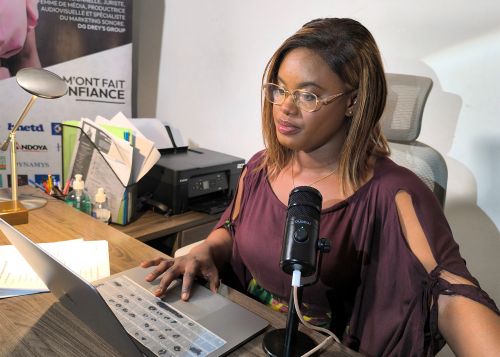
Audrey Keita, founder of the École des Métiers de la Voix, talking into a studio microphone connected to her computer during a work session, on August 29, 2026. Photo: Mel AKOI, bird story agency.
An ear for accents developed as a young girl led Audrey Keita towards a career in law. Then the creative economy called and today, on a very different career path, her ear for accents is again front and centre.
By Akoi Mel Herve, bird story agency
As a young woman growing up in Abobo, Côte d’Ivoire, Audrey Keita would imitate voices she heard on French television channels TF1 and M6. Later, she put the skills she had picked up through her imitations to work, initially to complete a literary baccalaureate and then to pursue a higher diploma in law.
Today, as voices fill the rooms of the École des Métiers de la Voix de Côte d’Ivoire (EMV-CI) Keita can be found moving about between learners, giving instructions, checking answers, and preparing students for another round of exercises. Providing one-one attention she often listens, corrects, and demonstrates to pupils.
The media entrepreneur is now a voice-over actress, vocal coach, and trainer. At her school, the voice is treated not simply as a talent but as a skill that can be trained and turned into a career.
Keita’s early fascination with voices helped her develop an ear for articulation, rhythm and interpretation, as she learned to mimic those she heard, skills that would later become central to her work.
After studying law, Keita was quick to change direction, setting to work as a sports columnist in local media before becoming a freelance voice-over artist with EUREUK-ART Studios. She also explored dubbing through MIABOX TV. By 2018, she had begun to professionalize her work as a voice-over actress.
A radio job would eventually show her that the voice could also generate an income.
“It really made me realize that the voice could become a real profession. It was when I started working as a radio presenter and was called for a voice-over project, for which I received a fairly good payment, that I told myself: ‘Ah, so if I focus, I can actually earn quite a lot with my voice.’ It was the fact that I was earning income through my voice that made me realize that it was possible.”
That realization changed the direction of her career.
Keita began lending her voice to brands and institutions, including Canal+ Côte d’Ivoire, MTN Côte d’Ivoire, NSIA Bank, BNETD, Jumia and Credit Access. Her work has included advertising, radio spots, institutional films, documentaries, e-learning content, dubbing and other audiovisual productions.
But as her own career developed, Keita also became aware of a gap she had encountered when she was starting out: there were few places where people interested in voice professions could acquire practical training without first pursuing a conventional communications education.
Training is becoming an essential part in skill development. A 2023 International Labor Organization analysis on Africa’s cultural and creative economy identified skills development, entrepreneurship, and job opportunities as areas that require additional support across the industry.
For Yannick Djanhoun, commissioner-general of the International Voice Professions Fair (SIMVOX), this kind of training is becoming increasingly important as African creative industries produce content for audiences beyond the continent.
“It is very important to have trained voices because we are at a very important crossroads in human history. Africa is asserting itself more and more. And in cinema, in music, we increasingly have voices that carry and reach the whole world. Voice professionals must be trained because we need them to carry, you know, the voice of this African cultural industry. So, the better trained they are, the better-quality work they will produce.”
In 2021, she opened the École des Métiers de la Voix.
“I created the École des métiers de la voix, which became the École des métiers de l’audiovisuel, with the aim of training stage and screen talents who need to learn more about these professions, especially people who have not necessarily studied communication. I studied law. The objective was to give them access to training in everything related to voice and audiovisual production.
The school’s training is built around practice, with 30% theory and 70% practical work. Learners train in advertising and informative voice-over, dubbing for fiction and animated films, acting, and hosting. The institution is also expanding into technical professions within the audiovisual industry.
“When I was starting out, there was not really any institution that was interested in this kind of situation.”
Today, skills are in high demand as the audiovisual sector grows, offering opportunities for those with talents in film, television, advertising, and digital content.
According to UNESCO, the cinema and audiovisual business already employs an estimated 5 million people and contributes approximately $5 billion to Africa’s GDP. If fully developed, the business is expected to provide more than 20 million jobs and $20 billion in yearly revenue.
For Keita, the opportunity is not limited to people seeking a full-time career in voice work. She sees it as a profession, a source of additional income and a possible route into a new career.
“Yes, it is possible to make a living from voice professions because they offer strong opportunities. Beyond a conventional job, they can be pursued as a complementary activity, hence the possibility of career retraining. I am also recommended internationally because I was able to become an example. I established myself as a business, and I really turned this into a living reality.”
That possibility is what drew Lucrech Kaya-Kaya, a sales agent, to the school.
Her first encounter with Keita’s work was not in person. She came across a video online in which Keita spoke about turning the voice into a professional opportunity. The idea stayed with her and eventually led her to enrol.
“I saw a video of Ms. Audrey Keita. She was talking about making her voice a career opportunity. So, I was touched by the message I saw. That made me want to enroll, so that I could also make my voice a career opportunity.”
Inside the school, that interest is tested through repetition and correction. Learners practice different forms of delivery, work on interpretation and learn how to adapt their voices to different productions.
For people like Kaya-Kaya, the challenge is moving beyond an appreciation for voice work to acquiring the technical and professional skills needed to pursue it.
Keita’s own experience has shaped the way she teaches. She entered the field without a communications degree, developed her skills through practice and eventually turned that experience into a business and a training institution.
Now, she wants the school’s reach to extend beyond Abidjan. Her plans include initiatives and a tour focused on voice professions in Yamoussoukro, Bouaké, Daloa, Lomé and Libreville.
The expansion reflects a wider ambition: to help more people across Africa see voice work as something that can be learned, developed and monetized.
Leave a Reply