
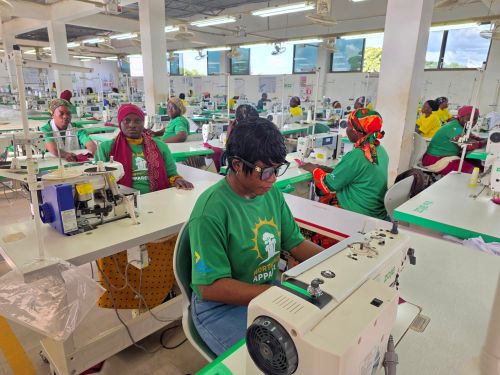
Kausara Alhassan at her workstation at Northshore Apparel in August 2026. Photo: Abdul Hayi Moomen, bird story agency
Northshore Apparel is turning industrial ambition into formal jobs in Savelugu. Its next phases could connect those sewing lines to northern Ghana’s farmers and build a fuller local value chain.
By Abdul Hayi Moomen, bird story agency
For years, Kausara Alhassan’s search for work followed the same dispiriting routine. She printed copies of her curriculum vitae, carried them from office to office in Tamale and waited for a call that never came.
Her university degree had been expected to open a door. Then she heard that a garment factory was recruiting in Savelugu, about 25 kilometres away. She applied. This time, her telephone rang.
“I roamed from place to place and office to office dropping my CV for many years, but I got no response until I heard of the establishment of this garment factory,” the 23-year-old University for Development Studies graduate said from her new workplace at Northshore Apparel. “Today I work here, earn a living and have my dignity restored. I am also a better version of myself because the factory invested in me through quality training before I started working here.”
For Alhassan, the change is immediate: regular work, new skills and an income earned close to home. Multiplied across Northshore’s production floor, experiences like hers suggest how manufacturing could widen the map of formal employment in Ghana.
President John Dramani Mahama officially commissioned the wholly Ghanaian-owned plant on August 28, 2026, presenting it as Ghana’s first regenerative apparel hub and part of the 24-Hour Economy programme. The facility is already operating, with workers running production lines and wages entering households.
Northshore currently operates 51 production lines and employs more than 2,300 workers, most of them women. The company plans to increase its workforce to 10,000 as later phases come onstream. Mahama said the wider industrial hub could ultimately employ at least 30,000 young people.
Those numbers refer to different stages of development rather than one present workforce. The opportunity will grow as the company sustains jobs, adds shifts, ships garments and wins repeat orders.
Northshore has also obtained Worldwide Responsible Accredited Production certification, following an independent audit of its fabric receiving, cutting, sewing, finishing, pressing, packing, quality-control and dispatch operations. The certification, valid from June 2026 to June 2027, gives the Savelugu factory a recognised credential as it seeks international buyers.
The location matters. Ghana’s industries and higher-paying formal jobs remain concentrated largely in and around Accra, Tema and other southern centres. For generations, young northerners have travelled south because that was where work was more likely to be found.
Mahama placed Northshore within Ghana’s effort to correct that imbalance. Recalling the country’s assessment under the African Peer Review Mechanism, he said one concern was “the lack of opportunities in the northern part” and the resulting imbalance in the distribution of the population.
“When students finished school and they had no opportunity, they just picked their bags, boarded a vehicle to go to the south,” he said. The movement places additional pressure on services in southern cities and takes young workers away from northern communities.
Northshore offers a practical way to change that pattern. “This is going to become a major employment and job creation centre for the whole of Northern Ghana,” Mahama said. The objective, he added, was to “create more opportunities in the north so that people will remain here.”
Emmanuel Ayamga, a retired staff member of Ghana’s Ministry of Trade and Industry, said the factory stands apart from policy announcements because residents can already see its effect.
“People can see the factory, they can see young women and men going to work, and they can see wages beginning to circulate in the local economy,” Ayamga said. “That is different from another policy document or another promise.”
That visibility is especially important for women. Northshore says 80 per cent of available jobs are reserved for women and vulnerable groups. Its on-site crèche allows breastfeeding mothers to leave their babies nearby and work with greater peace of mind. The facility also has a clinic and canteen, and jobs have been guaranteed for students from the Savelugu School for the Deaf.
“These additional facilities ensure that our workers can give their best, as there will be no need for them to leave the premises during working hours for basic services,” said Northshore CEO Nurideen Mohammed said in an interview for this story.
Prof. Hamdiyah Alhassan, an economist at the University for Development Studies, said the return from employing young people, especially women, extends beyond an individual payslip.
“When young people earn a decent income, the benefit does not end with the worker,” she said in an interview for this story. “It supports food, education, healthcare and small businesses within the household and the community.”
She is equally interested in where the work is being created. “For too long, many young people have felt that they must leave northern Ghana before they can find decent work,” she said. “A factory of this scale can help reverse north-south migration and begin to build the strong economic environment that will make young people stay.”
Northshore enters a region with an older history of turning fibre into livelihoods. A few metres from the factory, 82-year-old Amina Salifu remembers when locally produced cotton put money in women’s hands. After cooking, sweeping and caring for children, women spun cotton into yarn. “The work was slow and demanding,” she said, but the income gave them a measure of independence, helped meet household needs and made it easier to attend antenatal clinics.
That local chain later weakened. A 2015 study of cotton production in northern Ghana recorded production rising from about 1,500 tonnes in 1985 to 38,000 tonnes in 1999, supported by local textile demand and government finance, before falling to about 2,500 tonnes in 2010. It identified weak sector organisation, limited finance and poor links among farmers, ginneries and textile companies as factors in the decline.
For now, Northshore relies on imported fabric and other inputs. “Northshore Apparel currently imports cotton-based fabric and other inputs because that chain no longer functions in Ghana,” said Mohammed.
“We established Northshore Apparel to create decent jobs here in northern Ghana so that our young people, particularly women, would not have to migrate to Accra, Kumasi or other southern cities simply to find work,” Mohammed said.
“But our vision goes beyond garment production. We want to help revive cotton cultivation, develop a complete value chain from the farm to finished clothing and demonstrate that a large, competitive industrial enterprise can be successfully established and operated in northern Ghana.”
Sewing imported cloth is already creating valuable work, but the company’s planned expansion offers a bigger prize: capturing more of the value of each finished garment within Ghana.
The company says later phases will expand sewing capacity to 200 lines and add a cotton facility, fabric mill and outgrower scheme. If implemented, those investments could create demand for seed producers, farmers, extension officers, ginneries, spinners, knitters or weavers, dyers, testing laboratories, transporters and packaging businesses before cloth reaches a sewing line.
A reliable industrial buyer could also give farmers a reason to return to cotton, provided prices, contracts and quality requirements are fair. The task is to match Northshore’s visible downstream investment with financing, sourcing commitments and a credible timetable for the upstream phases.
For Ayamga, that connection is also a trade opportunity. Free Zones incentives and the African Continental Free Trade Area can open markets, while greater local sourcing can help products meet rules of origin and retain more value in Ghana. Competitiveness will also depend on electricity, finance, productivity, transport to Tema port, quality and repeat orders.
The potential market is substantial. In January 2026, the International Labour Organization valued Ghana’s garment market at about US$400 million. The government wants the industry to exceed US$2 billion and create 150,000 jobs by 2033. With more than 70 per cent of textiles and garments consumed in Ghana imported, local procurement by public institutions and private buyers could give manufacturers a base from which to build export business.
Northern Ghana has seen earlier efforts to spread investment more evenly. The Savannah Accelerated Development Authority was replaced in 2017 by the Northern Development Authority, whose mandate includes accelerating economic and social development and attracting investment to the northern development zone. Programmes such as One Village One Dam and One District One Factory also sought to strengthen local economies.
Their record provides lessons for the next phase. Research into One Village One Dam found that insufficient storage, shallow reservoirs and poor maintenance limited the impact of some projects. Prof. Alhassan said earlier interventions had not yet produced enough large, durable employers in the north. Northshore’s advantage is that its first phase is already operating; its long-term significance will depend on keeping the jobs secure and completing the wider hub.
Alhassan no longer has to imagine whether opportunity can reach her in northern Ghana. The factory that entered Salifu’s old age as a building filled with enormous machines entered Alhassan’s youth as a telephone call.
bird story agency