
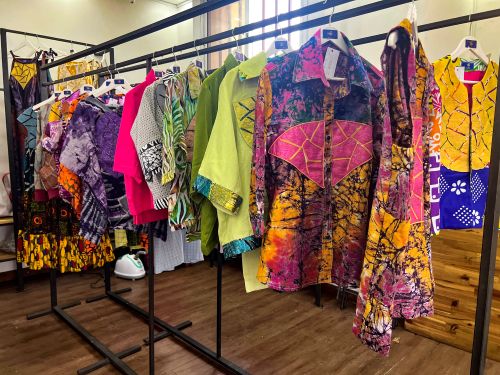
Clothes displayed on a rack at Just Fabulous Heritage Studio, Freetown on June, 27, 2026. Photo: Eric Kawa, bird Story Agency
Sierra Leone’s traditional textiles are being reimagined into a modern fashion economy, as designers like Frederica Williams preserve heritage while building a thriving local industry ready for global markets.
By Eric Kawa, Bird Story Agency
Inside her Freetown studio, Frederica Williams – surrounded by a bustling floor of over 20 tailors and design assistants – displays a vibrant bolt of Krio Print fabric, explaining the cultural significance of its intricate motifs. As the founder of Just Fabulous Heritage and president of the Fashion Design and Textiles Association (FDTA), Williams views each garment as a strategic vehicle for a much larger mission: preserving Sierra Leone’s rich cultural heritage while building a formal garment sector capable of creating jobs, reviving domestic cotton production, and tapping into lucrative export markets.
“We’ve been working on rejuvenating traditional designs and reinventing them for contemporary styling,” Williams said. “That way we preserve our heritage while promoting Sierra Leone internationally.”
Her own work reflects that vision. Williams is known for designing the Krio Print, a contemporary textile inspired by Sierra Leone’s Creole heritage, while also incorporating traditional fabrics such as gara cloth and country cloth into modern fashion.
As Sierra Leone seeks to diversify an economy long dominated by mining, policymakers, designers and entrepreneurs are betting that textiles and fashion can become a new driver of growth, creating opportunities from cotton farms and weaving communities to export-ready fashion brands.
Giving the Industry a Voice
The country’s textile landscape spans distinct cultural identities, including Krio Print, Fullah hand-woven indigo Léppi, Mende heavy Country Cloth, Temne Gara tie-dyes, and Limba and Kuranko earth-toned Ronko shirts. Long reserved for chieftaincy installations, weddings, and traditional rituals, these fabrics are increasingly utilized as daily “Africana” corporate attire and export-ready garments as policymakers look to creative manufacturing to reduce the nation’s historical reliance on mineral revenues.
Until recently, Sierra Leone’s designers largely worked independently, with little formal coordination despite growing international interest in locally made fashion. That changed in 2024 with the launch of the Fashion Design and Textiles Association (FDTA), which Williams now leads. The association brings together designers, weavers, dyers, tailors, cotton producers and entrepreneurs across the textile value chain to strengthen the sector, improve skills, advocate for supportive government policies and promote Sierra Leonean fashion locally and internationally.
“We’ve been advocating for people to wear Sierra Leone, look Sierra Leone and like Sierra Leone fashion,” Williams said. “That’s the only way to create demand that increases production and sustains the industry.”
Beyond promoting local consumption, the association is lobbying Parliament to strengthen intellectual property protections, arguing that copied designs discourage innovation and deprive artisans and designers of the benefits of their work.
Williams says stronger legal protection, improved training and better market access are essential if Sierra Leone’s textile industry is to compete internationally.
Fashion Beyond the Runway
For Williams, preserving heritage is only part of the equation. Traditional textiles must also become commercially viable.
That means adapting heritage fabrics for modern consumers while improving production quality, branding and access to regional and international markets. Other designers are already testing that approach.
Designer Abdulai Mansaray, founder of His Masterpiece Collection and Stylings, has transformed traditional Country Cloth and Ronko fabrics into contemporary streetwear. He said his streetwear Léppi designs attracted buyers at Accra Fashion Week in Ghana last year.
Mansaray further says international audiences responded to designs rooted in Sierra Leonean identity rather than imported fashion trends.
“I want the world to know Sierra Leone has unique textiles,” Mansaray said. “If entrepreneurs create new ideas with them, the world market will accept them.”
Fashion entrepreneur Mohamed Barrie, CEO of Fashion One Sierra Leone, believes consumers are increasingly seeking clothing that reflects identity and heritage. He is on a special mission to promote the Léppi cloth, traditionally worn by the Fullah communities across West Africa, the fabric has evolved beyond ceremonial occasions into contemporary fashion, appealing to both local and international buyers.
“People are proud of their origin,” Barrie said. “The fabric has become a transformational tool. It connects people to their culture while creating opportunities for businesses.”
Revising the Cotton Industry
But while designers are finding new markets, Williams says the industry’s biggest challenge begins much earlier in the supply chain.
Traditional textiles depend on locally produced cotton, yet Sierra Leone’s cotton industry has steadily declined as many farmers moved into mining and other sectors offering quicker returns.
The result has been a growing dependence on imported fabrics, particularly polyester, reducing demand for traditional weaving and limiting production of country cloth.
“We’re hoping there will be a revival of the cotton industry,” Williams said. “If we increase cotton production, improve weaving techniques and modernise processing, we can increase the production of locally made fabrics.”
Government officials say those concerns align with Sierra Leone’s broader economic diversification strategy.
The Ministry of Trade and Industry has identified textiles and garments as priority sectors under initiatives including the Made in Sierra Leone Strategy and the Local Content Policy, with plans to strengthen the entire value chain, from cotton farming and processing to garment manufacturing and exports.
“We are looking at the entire value chain so our people can benefit,” said Emmanuel Billy Konjo, Chief Director and Professional Head at the Ministry of Trade and Industry.
“We must promote what we wear and wear what we produce.”
The government is also exploring incentives to revive cotton farming, establish stronger markets for farmers and expand exports through preferential trade arrangements such as the African Growth and Opportunity Act (AGOA), the ECOWAS Trade Liberalisation Scheme and the African Continental Free Trade Area (AfCFTA).
Officials believe rebuilding the cotton industry could stimulate employment across farming, weaving, tailoring, manufacturing and retail while creating greater value from locally produced raw materials.
Jobs, Exports and Opportunities
Economists say the sector offers Sierra Leone one of its strongest opportunities for inclusive growth.
Economist Dr. Mohamed Ibrahim Justice Ganawah said the country combines centuries of craftsmanship with growing international demand for authentic, sustainably produced African fashion.
Data from UNESCO shows that Sub-Saharan Africa’s clothing and footwear market was valued at around US$31 billion in 2020 and is projected to continue expanding as consumers increasingly seek African-made products.
Sierra Leone also enjoys preferential access to key export markets in Europe, the United Kingdom and the United States, advantages that remain largely underutilised. Concurrently the country benefits from China’s zero-tariff policy on all taxable items under the Forum on China-Africa Cooperation (FOCAC).
Unlike mining, Ganawah said, textiles generate employment throughout an entire value chain, from cotton farming and spinning to weaving, dyeing, tailoring, branding and exports.
Globally, the fashion and textile industry employs more than 75 million people, the majority of them women.
“In a country rebuilding formal employment, this is exactly the type of sector that creates inclusive growth,” he said.
Women already play a leading role in Sierra Leone’s traditional weaving and dyeing industries, while young designers are increasingly adapting heritage textiles into products for contemporary regional and international markets.
Government-backed initiatives, including the Sierra Leone Economic Diversification Project (SLIDEP), have supported designers through skills training, certification programmes and participation in fashion events in Kenya, Nigeria, Europe and the United States.
Looking Beyond Sierra Leone
Industry experts believe Sierra Leone has an opportunity to follow the example of countries such as Ghana, which successfully positioned kente cloth as both a cultural symbol and an internationally recognised brand.
Ganawah says the country should combine heritage preservation with modern production, stronger branding and greater protection for indigenous designs rather than competing solely on low-cost manufacturing.
For Williams, success ultimately depends on building an ecosystem that supports everyone; from cotton farmers and weavers to designers and exporters.
“If we create demand, support our artisans, revive cotton production and protect our designs,” she said, “our heritage won’t just survive, it will become an industry.”
For Sierra Leone, where policymakers are searching for new engines of economic growth, that industry could prove just as valuable as the traditions it seeks to preserve.
Bird Story Agency