
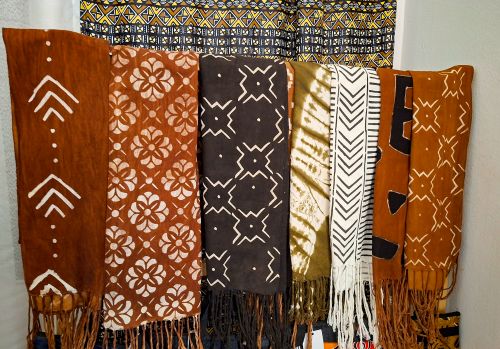
Scarves on display in Assa Gope’s shop in Bamako, Mali in July 2026. Photo: Die Sacko, bird story agency
Mali’s iconic mud-dyed textile, bogolan, is creating new opportunities beyond its cultural significance. As the centuries-old craft gains protected status, women artisans and entrepreneurs are turning tradition into thriving businesses while preserving indigenous knowledge.
By Die Sacko, bird story agency
16 July 2026
At dawn in Ségou in south-central Mali, Massaran Koné begins preparing cotton cloth for dyeing. Twenty years ago she learned the technique from her mother. Today, the income from bogolan pays her children’s school fees and helps support other women she employs.
Hands dip fabric into fermented mud, then patiently trace symbols passed down through generations. In Mali, bogolan is a language that speaks of heritage. Every motif tells a story, conveys knowledge, and carries the memory of the communities that have shaped it over time. Rooted in ancestral traditions, this unique art form is experiencing a remarkable revival. From natural dye workshops in rural villages to international fashion runways, bogolan is inspiring a new generation of artisans and women entrepreneurs who see in it both a treasured cultural heritage and a pathway to economic opportunity.
Cotton, the first step of bogolan, is Mali’s second-largest export after gold, generating nearly 70 million USD in 2024 despite falling global prices. Production reached 598,500 tonnes in 2026, with the state-owned Compagnie malienne pour le Développement des textiles (CMDT) aiming for 650,000 tonnes in 2027. Around 40% of rural households depend on cotton cultivation, yet most of it is exported raw, leaving little value captured locally.
Since April 2026, bogolan has been recognised as a Protected Geographical Indication (Indication Géographique Protégée or IGP), giving the centuries-old textile international legal protection and strengthening its economic value.
For decades, women have driven change in bogolan domain. While global fashion brands search for authenticity, women artisans in Mali are ensuring that centuries-old techniques are not lost. Assa Gopé is an entrepreneur and bogolan artisan. “My mother was a natural dye artisan. She created “Gopé Design” and hired two people as well as multiple seasonal employees in the bogolan industry.
“I believe that developing a strong industry around the sector is essential if artisans are to earn a sustainable living from their work,” said Gopé.
She explains that when large orders need to be fulfilled, women entrepreneurs working in the bogolan industry often join forces: “To handle large-scale orders, we work together and combine our efforts to produce the quantities required.”
This spirit of collaboration allows women artisans to overcome limitations in production capacity while ensuring that customers receive their orders on time. It also highlights the importance of collective action in strengthening the bogolan value chain and creating greater economic opportunities for women working in the sector.
Anthropologist Baba Fallo Keita, who previously worked at the National Museum of Mali and one of the guardians of bogolan, is among those who revolutionised the added value of bogolan for Malian cotton. In the 1970s, during his time at the prestigious “Institut National des Arts” of Mali, he and a group of friends and classmates came together with a shared ambition: to promote Malian culture by reimagining the possibilities of bogolan. At that time, bogolan was mainly used as clothing for women, with each symbol carrying a specific meaning. They introduced colors, giving the textile a new dimension and opening the way for its evolution into a modern art form.
Keita is also a founding member of Kassobané, a collective established by five friends to promote bogolan and train young people in the traditional techniques of this centuries-old craft. In Bambara, one of Mali’s national languages, bogolan means “made with mud”.
According to oral tradition, the craft originated by chance. A hunter returned home with game, his cotton garment stained by mud. Despite repeated washing, the stain would not come out because the mud had reacted with ngalama, a wild plant used to prepare cotton for dyeing.
That accidental discovery is said to have given rise to bogolan, a distinctive mud-dyeing technique passed down through generations. Today, the fabric remains a powerful symbol of Malian cultural identity, craftsmanship and indigenous knowledge, while gaining growing recognition in international fashion and design markets.
Kadia Coulibaly, aka Adja Coulibaly, was born in a family where bogolan has been omnipresent. “Since I was a child, I have grown in an environment dominated by Bogolan. This is the only job I do since ever,” recalled Coulibaly. “I grew up in an environment where all we do is bogolan; it is the only thing I know. My entire life has been spent in this sector.”
According to studies on the economic weight of handicrafts in Mali – carried out with the support of The West African Development Bank (BOAD) – the financial returns for the entire handicraft sector amount to billions of CFA francs, with a significant share coming from traditional textiles.
Everything is done by hand and the process can be demanding.
“We work a lot during the dry season. The sun is our number one ally because the fabric has to be left to dry several times,” said Coulibaly.
She said she regretted the difficult conditions in which she worked because she lacked the resources to expand her workshop. Despite these modest facilities, she had trained dozens of young people who later went on to open their own workshops, becoming her competitors in the process.
Women are actively involved in the production process and contribute significantly to keeping traditional knowledge alive while adapting it to contemporary tastes and markets. Through their work, they help ensure that bogolan remains not only a symbol of Malian identity but also a source of economic opportunity for local communities.
Assimi Guindo, a young Malian who describes himself as a “bogolan fan” says: “I really love bogolan, and I never miss an opportunity to wear it whenever I can.” He buys his clothes and accessories from Oumou Yanogue a young woman entrepreneur who founded “Anw Dambé”. Bogolan has become more than a craft for her. It is the foundation of her independence. Through this ancestral art, Yanogue has secured a stable income, steadily increasing her sales and expanding her customer base.
With each piece of cloth, Yanogue reinvests in her workshop, strengthening its capacity and opening doors for future growth. The financial stability has not only allowed her to manage daily needs but has also given her the confidence to envision bigger ambitions.
Competition in the market is fierce, with imported fabrics such as bazin, a cotton fabric produced in Germany and highly prized in clothing across Mali, dominating the sector.
“The process of producing a single bogolan cloth can take anywhere from one day to a full week, depending on the amount of work involved,” said Coulibaly.
Awa Meité is a Malian-Ivorian fashion designer, artist, and filmmaker based in Bamako, known for her sustainable approach to fashion and her pioneering work in transforming Malian cotton into high-value textile art.
“The mindset the brand Awa Meite has is not about reconciling tradition with modern design and business,” said Meité. “It is simply being aware of what is available locally, that we can work on with artisans without them loosing their know-how and knowledge. We call authenticity what is called tradition and sometimes even indigenous, even if I don’t like that word.”
At “Farafina Tignè”, a bogolan brand that can be found in Bamako, San, Mopti and Segou, women also play an important role in preserving the heritage. According to its founder, Issouf Cissé, “Bogolan has become an essential part of Malian society today, especially among younger generations, but also among older people.”
With more than 100 employees, Cissé believes innovation should not come at the expense of cultural identity. Rather, the challenge is to modernize bogolan while safeguarding the traditional techniques, symbols, and knowledge that make it unique. This balance, he believes, is essential to ensuring that bogolan remains both a vibrant expression of Malian heritage and a competitive product in modern markets.
“Women are indispensable throughout the production chain, and we rely heavily on them to transform the fabric and work on the other raw materials that make up the finished product. The young women we recruit also manage our social media platforms as community managers,” Cissé noted.
The future of bogolan will not be shaped by mud and cotton alone, but by the women who continue to breathe life into them. As entrepreneurs, mentors and keepers of knowledge, they are proving that cultural heritage can be both a source of identity and an engine of economic transformation.
bird story agency