

Drosophila (also known as fruit flies) in the laboratory © NeuroCure | 2470.media
Charité study in Nature reveals fundamental processes in the fly brain
Berlin, August 20, 2025
Flies also need to sleep. However, in order to be able to react to dangers, they cannot completely block out their surroundings. Researchers at the Charité – Universitätsmedizin Berlin have now deciphered how the animal’s brain creates this state. As they describe in the journal Nature*, the fly’s brain rhythmically filters out visual information during sleep – so that strong visual stimuli could still wake the animal.
Rest periods and sleep are vital – probably for all animals. “Sleep serves physical regeneration; in humans and many animals, it is also fundamental for memory formation,” explains Prof. David Owald, a scientist at the Charité Institute of Neurophysiology and leader of the recently published study. It was previously unclear how an organism reduces its response to stimuli sufficiently to be able to regenerate, while still remaining alert enough to react to external threats.

Research on Drosophila at the Charité © NeuroCure | 2470.media
A team led by David Owald has now investigated this question using fruit flies as an example. Commonly known as fruit flies, these two-and-a-half-millimeter-long insects are ideal for studying neurological processes due to their small brains. “We discovered that the brains of flies finely tune activating and inhibitory networks during sleep,” says David Owald. “This creates a filter that effectively suppresses visual stimuli, but can still allow particularly strong stimuli to pass through. The condition is comparable to a window that’s left ajar: The airflow, i.e., the transmission of stimuli, is interrupted, but a strong gust of wind can push the window open, and a powerful stimulus can wake the animal.”
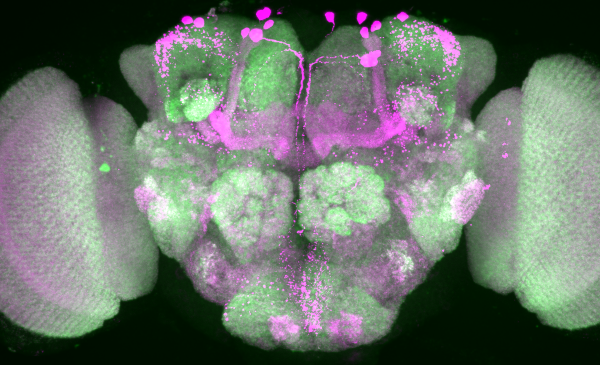
The brain of a Drosophila, consisting of a total of around 150,000 nerve cells. Some of them are highlighted in pink, while nerve cell connections are shown in green. © Charité | Anatoli Ender
An inhibitory neural network overrides the activating one
According to the study, the flies become sleepy in the evening, after a long period of wakefulness and following the rhythm of their body clock: Slow, synchronous electrical waves – so-called slow waves – arise in two different brain networks that connect visual stimuli with orientation movements. One activates, the other inhibits, the response to visual stimuli. “When both networks are active simultaneously, the inhibitory network wins and the processing of the stimuli is blocked,” explains Dr. Davide Raccuglia, lead author of the study from the Institute of Neurophysiology at the Charité. “The fly thus gently blocks out its surroundings and can fall asleep.”
In order to be woken up, however, this sleep filter must be breached. “We believe this is made possible by the rhythmic fluctuations of the electrical waves,” says Davide Raccuglia. The slow waves are due to the fact that the electrical voltage of the nerve cells oscillates up and down once per second. “It’s possible that when tension is high, a brief period occurs during which information can pass through the sleep filter,” adds Dr. Raquel Suaréz-Grimalt, also lead author of the study. She conducted the work at the Charité Institute of Neurophysiology and now works at the Free University of Berlin. “During this period, strong visual stimuli could overcome the subtle dominance of the inhibitory brain network, effectively opening the window, causing the fly to react.”

Sleep filter in the fly brain (blue): In this ring structure (pink), visual stimuli are filtered out so the animal can sleep. © Charité | Anatoli Ender
As fly, so man?
According to the researchers’ understanding, slow waves create windows through which intense stimuli could awaken a sleeping fly. In humans, sleep is also characterized by slow waves. Could our brain balance rest periods and alertness according to the same principle? “In humans, we know of a structure in the brain that filters stimulus information and acts as a rhythmic pacemaker—that’s the thalamus,” says David Owald. “There could be parallels here to the processes in the fly brain; perhaps these actually reflect a universal principle of sleep. However, this still needs to be investigated further.”
*Raccuglia D, Suárez-Grimalt R et al. Network synchrony creates neural filters promoting quiescence in Drosophila. Nature 2025 Aug 20. doi: 10.1038/s41586-025-09376-2
About the Study
The study was funded by the German Research Foundation (DFG) and the European Research Council (ERC). It was conducted within the framework of the NeuroCure Cluster of Excellence and the Einstein Center for Neuroscience, and in cooperation with researchers from Humboldt University Berlin.