
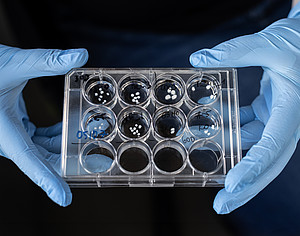
Photo: 30- and 60-day-old brain organoids in a petri dish. © Einstein Foundation Berlin | Pablo Castagnola
Research Network Aims to Rethink Prevention
Berlin, March 23, 2026
They want to detect and treat diseases before symptoms even appear: At the Einstein Center for Early Disease Interception, researchers from Charité – Universitätsmedizin Berlin, the Max Delbrück Center, the Berlin Institute of Health at Charité (BIH), and the Technical University of Berlin, together with other Berlin partners, are pooling their expertise to rethink prevention. Working across institutions, they are utilizing cutting-edge technologies to prevent the development of diseases in the future. The new Einstein Center officially launches its work today with a celebratory opening event.
The development of a serious illness often goes unnoticed for years. By the time symptoms appear, organ damage has already occurred and is only partially reversible. Sometimes, there is no way to stop the progression of the disease.
Researchers from twelve leading Berlin institutions aim to change this and rethink prevention. Using the latest technologies – including developments from Berlin – they want to understand what happens in the cells of our bodies at the very beginning of a disease. This knowledge lays the foundation for intervening much earlier: at a stage when only individual cells are affected and the disease is still manageable.
Researchers are pooling their expertise at the Einstein Center for Early Disease Interception (EC-EDI). It will be officially opened today with guests from politics, science, and society at the Max Delbrück Center’s Institute for Medical Systems Biology in Berlin-Mitte. The Einstein Foundation Berlin is funding the Einstein Center with a total of six million euros and is supporting the EC-EDI in recruiting young international talent with additional funding provided by the State of Berlin. The center builds upon a two-year preparatory phase.
A dynamic network for key technologies
Over the next six years, the scientists will advance the development, integration, and application of key technologies. These include, for example, single-cell multiomics technologies and spatial biology, patient-specific organoids, 3D bioprinting, and modeling of mechanisms and disease progressions based on artificial intelligence. The aim is to create a platform for inter-institutional collaboration, in particular to accelerate the translation of research findings into clinical practice in partnership with companies and investors, while simultaneously generating social and economic benefits for Berlin. The initial focus will be on respiratory and neurological diseases, such as inflammatory lung diseases, tuberculosis, Alzheimer’s disease, and multiple sclerosis.
The EC-EDI brings together institutions such as Charité, the BIH, the Max Delbrück Center, TU Berlin, Freie Universität Berlin, Humboldt-Universität zu Berlin, and other non-university research institutions like the Museum für Naturkunde and Max Planck Institutes.
The four speakers at the opening:
Prof. Nikolaus Rajewsky (Main Contact Person; Director of the Berlin Institute for Medical Systems Biology at the Max Delbrück Center and Professor at Charité): “We are advancing molecular prevention and intervention—and want to translate it into clinical practice as quickly as possible. Significant progress is not achieved solely in the clinic, nor exclusively in the laboratory or on the computer. The Einstein Center therefore creates a shared, open platform with clear rules and streamlined processes. Clinicians, basic researchers, and data scientists collaborate across institutional boundaries, including with companies and investors. This accelerates our progress and will hopefully contribute to further developing Berlin as an internationally renowned location and key player in this field.”
Prof. Leif Erik Sander (Project Leader; Director of the Department of Infectious Diseases and Intensive Care Medicine at Charité and Head of Research Group at the BIH): “Conventional methods often fail to detect the early signs of developing diseases. Furthermore, we don’t always understand what exactly goes wrong at the molecular level and how we could intervene causally to stop the diseases. This is where ‘Early Disease Interception’ comes in: Using high-resolution technologies, we want to understand what sets the course incorrectly and create opportunities to correct this course very early on. We want to get the train back on the right track, so to speak. From our findings, we want to develop innovative solutions, such as new diagnostic tests and medications. In this way, research leads to medical progress and added value – and that strengthens Berlin as a hub for innovation and business.”
Dr. Janine Altmüller (Head of the Core Unit Genomics at BIH): “New methods are key to the vision of the Einstein Center: Never before has it been possible to examine characteristic features such as nucleic acids or proteins of individual cells in their natural tissue context with such precision and high resolution. Even the smallest changes that mark the beginning of a disease can now be better deciphered and understood digitally, for example, using AI. This knowledge is crucial for developing targeted interventions. At the Einstein Center, experts from various disciplines work together toward this goal, thus accelerating the translation of scientific findings into clinical application.”
Prof. Jens Kurreck (Managing Director of the Institute of Biotechnology, TU Berlin): “The Einstein Center for Early Disease Interception opens up a unique platform for close collaboration between leading Berlin research institutions and makes it possible to better understand early mechanisms of disease development using various human models. Of particular importance is providing young scientists within this consortium with access to state-of-the-art technologies and creating optimal conditions for them to build their scientific careers.”