Berlin, 18 December 2025
From a local trade fair to the world’s leading trade fair
Over 104,800 exhibitors over 34 million visitors since 1926
Grüne Woche is the most traditional and best-attended trade fair in Berlin and is one of the best-known events in Germany. No other international exhibition with the direct involvement of hundreds of thousands of consumers each year has been held in Germany more often than Grüne Woche. From a simple local commodity exchange, it has developed into the world’s largest consumer show for agriculture, food and horticulture. Since 1926, over 104,800 exhibitors from 130 countries and over 34 million trade and private visitors have presented a comprehensive range of products from all continents.
First Grüne Woche puts an end to ‘wild trade’
It all started with loden coats. When the German Agricultural Society (DLG) held its winter conferences in Berlin at the end of the 19th century, green clothing dominated the cityscape for a whole week. At the same time, trade and industry offered profession-specific articles and consumer goods on the open street in the conference district. As this wild ‘trade and change’ took on ever stronger forms, the farmer Hans-Jürgen von Hake, at the time an employee of the Berlin Tourist Office, had the idea of linking the conference with an agricultural exhibition on Kaiserdamm for the first time in 1926. ‘Grüne Woche’ – the term was probably coined by journalists – was born.
This move met with unanimous approval at the time. Previously, riding and driving competitions, small animal exhibitions, a seed market and hunting shows were scattered all over Berlin. These were now presented for the first time in a compact 7,000 square metre space in a radio hall and a car hall and attracted more than 50,000 visitors in the opening year. At that time, the German capital itself still used a fifth of its territory for agriculture and horticulture. The city was home to 45,000 horses, 25,000 pigs, 21,000 dairy cows and more than half a million poultry. 200,000 Berliners owned an allotment garden. The largest exhibit at the first show was an iron-tyred universal tractor with 100 hp. The four-metre-high monster with wheels the size of a man’s head was seen as a sign of the beginning of mechanisation in agriculture.
Achievements in science and technology
Grüne Woche developed rapidly in the following years. From then on, achievements in science and technology celebrated their premieres at ‘Grüne Woche’. In 1928, for example, a footprint machine was designed to prove that a dog only follows human footprints and not scent. At the 5th ‘Grüne Woche’ in 1930, a huge egg freshening machine, in which 5,000 eggs rotated in a circle and were to be kept fresh ‘naturally’ for over a year, caused quite a stir. Innovations such as a can milking system, a caterpillar tractor or more efficient grain varieties from well-known breeders were always very popular in the 1920s and 1930s. In 1935, the trademark designed by Wilhelm Hölter – the stylised yellow ears on a green background – became the symbol of Grüne Woche. After being cancelled in 1938 due to the foot-and-mouth epidemic that was rampant in Germany, ‘Grüne Woche’ opened its doors for the last time a year later and highlighted a topic that is still relevant today: A special and highly visible attraction was the ‘nutrition clock’, which was programmed to save calories and automatically provided tips for healthy meals. For example, instead of smoked cured ribs, the nutrition clock recommended a tasty vegetable platter with a precise list of ingredients.
Grüne Woche in the years of Nazi propaganda
After the National Socialists’ “seizure of power” on 30 January 1933 (at the same time Grüne Woche 1933 was running, this time under the name “Green Sports and Animal Breeding Week” from 28 January to 5 February), it only took a few weeks for the Nazi regime to bring all trade fair and exhibition activities in the German Reich under its complete control. The appointment of Josef Goebbels as ‘Reich Minister for Public Enlightenment and Propaganda’ on 13 March 1933 marked the beginning of a new era for the Berlin trade fair company. On 18 April 1933, the ‘Institute for Cultural and Economic Propaganda’ was founded, which controlled all exhibition activities in the Nazi sense. This was followed by the transfer of responsibility for trade fairs and exhibitions from the Reich Ministry of Economics to the Ministry of Propaganda on 30 June 1933 and the founding of the ‘Advertising Council of the German Economy’ on 12 September 1933. All these steps completely robbed the trade fair company of any responsibility for the content of the trade fairs and exhibitions on Kaiserdamm and Funkturm. By law, the trade fair was placed under state control.
The effects of this could already be seen during the 39th travelling exhibition of the German Agricultural Society, which was organised under Nazi aegis on the entire exhibition grounds and the open spaces to the south from 20 to 28 May 1933. Even this last DLG exhibition (the society subsequently merged into the ‘Reichsnährstand’) was completely dominated by Nazi agricultural policy, which pursued racial ideological and ultimately expansionist goals under the slogan ‘blood and soil’. At ‘first Grüne Woche in the new state’, the 1934 Grüne Woche, the goal of self-sufficiency for the Reich and the end of food and animal feed imports was announced, a measure that diverted foreign currency and resources previously used for imports into rearmament.
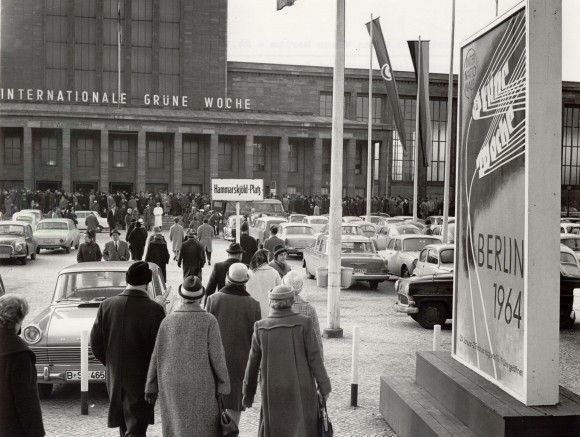
1964: Visitors flock to International Grüne Woche/Photo Credit: Messe Berlin
From then on, ‘blood and soil’ ideologues such as the Nazi Minister of Agriculture Walter Darré determined the content of Grüne Woche. In total, the National Socialists completely put their stamp on five ‘Grüne Woche’ (1934, 1935, 1936, 1937 and 1939). In 1938, ‘Grüne Woche’ was cancelled due to the rampant foot-and-mouth disease. During last Grüne Woche in 1939, it was proudly announced that the level of self-sufficiency in food was now higher than in 1914, a clear indication of the next war, which then led to the end of exhibitions at the exhibition centre.
A new start with cardboard sausages and ham
After years of war, hunger and destruction, the Central Association of Allotment Gardeners, Settlers and Landowners revived ‘Grüne Woche’ in the late summer of 1948 with incredible civil courage. 59 exhibitors presented their exhibits to the Berlin public – under adverse circumstances. The three western sectors of Berlin only had electricity from 11 pm to 1 am and from 9 am to 11 am and suffered from the Soviet blockade of all land and waterways. On the opening day of ‘Grüne Woche’, for example, 250 British and 357 American aeroplanes brought supplies of all kinds to the western part of the city within 24 hours. Fruit and vegetables such as a 3.3-kilogram boxed cucumber or a pumpkin weighing 40 kilograms were much admired attractions on the exhibition grounds, representing unattainable treasures for many Berliners in times of hunger and scarcity. The Kreuzberg breeding sow ‘Dora’ with her piglets made visitors dream of ham and bacon sides, but the actual ham and sausages hanging on some stands were unfortunately only made of cardboard.
Adenauer marvelled at the Dutch vegetable pyramid
The new beginning had been made. From 1949, the ‘state-owned Berlin exhibitions’ were responsible for the fair. In 1950, Grüne Woche was cancelled due to major construction work. The internationality of Grüne Woche took off in 1951 when an obviously far-sighted exhibitor from Holland offered appetising vegetable pyramids to the astonished public. They also aroused the admiration of Federal Chancellor Konrad Adenauer. After that, the number of foreign exhibitors increased steadily over the following years. Grüne Woche has always been a trendsetter: the ‘Darmstadt’ biogas plant was presented to the experts as early as 1953. The manufacturer advertised a daily biogas production of ten cubic metres, ‘that’s enough to supply the burners in the house for cooking, hot water preparation and potato steaming.’
Until 1961, Grüne Woche was particularly attractive for farmers in the former GDR. Between 30 and 50 per cent of visitors repeatedly found their way to the Berlin Radio Tower – despite considerable obstructions at the sector borders. In 1954, for the first time, more than half a million visitors crowded through the now nine halls with a total area of 30,000 square metres.
Internationality in times of the Berlin Wall
The first exhibition after the Wall was built (13 August 1961) was an incentive for the organisers to prove the viability of the event after the lockdown. It was given the name ‘Internationale Grüne Woche Berlin “62” for the first time and was held under the patronage of Federal President Heinrich Lübke. Almost half of the 669 exhibitors came from abroad. A total of around 50 countries, most of them from Western Europe, as well as the USA, Canada, Israel, Morocco and Lebanon, had already secured a permanent place for themselves by this time. Over 438,000 visitors drank 100,000 pints of wine, ate 300,000 ‘penny apples’ and fortified themselves with 65,000 portions of yoghurt from the German stand, making the 1962 ‘Grüne Woche’ a complete success. There was even a shortage of supplies at the France stand: in the end, over 54,000 oysters had been cracked and slurped.
Growth through specialised focus
In the years that followed, Internationale Grüne Woche Berlin became increasingly important in terms of specialisation. It was increasingly based on the three pillars of the food industry, agriculture and horticulture. Special shows on current topics, joint country stands and individual regional shows were very popular. There was growing interest in the accompanying technical programme with up to 150 specialist events. The international agricultural film competition was part of the programme at this time.
In 1971, the concept was expanded to include educational and special shows, for example on IT and fishing, forests and landscapes. In the two decades after the World War, the focus was still on providing the population with sufficient food, but the aesthetic side of food and drink became increasingly important. ‘From the homeland it tastes best’, the German Wine and Sparkling Wine Route, “Appetit ahoi” of the fishing industry and more and more flowers bore witness to this.
At the same time, the German agriculture and food industry stepped up its efforts to promote the sale of agricultural products. In close contact with consumers, Grüne Woche offered specialised information and presentations on the production and processing of agricultural products. This was demonstrated by changing special show themes such as ‘From grain to bread’, ‘The benefits of the forest’, ‘Barley, hops and malt’, ‘Cheese from Germany’ and ‘Extensive animal husbandry’.
With the opening of the International Congress Centre Berlin (ICC Berlin), which is directly connected to the Berlin Exhibition Grounds by a bridge, the number of conferences accompanying the trade fair increased to over 250 events at each Grüne Woche. Grüne Woche was further enriched in 1981 with the first International Forum on Agricultural Policy, in 1982 with the first ‘Fresh Forums’ for sensitive agricultural products, in 1984 with the first MultiServa for communal catering and in 1986 with the first ‘Federal Show of Beef Cattle’, later followed by ‘Sheep’ and ‘Cold-Blooded Horses’.
A new heyday after reunification
1990 marked the beginning of a new heyday for Grüne Woche. After the reunification of Germany, it was once again open to all visitors from the natural environment as well as from the neighbouring countries of Central and Eastern Europe. While some things were initially improvised due to time constraints, from 1991 onwards the five new federal states, together with the old federal states, visibly demonstrated the capabilities of the food industry in the first all-German joint show organised by the Central Marketing Agency of the German Agricultural Industry (CMA) and the federal states.
Since then, the product markets for beer, milk, meat/sausage, tea/herbs/spices and seafood with international participation have been added to the programme – with great success.
Grüne Woche participants were offered an extensive supporting programme with around 300 lectures, seminars and symposia, including the International Forum on Agricultural Policy of the German Farmers’ Association and the East-West Agricultural Forum of the Federal Ministry of Agriculture.
With the first FRUIT LOGISTICA in 1993 (since 2004, the world’s leading trade fair for the international fruit trade has been held separately from Grüne Woche), the Agricultural Machinery Show and MultiServa as trade events as well as Heim-Tier & Pflanze (integrated into Grüne Woche since 1996) and the BioMarkt in 1998, the traditional trade fair under the radio tower gained new attractive programme items.
New millennium with topics of the future
With the completed expansion of the Berlin exhibition grounds to 160,000 square metres in 1999, the agricultural section of the Grüne Woche was expanded to include the segments ‘Animal Husbandry’ and ‘Renewable Resources’. With the new millennium, Grüne Woche was conceptually supplemented by future-orientated themes such as ‘Green Money’ and ‘Renewable Energies’. The Adventure Farm started its success story and has been showing how modern agriculture works since 2000.
Future-oriented topics such as “Multitalent Holz” (Wood: A Multitalented Material) and “nature.tec” – a trade show for bioenergy and renewable raw materials – enriched Grüne Woche 2008. The Federal Association of the German Food Industry (BVE) and the Federation for Food Law and Food Science (BLL) presented themselves for the first time in 2008 under the motto ‘Power for Life – Eating and Moving’.
At IGW 2012, visitors were able to experience their gourmet tour through Germany for the first time on a ‘Germany Tour’. The previous country hall Germany (Hall 20) was upgraded with seven consecutive exhibition halls. Since then, regional specialities from the coast to the Alps have been presented even more authentically than before. A total of 14 federal states presented food and beverages from their respective regions of Germany.
Grüne Woche focussed on the enlarged EU
With Grüne Woche 2005 – the first event after the EU’s eastward expansion (1 May 2004) into the largest single market in the western world – Berlin became more than ever a meeting place for politicians and experts from the fields of consumer protection, food and agriculture. By 2007, the EU had grown to 27 member states. The impact that the opening of German and European borders since 1989 has had on Grüne Woche is demonstrated by the fact that, in addition to the traditional participation from Western Europe, around a third of the exhibiting nations now come from Central and Eastern Europe.
Partner country takes centre stage
In 2005, there was an official partner country at Grüne Woche for the first time. The Czech Republic kicked things off, followed by Russia in 2006 with an impressive range of specialities from almost all regions of the country, from St. Petersburg to distant Siberia. The 2007 Grüne Woche, which was opened by German Chancellor Dr Angela Merkel and EU Commission President José Manuel Barroso, was dominated by the German EU Council Presidency. As the partner country in 2008, Switzerland presented itself under the motto ‘Grüezi Berlin! Switzerland. Naturally.’ specialities from all 26 cantons of the country. As partner country 2009, the Netherlands offered ‘Quality from next door’. With 6,000 square metres, Russia once again had the largest foreign participation at the Berlin exhibition grounds this year. This strong presence was emphasised by the first visit of Russian Prime Minister Vladimir Putin to Grüne Woche.
Hungary continued its tradition as a partner country at IGW 2010. In 2011, Poland made its biggest appearance at a Grüne Woche to date, impressing visitors with culinary specialities from all regions and the slogan: ‘Polska tastes good!’. The partner country of 2012 Grüne Woche, Romania, called on visitors to ‘Explore the Carpathian Garden!’ The Netherlands celebrated its 60th Grüne Woche anniversary in 2013 with the message ‘Quality grows in Holland’. With the slogan ‘NATURally Estonia’, the partner country drew attention to the importance of its clean nature for agriculture and tourism in 2014. ‘Latvia – take your time’ was the recommendation made by Latvian President Andris Berzins at the IGW opening in 2015. The 2015 partner country also held the EU Council Presidency in the first half of the year. In 2016, Morocco was the first non-European partner country to welcome its guests in the atmosphere of a North African medina. The partner country in 2017 presented itself under the motto ‘Rich in tradition, diverse, natural: Hungary’. In 2018, the partner country Bulgaria brought the ‘Flavour of the Sun’ to Berlin. ‘From the wilderness’ greeted the partner country Finland in 2019. In 2020, the partner country Croatia presented its culinary diversity. In 2026, Mecklenburg-Western Pomerania will continue the tradition of the partner country and, as a partner of Grüne Woche, will present the diversity and regional character of this northern German state in Berlin.
On the way to the World Agricultural Summit
Since 2008, the Global Forum for Food and Agriculture (GFFA) has been held parallel to Grüne Woche. The international conference on agricultural and food policy issues is organised by the Federal Ministry of Food and Agriculture (BMEL) in cooperation with the Senate of Berlin, Messe Berlin and the GFFA Berlin e. V. association. The further expansion of the World Agricultural Summit was continued at the 2009 Grüne Woche with the top representatives of the entire value chain. Around 50 agriculture ministers, twice as many as in the previous year, accepted the invitation of Federal Agriculture Minister Ilse Aigner to launch an international climate protection initiative at the Berlin Agriculture Ministers’ Summit 2010.
Today, the GFFA is an integral part of Grüne Woche. Every year, participants from politics, business, science and civil society discuss a key topic, usually in the area of food security. The highlight of the GFFA is the Berlin Agriculture Ministers’ Conference on the last day of the conference. Around 70 agriculture ministers and other participants from international organisations such as the FAO, OECD, WTO and World Bank take part here every year. At the 15th GFFA 2023, the topic was ‘Transforming food systems: A global response to multiple crises’ was the focus of the discussion.
Corona caesura: Two years without a live event
Grüne Woche 2021 was overshadowed by the global coronavirus pandemic. For the first time in its 95-year history, Grüne Woche went purely digital. On 20 and 21 January 2021, trade and private audiences were able to follow more than 100 contributions free of charge on four channels. Internationale Grüne Woche did not take place in 2022 due to the coronavirus pandemic.
Strong comeback as a live event
In January 2023, Grüne Woche was held at the Berlin Exhibition Centre again after a two-year absence – with over 1,400 exhibitors from 60 countries. A total of around 300,000 visitors came to the Berlin Exhibition Centre. For the first time, Grüne Woche presented the theme world ‘greener living’, where ideas and practical examples of sustainable living were presented. In addition to the Federal Ministry of Agriculture, the Federal Ministry for Economic Cooperation and Development and the Federal Ministry for the Environment presented their own special shows. Five federal ministers took their own tours of Grüne Woche 2023, and high-ranking guests also included Janusz Wojciechowski, EU Commissioner for Agriculture, and Mykola Solskyi, Minister of Agriculture of Ukraine.
Into the future with a new brand identity
In the run-up to Grüne Woche 2024, Messe Berlin is presenting a new brand concept. The original logo from 1935 will be adapted and utilised for the requirements of the digital world. Internationale Grüne Woche becomes the ‘Grüne Woche’. The new claim ‘The global hub for agribusiness’ emphasises the global significance of Grüne Woche. Amid nationwide farmer protests about national subsidies, Grüne Woche 2024 once again served as an important platform for dialogue between politicians and the industry. During his visit to the trade fair, Federal Chancellor Olaf Scholz took the opportunity to engage directly with representatives from the agricultural sector in a factual exchange and listen to their concerns.
Grüne Woche 2026 will mark a special anniversary: 100 years of Grüne Woche. The anniversary edition will combine history and the future – with a special historical exhibition as well as new formats such as the ZERO theme island, which will cover topics ranging from plant-based nutrition to resource-efficient economic cycles.
Grüne Woche is organised by Messe Berlin GmbH. Its conceptual sponsors are the German Farmers’ Association (DBV) and the Federation of German Food and Drink Industries (BVE).
About Grüne Woche
Grüne Woche is one of the most traditional trade fairs nationwide and one of the best-known events in Germany. Founded in 1926 in the Berlin of the Golden Twenties, it is unique as the leading international trade fair for food, agriculture and horticulture. Exhibitors from all over the world present an extensive range of products on ten event days. In addition, Grüne Woche gives current social issues such as climate protection, circular economy, resource conservation and sustainable land use a stage. Grüne Woche is the starting point for the Global Forum for Food and Agriculture (GFFA for short). The GFFA is the leading international conference on key issues for the future of the global agriculture and food industry. The highlight is the meeting of more than 70 ministers of agriculture.
The 90th edition of Grüne Woche takes place from January 16 to 25, 2026. It will then be celebrating its 100th anniversary.
About Messe Berlin
Berlin has been a trade fair destination for 200 years, and has been one of the most important such hubs for many decades. Messe Berlin – the state’s own trade fair company – conceives, markets and organises hundreds of live events every year. It strives to be an outstanding host for visitors at all events, generate optimal business stimuli, and provide fair conditions for everyone. This concept is reflected in the company slogan: Messe Berlin – Hosting the World.