
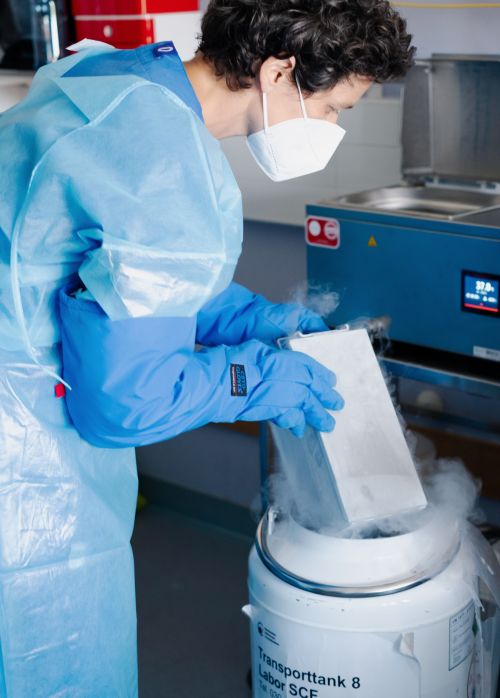
The gene-edited stem cells must be thawed slowly before they can be administered. © Charité | Mariia Streltsova
Exagamglogene autotemcel used for the first time in Germany following approval
Berlin, October 1, 2026
Nineteen-year-old Mohammad is the first patient in Germany with beta-thalassemia to receive the drug exagamglogene autotemcel—based on the CRISPR gene-editing tool—as part of standard medical care. He was administered the gene therapy in May at Charité – Universitätsmedizin Berlin, in the presence of CRISPR discoverer and Nobel laureate Prof. Emmanuelle Charpentier. The drug is the world’s first CRISPR-based therapy to receive regulatory approval. Four months after receiving the treatment, Mohammad no longer relies on blood transfusions and leads a normal daily life.
“On May 28, basic research became medical care,” says PD Dr. Lena Oevermann, a senior physician at Charité’s Department of Paediatric Oncology and Haematology and head of the hemoglobinopathy program. It was on that day that she administered the gene therapy Exa-cel to Mohammad. Exa-cel (short for exagamglogene autotemcel) is a novel drug that modifies the genetic material of the young patient’s blood stem cells to cure his severe hereditary disease. Emmanuelle Charpentier laid the foundation for its development through a company she founded.
A Medical Milestone
Emmanuelle Charpentier and her colleague Prof. Jennifer Doudna first described the CRISPR-Cas9 gene-editing tool—essential for this genetic modification—in 2012. While bacteria originally use this tool to defend against viruses, it was adapted into a precise gene-editing instrument that has become widely used in bioscience research. The two discoverers were awarded the Nobel Prize in Chemistry for this work in 2020.
“Now, just 14 years after its initial description, the gene-editing tool has become part of a treatment used to care for seriously ill young people within the framework of standard clinical practice,” emphasizes Prof. Heyo K. Kroemer, CEO of Charité. “The fact that this therapy is now being administered at Charité for the first time in Germany following its approval marks a medical milestone. Charité is committed to bringing medical progress to patients, and Mohammad’s treatment demonstrates exactly what that can mean in practice.”
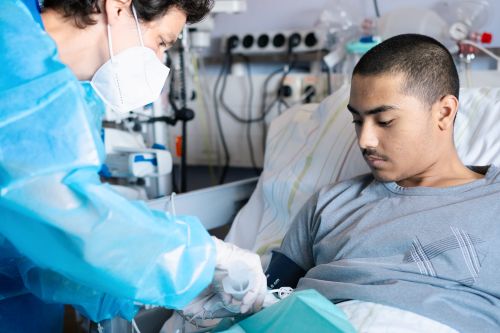
The moment PD Dr. Lena Oevermann (left) administers Mohammad’s stem cells, which were genetically corrected using CRISPR technology. © Charité | Mariia Streltsova
Around 60,000 children worldwide are born with severe beta-thalassemia each year; Mohammad was also born with this condition. It is caused by a genetic defect that impairs the production of haemoglobin, the blood pigment responsible for transporting oxygen to all parts of the body within red blood cells. In cases of beta-thalassemia, insufficient oxygen reaches the tissues, depriving cells of the fuel needed for essential metabolic processes. Without treatment, individuals with the severe form of the disease die in early childhood.
Gene therapy for particularly severe cases
To survive, children with severe beta-thalassemia require blood transfusions every three weeks—procedures that can have serious long-term side effects. In such cases, stem cell transplantation is an option that can cure the disease. However, this requires finding a suitable stem cell donor and ensuring the patient’s health is robust enough to withstand such a major procedure.
“Unfortunately, stem cell transplantation is only an option up to the age of 14, as the risk of complications becomes too high beyond that point,” explains PD Dr. Lena Oevermann. “Mohammad, too, was already too old for the procedure. Since there was no other treatment option for him, we administered Exa-cel to him following an individual case review by the health insurance provider.”
Treatment lasting several months
Exa-cel is not a drug in the traditional sense but a cell-based gene therapy product; consequently, the treatment process spanned approximately twelve months. “We first stimulated the patient’s blood stem cells to mobilize from the bone marrow into the bloodstream,” the physician explains. “After filtering out the stem cells using an automated process, we sent them to the manufacturer’s laboratories in the Netherlands.”

Attending physician PD Dr. Lena Oevermann, Nobel laureate Prof. Emmanuelle Charpentier, and Dr. Jonathan Groß, a paediatrician on the hemoglobinopathy team (from left). © Charité | Mariia Streltsova
The genetic modification took place there: using the CRISPR gene-editing tool, the gene responsible for the gamma-globin chain was reactivated within the patient’s stem cells. Every human produces this haemoglobin subunit while in the womb; it is a component of so-called foetal haemoglobin. After birth, the body naturally ceases its production. “The genetic intervention enabled the stem cells to produce foetal haemoglobin once again,” explains Lena Oevermann. “Because foetal haemoglobin transports oxygen just as effectively as the haemoglobin produced in adulthood, it can resolve the oxygen deficiency experienced by people with beta-thalassemia.”
900 million cells for a life with sufficient blood oxygen
Before Mohammad could receive his gene-edited stem cells back, space had to be created in his bone marrow through a process known as chemo-conditioning. The big moment finally arrived on May 28. “We were able to return over 900 million of his gene-edited stem cells to Mohammad’s bloodstream via infusion,” says Lena Oevermann. The cells had previously undergone a quality control process lasting several months to verify the success of the genetic modification.
Over the following six weeks or so, the stem cells engrafted in the patient’s bone marrow and began producing new blood cells. “Within 40 days, Mohammad’s body began producing foetal haemoglobin; it now accounts for 85 percent of his total haemoglobin level,” says his attending physician. “It will take about six months in total to reach full haemoglobin production. Fortunately, however, his total haemoglobin level is already within the normal range, meaning blood transfusions are no longer necessary. Mohammad’s immune system has also recovered; he is currently doing really well.”
A fresh start in life
Overall, the patient tolerated the treatment well; he was able to be discharged from Charité just under six weeks after the administration of the gene-modified cells. Nevertheless, the therapy is a major procedure associated with both side effects and long-term risks. “Chemo-conditioning entails acute side effects such as painful inflammation of the mucous membranes; it carries a significant likelihood of causing infertility and can lead to liver damage,” says Lena Oevermann. “Furthermore, we do not yet have data on the long-term safety and efficacy of the gene therapy.”
The drug’s conditional approval therefore mandates that patients receiving Exa-cel undergo follow-up monitoring for 15 years. “For Mohammad, however, a completely new life is beginning now,” says his treating physician. “After just this single dose of the gene therapy, he has the chance to lead a normal, symptom-free life and is keen to start vocational training. We wish him every success and all the very best.”
About Beta-Thalassemia
Beta-thalassemia is a congenital disorder that is life-threatening in its severe form. The underlying genetic defect impairs the production of beta-globin chains—a component of the blood pigment haemoglobin. This results in severe anaemia that necessitates blood transfusions as early as the first few months of life. The anaemia is accompanied by symptoms such as profound fatigue, pain, impaired physical and cognitive development, and iron overload, which can damage organs. Every year, approximately 60,000 children worldwide are born with severe beta-thalassemia. About Exa-cel
Exagamglogene autotemcel (exa-cel) is a cell-based gene therapy that utilizes the CRISPR/Cas9 gene-editing tool. Since 2024, exa-cel has held conditional approval in Europe for treating specific patients with transfusion-dependent beta-thalassemia or severe sickle cell disease. Its use is therefore subject to specific requirements—such as monitoring patients for 15 years. The therapy may only be administered at specialized centres; Charité is the first centre in Germany to be qualified for this purpose. The drug was developed by CRISPR Therapeutics—a company founded by Prof. Emmanuelle Charpentier, Dr. Rodger Novak, and Shaun Foy—and Vertex Pharmaceuticals.
Leave a Reply