
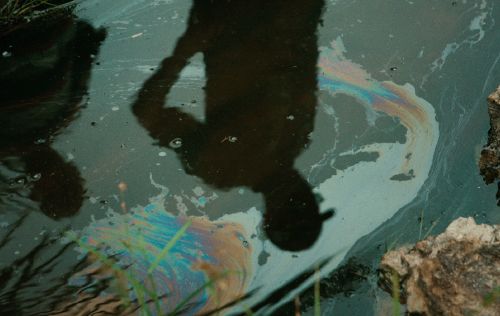
A still image from the film ‘Hope is a Word’ showing open water contaminated with an oil spill. Photo credits: Anita Vedå.
As ‘Hope is a Word’ begins its international festival journey, the film turns one of Africa’s longest environmental struggles into an intimate story of poetry, memory, and a new generation determined to carry the fight for justice in the Niger Delta.
Bonface Orucho, bird story agency
Five young Nigerians sit in a circle, notebooks resting on their laps. They have gathered not to draft petitions or organise a protest, but to write poems.
At the centre of the group sits environmental activist and poet Nnimmo Bassey. He listens more than he speaks, occasionally posing a question or reciting a verse. Ideas move from one voice to another, memories become metaphors, and personal stories gradually find a collective rhythm.
“Are you inspired to write?” Bassey asks the curious yet keenly listening group of youngsters.
The question anchors ‘Hope is a Word,’ an 82-minute documentary by Norwegian-Italian filmmaker Maria Galliani Dyrvik that premiered last month at Sheffield DocFest in the International First Feature Competition in June 2026.
Produced by Smau Media in collaboration with Ginko Film and Zuri24 Media, the documentary follows Bassey as he mentors a new generation of writers and activists living in Nigeria’s oil-producing Niger Delta.
For nearly seven decades, the Niger Delta has been at the centre of Nigeria’s oil industry, producing billions of barrels of crude, while thousands of recorded oil spills, according to Nigerian regulators and international environmental organisations, have left many communities battling contaminated land and water.
Nigeria is Africa’s largest oil producer, averaging about 1.5 million barrels of crude a day in 2025. Since oil was first discovered in the Niger Delta in 1956, an estimated 13 million barrels have been spilled into the region, according to the United Nations Environment Programme. Official records cited in academic studies show more than 16,000 spill incidents between 1976 and 2015, underscoring the scale of environmental degradation that frames the documentary.
Dyrvik’s film enters that familiar landscape from a different direction. It follows the people who continue to live there, write there, and imagine a different future there.
The result is a documentary where poetry is both narrative and method.
Poetry is the documentary’s language. Characters speak through verse, conversations unfold through poems, and the Niger Delta’s environmental history is told as much through memory and emotion as through facts.
That approach begins with Bassey himself.
For more than four decades, the Nigerian poet, architect, and environmental activist has challenged the ecological consequences of oil extraction in the Niger Delta. His work has taken him from village meetings to international climate summits, from prison cells during Nigeria’s military era to the leadership of organisations advocating for environmental justice across Africa.
His activism carries the influence of Ken Saro-Wiwa, the Ogoni writer and campaigner who was sentenced to death and consequently executed by Nigeria’s military government in 1995 alongside eight other activists after leading protests against environmental destruction in Ogoniland.
Inside one workshop, Bassey recalls the question that has stayed with him ever since.
“Why should you kill a poet?” he asks.
For him, poetry has never been separate from activism.
“Arguments may touch people’s heads,” he tells the young writers gathered around him. “But poetry goes for the heart. And the change comes from the heart.”
The documentary gradually shifts attention from Bassey to the younger generation sitting beside him, exploring what happens when a movement built over decades begins to pass into new hands.
Among them is Barinedum Mbee, an Ogoni writer who describes poetry as the place she returned to during one of the most difficult periods of her life. Her verses carry memories of polluted rivers, family history, and the search for belonging in a landscape transformed by extraction.
Her poems rarely separate personal grief from environmental loss.
“My father’s well that had the finest water has been filled with crude,” she reads in one sequence. “His farmland turned into cemetery.”
Another participant, Oduduabasi Asuquo, works alongside Bassey at the Health of Mother Earth Foundation (HOMEF). She wrestles openly with frustration, questioning how people continue organising after decades of violence, political inertia, and broken promises.
Ukpono Bassey, Nnimmo’s youngest son, finds his own language through rap.
His music carries the cadence of protest poetry while speaking directly to younger audiences. One performance moves through generations of environmental injustice before asking a simple question: “How much longer till we see fishes in the sea swimming free?”
The film follows these young writers as they discover their own voices, challenge Bassey’s ideas, question old strategies, and define activism on their own terms.
That evolution gives the documentary its emotional centre.
The workshops become spaces where uncertainty is welcomed alongside conviction. Participants debate, revise poems, interrupt each other, laugh, doubt themselves, and begin again.
Dyrvik, the filmmaker, allows these conversations to unfold patiently, giving the audience time to watch confidence develop, sentence by sentence.
The camera adopts the same philosophy.
It moves quietly between intimate conversations, community visits, and expansive landscapes marked by pipelines, polluted waterways, and abandoned infrastructure. Oil appears throughout the documentary, but it is never reduced to spectacle. Burning pipelines, rainbow-coloured slicks floating across rivers, and smoke rising above vegetation become part of the lived environment that frames every conversation.
Some of the documentary’s most powerful moments emerge without dialogue.
A slow drive through villages intersected by pipelines.
Residents pointing silently towards contaminated water.
A notebook filling with fresh lines of poetry.
Nnimmo standing before an audience, reciting words that have travelled with him for decades.
Those visual rhythms reveal a filmmaker interested in observation as much as explanation. Dyrvik gives equal attention to silence, landscape and conversation, allowing each to deepen the other.
The documentary also follows Bassey beyond Nigeria.
At the COP26 climate conference in Glasgow, he challenges the continued expansion of fossil fuel production while reciting another poem before a crowd.
“This is extra time in injury time,” he declares.
“It is time for action.”
Back in the Niger Delta, the political questions become more immediate.
Community members describe ageing pipelines that have never been replaced, contaminated waterways, and decades of promises that never reached their villages. Those concerns continue to resonate across the Niger Delta. In communities such as Bille, residents continue to confront new environmental emergencies linked to oil and gas infrastructure, reinforcing the documentary’s central argument that the region’s story remains unfinished.
Residents question whether justice can still be achieved after decades of peaceful protest. Bassey raises concerns about multinational oil companies leaving the region without addressing environmental damage left behind, while warning against carbon credit schemes that could create what he calls “carbon colonialism” by excluding communities from decisions about their own forests.
These conversations never interrupt the documentary’s rhythm.
They emerge naturally from community meetings, field visits and workshops, placing policy discussions alongside the everyday realities of people living with their consequences.
Hope also appears in practical forms.
The documentary visits restoration projects where mangroves are returning after years of degradation. Watching new growth emerge, Bassey welcomes the recovery while insisting that environmental restoration must remain rooted in community participation and ecological justice.
“We need environmental democracy,” he says. “When we respect the environment, the environment also takes care of us.”
By the final workshop, the atmosphere has changed.
The hesitation visible in the opening sessions has given way to confidence. Young writers stand before audiences reading work that speaks openly about identity, memory, environmental justice and hope. Their voices no longer echo Bassey’s. They carry their own rhythms.
Before the film closes, one participant reminds the group of Ken Saro-Wiwa’s enduring legacy.
“If Ken Saro-Wiwa had taken a gun instead of a pen,” he says, “you and I would not be here today.”
He pauses before asking the question that lingers after the credits.
“Ken is dead. Could they kill his words?”
‘Hope is a Word’ answers that question not through argument, but through every poem, every workshop, and every young voice that continues writing.
bird story agency
Leave a Reply