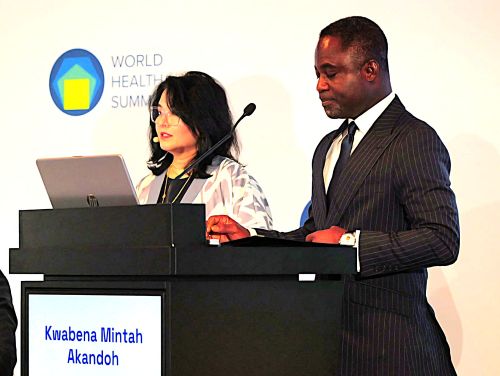
Ghana’s Minister of Health, Kwabena Mintah Akandoh addresses a Panel titled: “The Moment is Now: Unlocking New Capital for Women’s Health Beyond Aid. Financing the Future of Women’s Health: A New Model for Global Investment”/Photo Credit:AfricaNewsAnalysis/AM
With health systems strained by conflict, climate shocks and the long shadow of the pandemic, the 2026 gathering puts innovation, equity and international cooperation at the centre of a three-day global conversation.
BERLIN, 11 October 2026 — Morning light flashes across the rain-darkened pavement outside the InterContinental Berlin as delegates stream through the revolving doors.
Inside the lobby of the prestigious hotel, name badges catch the chandeliers; voices overlap above the chime of phones.
Scientists from across the world bring findings from laboratories, health workers carry lessons from crisis zones, and ministers arrive with promises shaped in distant capitals.
As the clock ticks by, the corridors emptied into conference rooms, but one question already follows the crowd: can the world build health systems strong enough not merely to endure the next shock, but to meet it?
The theme of this year’s summit, “From Crisis to Resilience: Innovating for Health,” captures both the anxiety and the ambition of the moment. Over the next three days, more than 4,000 participants on site and 400 speakers are expected to take part in more than 75 sessions, while a much larger audience follows online. The scale is significant, but the test will be whether the summit can turn a crowded agenda into practical alliances, financing and policy.
A summit shaped by overlapping emergencies

Dr. Zubaida Rahman, First Lady of Bangladesh, Ziaur Rahman Foundation Vice President Bangladesh/Photo Credit: AfricaNewsAnalysis/AM
Discussions at this year’s high-level meeting unfold against a backdrop of overlapping pressures. Wars have damaged hospitals and displaced patients and staff. Climate-related disasters are widening the reach of disease and amplifying food and water insecurity. Governments are still weighing the lessons of COVID-19, even as health budgets tighten and trust in institutions remains fragile. Meanwhile, demographic change and chronic illnesses are testing systems designed for a different era.
The programme at the Berlin summit reflects that complexity. Its six central topics range from the global health architecture and pandemic preparedness to health equity for women, children and young people; future-ready health systems; conflict and health; and the environmental drivers of disease. Rather than treating these as separate lanes, the summit is built around their intersections: a climate shock can become a nutrition crisis, a conflict can trigger an outbreak, and a financing gap can turn a manageable threat into a regional emergency.
Resilience moves from slogan to strategy
“Resilience” has become a familiar word in global policy circles, but in Berlin it is being pressed into more concrete service. It means surveillance systems that can detect threats early, supply chains that do not collapse under pressure, a trained workforce that can be retained, and primary care strong enough to reach people before emergencies overwhelm hospitals. It also means communities having a meaningful role in the decisions that shape their care.

A section of delegates at the Summit/Photo Credit: AfricaNewsAnalysis/AM
Innovation is the other half of the summit’s proposition. Artificial intelligence, data-driven planning, new vaccines and diagnostics, and novel financing models promise to expand what health systems can do. Yet technology alone is not a health strategy. Its value will depend on who can access it, whose data shapes it and whether public institutions have the capacity to use it responsibly. The sharper debate is therefore not simply about invention, but about distribution.
Big names, difficult questions
The speaker list underscores the summit’s reach. It includes WHO Director-General Tedros Adhanom Ghebreyesus, Gavi chief executive Sania Nishtar, UNAIDS Executive Director Winnie Byanyima, health ministers, researchers, humanitarian leaders and pharmaceutical executives. Their presence brings influence into the room—and exposes the tensions that often slow global action.
Several critical questions would emerge during this year’s World Health Summit. Amongst them are the following: Who pays for preparedness before a crisis is visible? How should scarce resources be shared? Can international institutions act decisively in a more fragmented political order? And how can governments work with private companies without allowing commercial priorities to eclipse public need?
Sessions on pandemic financing, the future of the global health architecture, maternal and child mortality, and health care in conflict settings place those questions at the heart of the programme.
The opening day offers a snapshot of that breadth, with conversations on national health security, new capital for women’s health, fragile health systems, mental well-being, drug policy and metabolic disease.
Later sessions would turn to 21st-century threats, strategic health industries, migration, antimicrobial resistance and the future of multilateral cooperation. The official opening night will also mark five years of the WHO Hub for Pandemic and Epidemic Intelligence in Berlin.
Berlin’s role—and the measure of success
Founded in 2009 at Charité – Universitätsmedizin Berlin, the World Health Summit has helped establish the German capital as a regular meeting place for health diplomacy. Berlin offers more than a stage: it is home to universities, research institutions, government ministries and the WHO intelligence hub. That concentration of science and policy gives the city unusual convening power at a time when international consensus is harder to build.
But summits are ultimately judged after the lights dim. A successful meeting will not be measured by the number of panels or prominent names, but by what travels home with participants: commitments that are financed, partnerships with clear responsibilities, evidence that informs policy, and solutions designed with the people most affected.
For three days, Berlin will host a concentrated version of the world’s health challenges—and its capacity to respond. The promise of the 2026 summit is that crisis need not be the permanent operating condition of global health. The harder task begins with converting that promise into systems able to anticipate shocks, protect the vulnerable and continue delivering care when the next emergency arrives.