
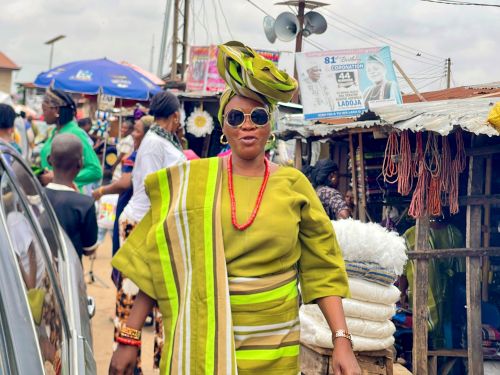
A woman, dressed in Aso-Oke and beads posing along Basorun Gate Road in Ibadan, South Western Nigeria on July 21, 2026. Photo: Uyojo Jeremiah, bird story agency
Aso-Oke has never been more fashionable, appearing on international runways and in luxury collections. But behind the vibrant fabric lies a quieter story: the women who built Nigeria’s iconic textile trade are fighting rising costs, imported materials and disappearing skills to ensure a centuries-old tradition survives another generation.
By Uyojo Jeremiah, bird story agency
By the time Olugbesan Omosolape unlocks her shop each morning at the Olabisi Onabanjo International Market in Ijebu-ode, south-west Nigeria, the colours have already begun to compete for attention. Rolls of shimmering Aso-Oke – crimson, emerald, sapphire and gold – spill across shelves waiting to become wedding gowns, ceremony wrappers, and headpieces that will outlive the celebration they adorn. Customers still come – some in person, many through their mobile phones – searching for the handwoven fabric that has clothed Yoruba royalty, brides and families for centuries.
Aso-Oke is a prestigious handwoven cloth, which was historically made from Nigerian grown cotton. It is common among the Yoruba people in the Southwest and the weaving is largely done in Iseyin, Oyo State and Ilorin, Kwara State.
For Omosolape, beneath the brilliance of the fabric lies an uncertainty that has never confronted the four generations of women before her. “My mother inherited it from her own mother and now I have continued it. We are the fourth generation,” Omosolape said.
The business has paid school fees, built livelihood and given women in her family financial independence across decades. It is a legacy she hopes her daughter will inherit. But for the first time, she’s unsure whether the next generation wants it.
“I would love to pass the business on to my daughter, however, I am worried that because the business is no longer as profitable as it used to be, she may not be interested in continuing it.”
This anxiety mirrors the transformation unfolding inside one of Nigeria‘s oldest indigenous industries. As Aso-Oke enjoys a renaissance in fashion houses, export market and runways in New York, Paris, the women who built its commercial success are discovering that popularity does not always translate into prosperity for generations.
For generations, Aso-Oke has survived because its economy rested on an unwritten partnership. In weaving communities, men traditionally sat behind wooden looms, painstakingly producing the narrow strips of clothes that are stitched together into ceremonial fabric.
Meanwhile women, who were also at some point in history behind looms as weavers, transitioned into building the markets. They financed production, advised customers, cultivated relationships with families and passed businesses from mothers to daughters. To many of them, Aso-Oke was more than commerce.
“My great grandmother was involved in it,” Omosolape recalls. “When my grandmother married into the family, she learnt from her. My mother continued in the trade and now I am part of it.”
In a continent where gender gap remains a challenge, that inheritance quietly empowered thousands of women across south-western Nigeria, even if they rarely appear in stories celebrating the craft itself.
“I wouldn’t limit it to women,” she explained.
Most of the weavers she deals with at the production level are men as are all her suppliers, a division of labour where men preserved the technical knowledge of weaving while women control the marketplace. But both sides of the relationship are coming under pressure.
“When I was growing up, there were only a handful of sellers here, including my grandmother. Today, there are hundreds, even thousands as people capitalise on smart phones and social media,” said Omosolape.
Social media has democratised access to the market. Traders who want to specialise in lace fabrics now sell Aso-Oke through Instagram, Facebook and WhatsApp. Customers increasingly buy directly from producers, bypassing long-established merchants, whose businesses depended on years of trust and apprenticeship.
This is forcing companies to compete on more than just profit. Corporate organisations, including those in the oil industry – where mandatory local content has risen above 60 per cent – are now extending localisation even to the fabric used in their uniforms.
“The Nigerian economy has made it difficult for the business to grow the way it should,” believes Omosolape. As unemployment tightens, young graduates find solace in trading Aso-Oke on the background of rising mobile penetration and e-commerce.
For Tosin Asana, who has traded Aso-Oke at the Dugbe market in Ibadan for almost a decade, the biggest challenge is not demand but affordability.
“About seven or eight years ago, when I started, a bundle of Aso-Oke sold for about N4,500 ($3.26). Today, that same bundle sells for about N23,000 ($16.65),” Asana said, adding that customer will admire the fabric but many walk away after hearing the price.
In Ilorin, the capital of Kwara State in northern Nigeria, generations of families still weave Aso-Oke by hand, including Abdulraham Jamiu. He learned the trade from his father and has monitored the cost spiral closely since he entered the business in 2014.
In 2022, a pack of thread cost N22,000 (USD $16.00) but in 2026 the same pack cost N120,000 (USD $87.00).
Much of the additional revenue generated by rising prices is swallowed up by imported raw material costs and weavers are making less money despite supplying lucrative markets such as the United Kingdom.
Like others, Jamiu is faced with rising skill shortage as younger employees, who usually enter the business as apprentices but prefer white collar jobs. As demand increases, most of the businesses in the value chain are struggling to find skilled hands.
“The younger people who should be learning the trade are not interested because the wages are too low,” he said. While Aso-Oke global reputation is expanding, the pool of the people capable of producing it is shrinking.
Media reports in 2024 estimated that Nigeria’s Aso-Oke industry supported more than 50,000 artisans and generated approximately US$120 million in export revenue in 2023.
Meanwhile, Lameed Safi, Chairman of the Ilorin Emirate Aso-Oke Weavers Association, says Nigeria should rebuild its textile industry so that the thread used to make Aso-Oke is produced locally.
For fashion designer, Lois Ogunbiyi, the Industry’s greatest challenge is not technology but what has been sacrificed in the pursuit of speed. Growing up in Ondo State, she remembers her mother bringing out pieces inherited from our grandmother.
“You could immediately see the quality,” she recalls. “The texture, colours and craftmanship were still intact after decades.” Today’s production is faster, she acknowledges, but often less durable.
“Technology and machinery have changed the production process. While they make weaving faster and more accessible, the quality is no longer the same,” Ogunbiyi said.
As countries such as China compete in the production of African-inspired textiles, she argues that modern manufacturing has reproduced the appearance of Aso-Oke without preserving the craftsmanship and quality that have long defined it.
“Aso-Oke is much more than weaving clothes. It starts from sourcing raw materials, preparing threads, producing dyes and then weaving fabrics,” Ogunbiyi noted, adding that the fabrics that were once a family inheritance are now increasingly becoming another disposable fashion product.
“There was a culture of preserving these fabrics so they could be passed from one generation to another. Sadly, much of what is available today cannot be passed down because it simply does not last.”
Economies and Chief Executive Officer of the Centre for the Promotion of Private Enterprise (CPPE), Dr Muda Yusuf, sees the industry’s evolution as both a cultural success and an economic warning.
“This is one of the biggest cultural heritages of the Yoruba people. It has stood the test of time,” Yusuf said as he added that while weaving has increasingly become dominated by men, women remain central to the industry’s commercial ecosystem.
“They dominate marketing, retailing and customer advisory services. Many of them don’t just sell Aso-Oke, they advise customers on colour combination, recommend size for ceremonies and coordinate complete outfits.
He recalled a time when the industry relied almost entirely on local inputs: “I remember watching my grandmother produce thread directly from locally grown cotton.”
Briobird International Limited Chief Executive Officer Inikpi Sule told Bird that Aso-Oke has moved beyond ceremonial clothing into luxury handbags and accessories exported to France, Canada, Ireland and other African countries.
She chose the fabric after discovering that the Aso Oke used during her parents’ wedding was preserved for more than three decades.
“Those fabrics were still intact,” she said, “and that moment convinced me that Aso-Oke was the fabric I wanted to explore.”
Her business now employs artisans and about 80 percent are women despite headwinds.
“I look forward to a time when skilled artisans will be more accessible. Many have not received adequate training,” Sule said.
Back in her shop, Omosolape and other women still believe Aso-Oke has a future. They know that survival will require more than nostalgia.
“My hope is to build the business into something much bigger,” she said “I want to become a role model for my daughter and inspire her to continue our family’s tradition.”
bird story agency
Leave a Reply