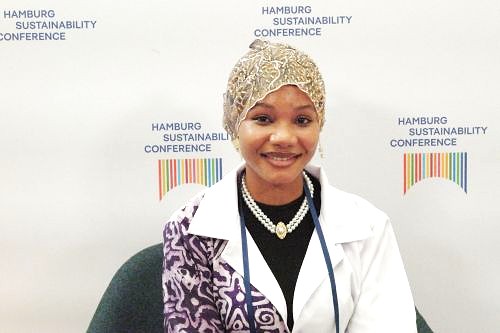
- Debrief By Fatoumata Fofana, HSC Youth Ambassador 2026
© AfricaNewsAnalysis/AM
11 July 2026
The Hamburg Sustainability Conference 2026 (HSC2026) was a highly enriching and productive experience. As one of the HSC Youth Ambassadors, I had the opportunity to contribute to several capacities rather than simply attend the conference.
I was a panellist in the “Forming the Future” session, where we discussed how to better support and scale youth-led initiatives instead of allowing promising ideas to stop halfway. The discussion reinforced the importance of creating the right ecosystems for youth innovation to grow into lasting impact.
During the Youth Hour, I presented ODD Kids School, an initiative I co-founded in Guinea to empower children to become changemakers in their schools and communities through sustainability education and local action. It was a valuable opportunity to showcase how community-based initiatives can contribute to achieving the Sustainable Development Goals while exchanging experiences with fellow youth leaders from around the world.
I also participated as a panellist in the session “Housing for Economic Transformation, Urban Equity and Human Dignity,” where I shared perspectives on climate-resilient housing, resilient basic services, and the importance of designing solutions around people’s everyday needs.
In addition, I contributed to the accelerator session “Circular Textiles: Europe’s Contribution to a Global Transformation,” working alongside experts and practitioners to develop recommendations that will feed into a forthcoming Global Policy Paper.
One of my most rewarding roles was co-creating and co-moderating the Youth Ambassador workshop “Scaling Impact: From Barriers to Action,” together with the Wilo Foundation and my fellow HSC Youth Ambassadors. The session explored how youth-led initiatives can overcome barriers to scaling through stronger partnerships, impact measurement, innovative financing, and technology.
Beyond the individual sessions, one of the conference’s major outcomes was the launch of the South-North Commission on Development, an initiative aimed at strengthening cooperation between the Global South and the Global North. Throughout the conference, there was a strong emphasis on moving beyond dialogue towards implementation, collaboration, and collective action.
One of the greatest values of HSC2026 was the opportunity to build meaningful relationships. During the conference, I connected with representatives from organizations including the African Union, the Wilo Foundation, the g7+ Foundation, the UN SDG Action Campaign, the Council of Europe Development Bank, the Wuppertal Institute, and several other international organizations, development partners, and research institutions.
Since returning, I have already begun following up with many of these contacts to explore opportunities for collaboration around ODD Kids School, environmental education, youth leadership, and community resilience. I have been encouraged by the positive responses received so far, with several organizations expressing interest in continuing the conversation, introducing me to their networks, and exploring future collaboration.
My biggest takeaway from HSC2026 is that innovative youth-led solutions already exist. The challenge is not a lack of ideas; it is creating the partnerships, financing, enabling policies, and long-term support needed to help those ideas scale and create lasting impact.
Looking ahead, one of the most important lessons I will take forward is that sustainable development is built through collaboration. No single organization, sector, or country can address today’s challenges alone.
For Guinea, I want to continue strengthening ODD Kids School by expanding climate and sustainability education for children while building partnerships that help local initiatives grow beyond the pilot stage. The conference reinforced my belief that investing in young people from an early age is essential for building resilient communities.
More broadly, I hope to use the relationships, knowledge, and opportunities gained through HSC2026 to foster greater collaboration across Africa. Many of the challenges discussed during the conference whether related to climate resilience, education, circular economy, housing, or youth empowerment are shared across the continent. I believe there is tremendous value in connecting youth-led initiatives, exchanging good practices, and developing solutions together rather than working in isolation.
For me, HSC2026 was not the end of a conference, it was the beginning of new collaborations. I returned not only with new knowledge, but also with concrete partnerships, potential opportunities, and a renewed commitment to translating dialogue into action for Guinea and Africa.
Perhaps the most valuable lesson I will carry forward is that meaningful youth engagement goes beyond inviting young people to participate. At HSC2026, young people were trusted to co-create sessions, moderate discussions, contribute to policy conversations, and engage as equal partners. I believe this model of meaningful youth participation is one that deserves to be replicated across other international platforms.
The writer, Fatoumata Fofana is a youth sustainability advocate from Guinea, working at the intersection of waste management, environmental policy, and youth engagement. Her work focuses on organic waste composting, plastic pollution reduction, and citizen science approaches, contributing to SDG 12 (Responsible Consumption and Production), SDG 11 (Sustainable Cities and Communities), and SDG 13 (Climate Action). She has supported and mentored youth-led initiatives addressing waste segregation, community composting, and environmental education, with a strong emphasis on linking grassroots action to policy and institutional frameworks. Fatoumata also has a research background in microplastic pollution in rivers, where she worked on mapping pollution hotspots to inform evidence-based policy recommendations. She advocates for moving youth-led environmental solutions from pilot projects to scalable, policy-supported systems that create green jobs and strengthen inclusive urban development across emerging and developing economies.
Leave a Reply